This volume interrogates the assumption that Visigothic practices and institutions were mere imitations of the Byzantine empire. Contributors rethink these practices not as uncritical and derivative adoptions of Byzantine customs, but as dynamic processes in dialogue with not only the Byzantine empire but also with the contemporary Iberian context, as well as the Roman past. The goal of the volume is to approach Visigothic customs not as an uncritical adoption and imitatio of contemporary Roman models (an acculturation model), but as unique interpretations of a common pool of symbols, practices, and institutions that formed the legacy of Rome. The contributors argue that it is necessary to reconsider the idea of imitatio imperii as a process that involved specific actors taking strategic decisions in historically contingent circumstances.
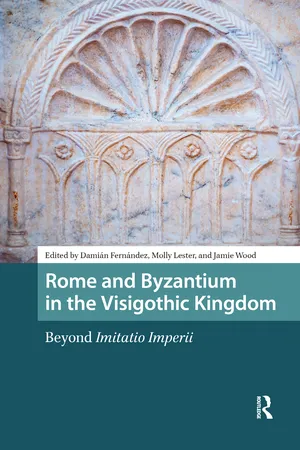
eBook - ePub
Rome and Byzantium in the Visigothic Kingdom
Beyond Imitatio Imperii
- English
- ePUB (mobile friendly)
- Available on iOS & Android
eBook - ePub
Rome and Byzantium in the Visigothic Kingdom
Beyond Imitatio Imperii
Table of contents
- Cover
- Half Title
- Title Page
- Copyright Page
- Table of Contents
- List of Figures and Tables
- Abbreviations
- Acknowledgements
- Introduction
- 1 Visigothic Spain and Byzantium: The Story of a Special (Historiographical) Relationship
- 2 The Development of the Visigothic Court in the Hagiography of the Fifth and Sixth Centuries
- 3 Experiments in Visigothic Rulership: Minting and Monetary Reforms under Alaric II
- 4 A Comparison of Roman and Visigothic Approaches to Exile
- 5 The Roman Jewel in the Visigothic Crown: A Reassessment of the Royal Votive Crowns of the Guarrazar Treasure
- 6 Capitalhood in the Visigothic Kingdom
- 7 Making Rite Choices: Roman and Eastern Liturgies in Early Medieval Iberia
- 8 Ethnicity and Imitatio in Isidore of Seville
- 9 Re-imagining Roman Persecution in the Visigothic Passions
- 10 Romanness in Visigothic Hagiography
- 11 Empire and the Politics of Faction: Mérida and Toledo Revisited
- 12 The Agents and Mechanics of Connectivity: The Mediterranean World and the Cities of the Guadiana Valley in the Sixth Century
- 13 Staying Roman after 711?
- Index
Trusted by 375,005 students
Access to over 1.5 million titles for a fair monthly price.
Study more efficiently using our study tools.
Frequently asked questions
Yes, you can cancel anytime from the Subscription tab in your account settings on the Perlego website. Your subscription will stay active until the end of your current billing period. Learn how to cancel your subscription
No, books cannot be downloaded as external files, such as PDFs, for use outside of Perlego. However, you can download books within the Perlego app for offline reading on mobile or tablet. Learn how to download books offline
Perlego offers two plans: Essential and Complete
- Essential is ideal for learners and professionals who enjoy exploring a wide range of subjects. Access the Essential Library with 800,000+ trusted titles and best-sellers across business, personal growth, and the humanities. Includes unlimited reading time and Standard Read Aloud voice.
- Complete: Perfect for advanced learners and researchers needing full, unrestricted access. Unlock 1.5M+ books across hundreds of subjects, including academic and specialized titles. The Complete Plan also includes advanced features like Premium Read Aloud and Research Assistant.
We are an online textbook subscription service, where you can get access to an entire online library for less than the price of a single book per month. With over 1.5 million books across 990+ topics, we’ve got you covered! Learn about our mission
Look out for the read-aloud symbol on your next book to see if you can listen to it. The read-aloud tool reads text aloud for you, highlighting the text as it is being read. You can pause it, speed it up and slow it down. Learn more about Read Aloud
Yes! You can use the Perlego app on both iOS and Android devices to read anytime, anywhere — even offline. Perfect for commutes or when you’re on the go.
Please note we cannot support devices running on iOS 13 and Android 7 or earlier. Learn more about using the app
Please note we cannot support devices running on iOS 13 and Android 7 or earlier. Learn more about using the app
Yes, you can access Rome and Byzantium in the Visigothic Kingdom by Damián Fernández,Molly Lester,Jamie Wood in PDF and/or ePUB format, as well as other popular books in History & Byzantine History. We have over 1.5 million books available in our catalogue for you to explore.