- English
- ePUB (mobile friendly)
- Available on iOS & Android
eBook - ePub
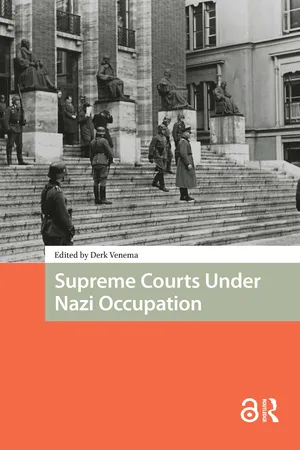
Supreme Courts Under Nazi Occupation
About this book
This is the first extensive treatment of leading judicial institutions under Nazi rule in WWII. It focusses on all democratic countries under German occupation, and provides the details for answering questions like: how can law serve as an instrument of defence against an oppressive regime? Are the courts always the guardians of democracy and rule of law? What role was there for international law? How did the courts deal with dismissals, new appointees, new courts, forced German ordinances versus national law? How did judges justify their actions, help citizens, appease the enemy, protest against injustice? Experts from all democracies that were occupied by the Nazis paint vivid pictures of oppression, collaboration, and resistance. The results are interpreted in a socio-legal framework introducing the concept of 'moral hygiene' to explain the clash between normative and descriptive approaches in public opinion and scholarship concerning officials' behaviour in war-time.
Table of contents
- Cover
- Half Title
- Title Page
- Copyright Page
- Table of Contents
- List of Figures and Tables
- Acknowledgements
- 1 War, Law, Society, and the Courts, 1939-1945: An Introduction
- 1 Introduction
- 2 Courts in a Democratic Rule-of-law State
- 3 German Expansionism: Ideas and Strategies
- 4 The Hague Regulations for Land Warfare
- 5 The Problems of Occupation: Reality and Morality
- 6 The Choice of Cases, the Structure of the Book, and the Big Question
- 2 Prelude: The Belgian Judiciary’s First Experience of German Occupation, 1914-18
- 1 Introduction
- 2 How to Behave during the Military Occupation: Political and Juridical Guidelines
- 3 New Actors
- 4 The Leading Action of the Chief Prosecutor at the Court of Cassation
- 5 The Issue of the Legislative Power of the Occupier
- 6 Some Internal Divisions
- 7 The 1918 Judicial Strike
- 8 Epilogue
- 3 Germany: The Reichsgericht 1933-1945
- 1 Introduction
- 2 Personnel Policy Measures by the NS Regime Affecting the Reichsgericht and the Self-image of its Judges
- 3 The Court’s Powers and Measures of the NS Regime Regarding these Powers
- 4 Legal Sources and Court Decisions
- 5 Evaluation of the Reichsgericht’s Role from 1933 to 1945
- 6 Evaluating the Reichsgericht from a Post-war Perspective
- 4 The Danish Supreme Court During the German Occupation
- 1 Introduction
- 2 Cases before the Danish Supreme Court
- 3 The Anti-Communist Statute
- 4 Final Remarks
- 5 The French Cour de Cassation During the Vichy Period
- 1 Introduction
- 2 France’s Specific Situation During the War
- 3 The Consequences of the Type of Occupation
- 4 The End of the Occupation
- 6 The Conseil d’État in Vichy France
- 1 Introduction
- 2 German Constraints on the Conseil d’État
- 3 The Conseil d’État’s Compliance with the Vichy Regime
- 4 The Conseil d’État’s Post-war Reputation
- 7 Sacrificing the Pig in the Temple – The Supreme Court in Occupied Norway
- 1 Institutional Legacy
- 2 The Occupation of Norway
- 3 The Establishment of a Norwegian Civil Administration
- 4 The Occupation Regime’s Policy toward the Judiciary and Legal System and the Resignation of the Supreme Court Judges
- 5 The Establishment of a New Court
- 6 Reactions
- 7 The Legal Approach of the Court
- 8 The Capitulation and the Aftermath
- 9 Disruption and Continuity
- 10 The Legacy of the Court
- 8 The Belgian Court of Cassation in the Turmoil of the Second Occupation
- 1 Introduction
- 2 From Delegation of Powers to Protocol: The Shadow Action of the Senior Judiciary in the Early Days of the War
- 3 The Judicial Crisis of the Summer of 1942
- 4 Epilogue and Conclusions
- 9 The Hoge Raad during the German Occupation of the Netherlands
- 1 Introduction
- 2 The Civil Occupation Regime
- 3 The Hoge Raad in 1940
- 4 New Courts
- 5 Personnel Policy
- 6 Personnel Changes in the Hoge Raad
- 7 Other Interventions in the Justice System
- 8 The Judicial Review Case
- 9 Liberation and Aftermath
- 10 Purges and Prosecutions
- 11 Conclusion
- 10 The Supreme Courts in the Protectorate of Bohemia and Moravia
- 1 Introduction
- 2 Outlines of the Functions of the Protectorate Legal System
- 3 Order and Changes in the System of Courts
- 4 The Constitutional Court
- 5 The Supreme Administrative Court
- 6 The Supreme Court
- 7 The Post-War Period
- 8 Summary
- 11 The Cour Supérieure de Justice and the Luxembourg State Collapse
- 1 Introduction
- 2 A Tendency to Violate the Principle of Universality
- 3 The Absorption of the Judicial System
- 4 National-Socialist Judges 258
- 5 The Collapse of the State 261
- 12 The Italian Supreme Court Between Fascism and German Occupation (1943-45)
- 1 Introduction
- 2 The Influence of Nazi-fascism on Case Law
- 3 Political Reliability
- 13 Supreme Courts Dealing with Nazi Occupation: The Struggle for Order and Identity
- 1 Introduction
- 2 Securing the Regime – Encapsulating the Courts
- 3 Judging under Enemy Rule
- 4 General Conclusions
- References
- Index
Trusted by 375,005 students
Access to over 1.5 million titles for a fair monthly price.
Study more efficiently using our study tools.
Frequently asked questions
Yes, you can cancel anytime from the Subscription tab in your account settings on the Perlego website. Your subscription will stay active until the end of your current billing period. Learn how to cancel your subscription
No, books cannot be downloaded as external files, such as PDFs, for use outside of Perlego. However, you can download books within the Perlego app for offline reading on mobile or tablet. Learn how to download books offline
Perlego offers two plans: Essential and Complete
- Essential is ideal for learners and professionals who enjoy exploring a wide range of subjects. Access the Essential Library with 800,000+ trusted titles and best-sellers across business, personal growth, and the humanities. Includes unlimited reading time and Standard Read Aloud voice.
- Complete: Perfect for advanced learners and researchers needing full, unrestricted access. Unlock 1.5M+ books across hundreds of subjects, including academic and specialized titles. The Complete Plan also includes advanced features like Premium Read Aloud and Research Assistant.
We are an online textbook subscription service, where you can get access to an entire online library for less than the price of a single book per month. With over 1.5 million books across 990+ topics, we’ve got you covered! Learn about our mission
Look out for the read-aloud symbol on your next book to see if you can listen to it. The read-aloud tool reads text aloud for you, highlighting the text as it is being read. You can pause it, speed it up and slow it down. Learn more about Read Aloud
Yes! You can use the Perlego app on both iOS and Android devices to read anytime, anywhere — even offline. Perfect for commutes or when you’re on the go.
Please note we cannot support devices running on iOS 13 and Android 7 or earlier. Learn more about using the app
Please note we cannot support devices running on iOS 13 and Android 7 or earlier. Learn more about using the app
Yes, you can access Supreme Courts Under Nazi Occupation by Derk Venema in PDF and/or ePUB format, as well as other popular books in History & Courts. We have over 1.5 million books available in our catalogue for you to explore.