Does neuroscience have anything to say about religious belief or the existence of God? Some have tried to answer this question, but, in doing so, most have strayed from the scientific method.
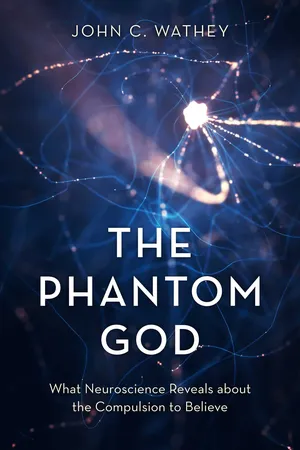
In The Phantom God, computational biologist and neuroscientist John C. Wathey, Ph.D., tackles this problem head-on, exploring religious feelings not as the direct perception by the brain of some supernatural realm, nor as the pathological misfiring of neurons, but as a natural consequence of how our brains are wired.
Unlike other neurobiological studies of religion and spirituality, The Phantom God treats mysticism not as something uniquely human and possibly supernatural in origin, but as a completely natural phenomenon that has behavioral and evolutionary roots that can be traced far back into our vertebrate ancestry. Grounded in evolutionary and behavioral biology, this highly original and compelling book takes the reader on a journey through the neural circuitry of crying, innate knowledge, reinforcement learning, emotional bonding, embodiment, interpersonal perception, and the ineffable feeling of certainty that characterizes faith.
Wathey argues that the feeling of God’s presence is spawned by innate neural circuitry, similar to the mechanism that compels an infant to cry out for its mother. In an adult, this circuitry can be activated under conditions that mimic the extreme desperation and helplessness of infancy, generating the compelling illusion of the presence of a loving, powerful, and all-knowing savior. When seen from this perspective, the illusion also appears remarkably like one that has long been familiar to neurologists: the phantom limb of the amputee, spawned by the expectation of the patient’s brain that the missing limb should still be there.
Including a primer on the basic concepts and terminology of neuroscience, The Phantom God details the neural mechanisms behind the illusions and emotions of spiritual experience.
,
- English
- ePUB (mobile friendly)
- Available on iOS & Android
eBook - ePub
About this book
Information
Subtopic
Religion & ScienceIndex
Biological SciencesTable of contents
- Cover
- Title
- Copyright
- Dedication
- Contents
- Prologue
- PART I: BEHAVIORAL FOUNDATIONS
- 1 Why Is God Two- Faced?
- 2 Evidence for the Innate Neural Model of Mother
- PART II: CIRCUITRY OF THE SENSED PRESENCE
- 3 Crying and the Neural Alarm System
- 4 Innate Knowledge and the Circuitry of Gut Feelings
- 5 Imprinting, Maternal Presence, and Addictive Love
- 6 Self, Other, and the Illusory Sensed Presence
- 7 Certainty, Neonatal Cortex, and the Phantom God
- PART III: NEUROTHEOLOGY MEETS NEUROETHOLOGY
- 8 The Image of God
- 9 The Helmet of God
- 10 The Flesh of God
- 11 The Madness of God
- 12 The Handedness of God
- 13 Predictions
- Epilogue: So What?
- Acknowledgments
- Appendix A: Getting Oriented in the Brain
- Appendix B: Measuring Religiousness
- Notes
Trusted by 375,005 students
Access to over 1.5 million titles for a fair monthly price.
Study more efficiently using our study tools.
Frequently asked questions
Yes, you can cancel anytime from the Subscription tab in your account settings on the Perlego website. Your subscription will stay active until the end of your current billing period. Learn how to cancel your subscription
No, books cannot be downloaded as external files, such as PDFs, for use outside of Perlego. However, you can download books within the Perlego app for offline reading on mobile or tablet. Learn how to download books offline
Perlego offers two plans: Essential and Complete
- Essential is ideal for learners and professionals who enjoy exploring a wide range of subjects. Access the Essential Library with 800,000+ trusted titles and best-sellers across business, personal growth, and the humanities. Includes unlimited reading time and Standard Read Aloud voice.
- Complete: Perfect for advanced learners and researchers needing full, unrestricted access. Unlock 1.5M+ books across hundreds of subjects, including academic and specialized titles. The Complete Plan also includes advanced features like Premium Read Aloud and Research Assistant.
We are an online textbook subscription service, where you can get access to an entire online library for less than the price of a single book per month. With over 1.5 million books across 990+ topics, we’ve got you covered! Learn about our mission
Look out for the read-aloud symbol on your next book to see if you can listen to it. The read-aloud tool reads text aloud for you, highlighting the text as it is being read. You can pause it, speed it up and slow it down. Learn more about Read Aloud
Yes! You can use the Perlego app on both iOS and Android devices to read anytime, anywhere — even offline. Perfect for commutes or when you’re on the go.
Please note we cannot support devices running on iOS 13 and Android 7 or earlier. Learn more about using the app
Please note we cannot support devices running on iOS 13 and Android 7 or earlier. Learn more about using the app
Yes, you can access The Phantom God by John C. Wathey in PDF and/or ePUB format, as well as other popular books in Biological Sciences & Religion & Science. We have over 1.5 million books available in our catalogue for you to explore.