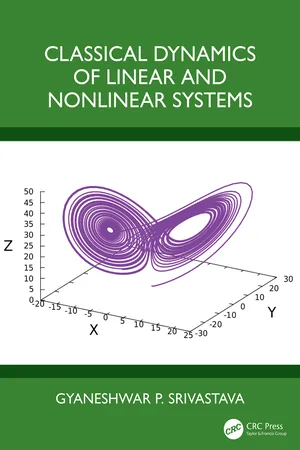
Classical Dynamics of Linear and Nonlinear Systems offers a comprehensive exploration of dynamical systems from fundamental principles to advanced applications. This textbook presents a unified treatment of classical dynamics, bridging the gap between linear and nonlinear systems while providing both theoretical foundations and practical applications.
Beginning with a thoughtful classification of dynamical systems, the book systematically builds understanding from particle mechanics to quantum field theory. Following a rigorous analysis of particle dynamics in both configuration and phase spaces (Newtonian, Lagrangian, Hamiltonian and Hamilton-Jacobi formulations), the book provides a detailed examination of molecular and crystalline structures across multiple dimensions. Later chapters conduct an in-depth exploration of nonlinear phenomena and chaos theory with real-world applications and elegant formulations of classical field theories using Lagrangian and Hamiltonian approaches. The final sections of the book provide an accessible introduction to quantum field theory and its relationship to classical systems, in addition to powerful perturbation techniques applicable to both classical and quantum problems. This book transforms abstract theoretical concepts into practical understanding through rigorous mathematical and numerical frameworks and illuminating examples, making it ideally suited for advanced undergraduate and postgraduate students enrolled in physics, applied mathematics, engineering and materials science courses.
Key Features:
- Connects traditional mechanical concepts with modern physics.
- Includes several worked examples, in addition to end-of-chapter problems and further reading to support teaching and learning.
- Features seven appendices covering further topics such as mathematical preliminaries, numerical solutions to first-order and second-order differential equations and the Euler-Lagrange variational principle.
Gyaneshwar P. Srivastava is Emeritus Professor of Theoretical Condensed Matter Physics at Exeter University, UK. In a teaching career of over 45 years he has taught several physics modules, including analytical and chaotic dynamics. His research has concentrated on theoretical and computational studies of the physics of phonons and electrons in crystalline solids, surfaces and nanostructures. He has collaborated with various physicists, both experimentalists and theorists, of international reputation. This has led to over 500 publications, including several review articles and three postgraduate books. He is an Outstanding Referee for APS journals.