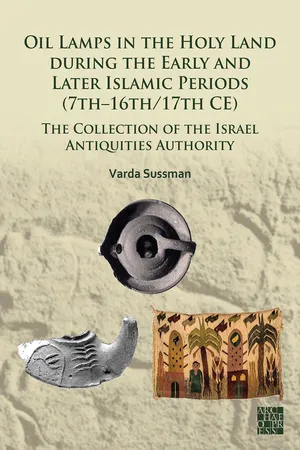
Oil Lamps in the Holy Land during the Early and Later Islamic Periods (7th–16th/17th CE)
eBook - PDF

Oil Lamps in the Holy Land during the Early and Later Islamic Periods (7th–16th/17th CE)

The Collection of the Israel Antiquities Authority

  1. 396 pages
  2. English
  3. PDF
  4. Available on iOS & Android
eBook - PDF

Oil Lamps in the Holy Land during the Early and Later Islamic Periods (7th–16th/17th CE)

The Collection of the Israel Antiquities Authority

About this book

This volume is the last in a comprehensive catalogue of oil lamps in the collection of the Israel Antiquities Authority. It considers the final stage of development in the shaping and decoration of pottery lamps, drawing from earlier forms to gradually become distinct lamps in their own right while retaining characteristics of their forerunners. The change of shape from a saucer to a small closed lamp was subject to both western and eastern influences and guided the local workshops for the next thousand years. The lamps of the Islamic period clearly demonstrate this continuity, incorporating the ethnic and cultural changes among Jews, Samaritans, Christians, and Muslims in the Holy Land.


This is readily discernible in the Islamic period, when lamp production throughout the country became 'culturally' unified, as expressed by the general avoidance of depicting ethnic symbols. The lamps from the Islamic period are easily recognizable by their linear style of decoration (no relief, the avoidance of figural art). The acceptance of the shape of these lamps and their division into sections with a central pattern (the decorated 'channel') – suggested here as a Christian means of perceiving the lamp and its light as a divine vessel – was now further adapted through the pattern along the center of the 'nozzle' under the wick hole, rendering the torch from which the flame/light emanated (or the shrine and hanging lamp (the wick hole) beneath the lamp's vault) as an integral part of the pattern resting on the filling hole.

Frequently asked questions

Yes, you can cancel anytime from the Subscription tab in your account settings on the Perlego website. Your subscription will stay active until the end of your current billing period. Learn how to cancel your subscription.
At the moment all of our mobile-responsive ePub books are available to download via the app. Most of our PDFs are also available to download and we're working on making the final remaining ones downloadable now. Learn more here.
Perlego offers two plans: Essential and Complete
  • Essential is ideal for learners and professionals who enjoy exploring a wide range of subjects. Access the Essential Library with 800,000+ trusted titles and best-sellers across business, personal growth, and the humanities. Includes unlimited reading time and Standard Read Aloud voice.
  • Complete: Perfect for advanced learners and researchers needing full, unrestricted access. Unlock 1.4M+ books across hundreds of subjects, including academic and specialized titles. The Complete Plan also includes advanced features like Premium Read Aloud and Research Assistant.
Both plans are available with monthly, semester, or annual billing cycles.
We are an online textbook subscription service, where you can get access to an entire online library for less than the price of a single book per month. With over 1 million books across 1000+ topics, we’ve got you covered! Learn more here.
Look out for the read-aloud symbol on your next book to see if you can listen to it. The read-aloud tool reads text aloud for you, highlighting the text as it is being read. You can pause it, speed it up and slow it down. Learn more here.
Yes! You can use the Perlego app on both iOS or Android devices to read anytime, anywhere — even offline. Perfect for commutes or when you’re on the go.
Please note we cannot support devices running on iOS 13 and Android 7 or earlier. Learn more about using the app.
Yes, you can access Oil Lamps in the Holy Land during the Early and Later Islamic Periods (7th–16th/17th CE) by Varda Sussman in PDF and/or ePUB format. We have over one million books available in our catalogue for you to explore.

Information

Table of contents

  1. Cover
  2. Title Page
  3. Copyright page
  4. Contents Page
  5. List of Figures
  6. Figure A. (1) Lamp bearing both a cross and a full inscription in praise of the savior. (2–3) The inscription bears also the name of Allah in Arabic script (from the Jerusalem Ophel), suggesting the addition of short strokes to the letter “O” on the front
  7. Introduction. The Islamic Period(The Late Byzantine to Medieval Periods)
  8. Part I. Mold-Made Oil Lamps
  9. Part II. Tongue-shaped handles
  10. Part III. Wheel-Made Oil Lamps: Introduction
  11. Bibliography
  12. Concordance table of sites
  13. Catalogue
  14. Plates