Unique among Union army corps, the Ninth fought in both the Eastern and Western theaters of the Civil War. The corps’ veterans called their service a “geography class,” and others have called the Ninth “a wandering corps” because it covered more ground than any corps in the Union armies. With the same attention to detail that he gave to the First Corps in First for the Union, Darin Wipperman vividly reconstructs life—and death—in the Ninth Corps.
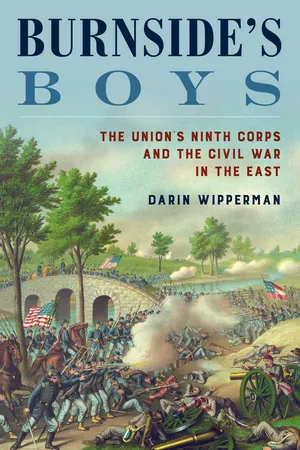
The roots of the Ninth Corps lay in the early 1862 coastal expeditions in the Carolinas under Ambrose Burnside. After this successful campaign—a master class in Civil War amphibious warfare that turned Burnside into a star—Burnside’s units coalesced into a corps, part of which reinforced Pope’s Army of Virginia at Second Bull Run during the summer of 1862. The Ninth fought with the Army of the Potomac in the Maryland campaign in September 1862, first at the Battle of South Mountain and then, in its most famous action, at Antietam, where it suffered 25 percent casualties attempting to seize what became known as Burnside’s Bridge. Three months later, the corps was lightly engaged at the Battle of Fredericksburg, during which Burnside commanded the entire Army of the Potomac.
After the disaster of Fredericksburg, the Ninth—again under Burnside—spent much of 1863 in the West with the Army of the Ohio, performing occupation duty in Kentucky and then in Grant’s campaign to take Vicksburg, Mississippi. It fought in Tennessee and helped take Knoxville before returning East, a shell of itself thanks largely to disease. Reorganized, the Ninth joined Grant’s Overland Campaign in Virginia, fighting—with horrifying losses—at the Wilderness and Spotsylvania. It joined the siege of Petersburg, including the infamous Battle of the Crater in July 1864, and remained at Petersburg through the end of the war, where it participated in the assault that broke the siege in April 1865, forcing Lee’s army into retreat, and final defeat, at Appomattox.
From the Carolinas to Maryland, from Kentucky, Mississippi, and Tennessee to Virginia, the Ninth Corps sacrificed for the Union—and burnished its place in the annals of the American Civil War.
- English
- ePUB (mobile friendly)
- Available on iOS & Android
eBook - ePub
About this book
Information
Subtopic
American Civil War HistoryIndex
HistoryTable of contents
- List of Maps
- Acknowledgments
- Preface
- Introduction: Origins of a Command in the Carolinas
- Part One: The Chaos of a Virginia Summer
- Part Two: To the Mountain Gaps and Beyond
- Part Three: Glass in a Hailstorm: The Battle of Antietam
- Part Four: Autumn of Transition
- Part Five: Fredericksburg and the West
- Part Six: Hellish Spring
- Part Seven: Slow Victory around Petersburg
- Conclusion: The Fate of Heroes
- Notes
- Bibliography
Trusted by 375,005 students
Access to over 1.5 million titles for a fair monthly price.
Study more efficiently using our study tools.
Frequently asked questions
Yes, you can cancel anytime from the Subscription tab in your account settings on the Perlego website. Your subscription will stay active until the end of your current billing period. Learn how to cancel your subscription
No, books cannot be downloaded as external files, such as PDFs, for use outside of Perlego. However, you can download books within the Perlego app for offline reading on mobile or tablet. Learn how to download books offline
Perlego offers two plans: Essential and Complete
- Essential is ideal for learners and professionals who enjoy exploring a wide range of subjects. Access the Essential Library with 800,000+ trusted titles and best-sellers across business, personal growth, and the humanities. Includes unlimited reading time and Standard Read Aloud voice.
- Complete: Perfect for advanced learners and researchers needing full, unrestricted access. Unlock 1.5M+ books across hundreds of subjects, including academic and specialized titles. The Complete Plan also includes advanced features like Premium Read Aloud and Research Assistant.
We are an online textbook subscription service, where you can get access to an entire online library for less than the price of a single book per month. With over 1.5 million books across 990+ topics, we’ve got you covered! Learn about our mission
Look out for the read-aloud symbol on your next book to see if you can listen to it. The read-aloud tool reads text aloud for you, highlighting the text as it is being read. You can pause it, speed it up and slow it down. Learn more about Read Aloud
Yes! You can use the Perlego app on both iOS and Android devices to read anytime, anywhere — even offline. Perfect for commutes or when you’re on the go.
Please note we cannot support devices running on iOS 13 and Android 7 or earlier. Learn more about using the app
Please note we cannot support devices running on iOS 13 and Android 7 or earlier. Learn more about using the app
Yes, you can access Burnside's Boys by Darin Wipperman in PDF and/or ePUB format, as well as other popular books in History & American Civil War History. We have over 1.5 million books available in our catalogue for you to explore.