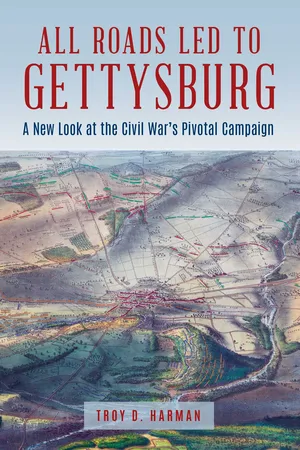
It has long been a trope of Civil War history that Gettysburg was an accidental battlefield. General Lee, the old story goes, marched blindly into Pennsylvania while his chief cavalryman Jeb Stuart rode and raided incommunicado. Meanwhile, General Meade, in command only a few days, gave uncertain chase to an enemy whose exact positions he did not know. And so these ignorant armies clashed by first light at Gettysburg on July 1, 1863. In the spirit of his iconoclastic Lee’s Real Plan at Gettysburg, Troy D. Harman argues for a new interpretation: once Lee invaded Pennsylvania and the Union army pursued, a battle at Gettysburg was entirely predictable, perhaps inevitable.
Most Civil War battles took place along major roads, railroads, and waterways; the armies needed to move men and equipment, and they needed water for men, horses, and artillery. And yet this perspective hasn’t been fully explored when it comes to Gettysburg. Look at an 1863 map, says Harman: look at the area framed in the north by the Susquehanna River and in the south by the Potomac, in the east by the Northern Central Railroad and in the west by the Cumberland Valley Railroad. This is where the armies played a high-stakes game of chess in late June 1863. Their movements were guided by strategies of caution and constrained by roads, railroads, mountains and mountain passes, rivers and creeks, all of which led the armies to Gettysburg. It’s true that Lee was disadvantaged by Stuart’s roaming and Meade by his newness to command, which led both to default to the old strategic and logistical bedrocks they learned at West Point—and these instincts helped reinforce the magnetic pull toward Gettysburg.
Moreover, once the battle started, Harman argues, the blue and gray fought tactically for the two creeks—Marsh and Rock, essential for watering men and horses and sponging artillery—that mark the battlefield in the east and the west as well as for the roadways that led to Gettysburg from all points of the compass. This is a perspective often overlooked in many accounts of the battle, which focus on the high ground—the Round Tops, Cemetery Hill—as key tactical objectives.
Gettysburg Ranger and historian Troy Harman draws on a lifetime of researching the Civil War and more than thirty years of studying the terrain of Gettysburg and south-central Pennsylvania and northern Maryland to reframe the story of the Battle of Gettysburg. In the process he shows there’s still much to say about one of history’s most written-about battles. This is revisionism of the best kind.
- English
- ePUB (mobile friendly)
- Available on iOS & Android
eBook - ePub
About this book
Information
Subtopic
American Civil War HistoryIndex
HistoryTable of contents
- Acknowledgments
- Introduction
- CHAPTER 1: Unique Challenges in Doing Gettysburg Battle History
- CHAPTER 2: Symbolic Polarities, Watercourses, Improved Roads, Rail Links, and Passes
- CHAPTER 3: Day One—Union Establishment of a Battlefront on Monocacy’s Headwaters
- CHAPTER 4: Day Two, Morning—Union Offensive Plans to Secure the Rock Creek Line
- CHAPTER 5: Day Two, Afternoon—Union Offensive Plans Shift to Left of Rock Creek Line
- CHAPTER 6: Day Three—Focus Shifts to Center of Rock Creek Line
- CHAPTER 7: Days Four and Five—Full Restoration of the Rock Creek Line
- Appendix: Army Organizational Charts from the Official Records
- Notes
- Sources
- About the Author
Trusted by 375,005 students
Access to over 1.5 million titles for a fair monthly price.
Study more efficiently using our study tools.
Frequently asked questions
Yes, you can cancel anytime from the Subscription tab in your account settings on the Perlego website. Your subscription will stay active until the end of your current billing period. Learn how to cancel your subscription
No, books cannot be downloaded as external files, such as PDFs, for use outside of Perlego. However, you can download books within the Perlego app for offline reading on mobile or tablet. Learn how to download books offline
Perlego offers two plans: Essential and Complete
- Essential is ideal for learners and professionals who enjoy exploring a wide range of subjects. Access the Essential Library with 800,000+ trusted titles and best-sellers across business, personal growth, and the humanities. Includes unlimited reading time and Standard Read Aloud voice.
- Complete: Perfect for advanced learners and researchers needing full, unrestricted access. Unlock 1.5M+ books across hundreds of subjects, including academic and specialized titles. The Complete Plan also includes advanced features like Premium Read Aloud and Research Assistant.
We are an online textbook subscription service, where you can get access to an entire online library for less than the price of a single book per month. With over 1.5 million books across 990+ topics, we’ve got you covered! Learn about our mission
Look out for the read-aloud symbol on your next book to see if you can listen to it. The read-aloud tool reads text aloud for you, highlighting the text as it is being read. You can pause it, speed it up and slow it down. Learn more about Read Aloud
Yes! You can use the Perlego app on both iOS and Android devices to read anytime, anywhere — even offline. Perfect for commutes or when you’re on the go.
Please note we cannot support devices running on iOS 13 and Android 7 or earlier. Learn more about using the app
Please note we cannot support devices running on iOS 13 and Android 7 or earlier. Learn more about using the app
Yes, you can access All Roads Led to Gettysburg by Troy D. Harman in PDF and/or ePUB format, as well as other popular books in History & American Civil War History. We have over 1.5 million books available in our catalogue for you to explore.