Tales of the country’s original criminals—and how the courts punished them for their misdeeds
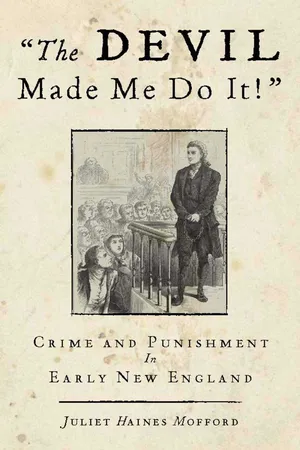
Scarlet Letters, wanton dalliances, Sabbathbreaking, and debt: Colonial laws were easily broken and the malefactors who broke them, swiftly punished. How did our ancestors deal with murder and mayhem? How did seventeenth- and eighteenth-century New England communities handle deviants? How have definitions of criminal behavior and its punishment changed over the centuries? What were early prisons like? What were the duties of a turn-key? Find out all this and more in The Devil Made Me Do It.
Drawing on early court dockets, diaries, sermons, gaolers’ records, and other primary sources, Juliet Haines Mofford investigates historical cases from a time when accused felons often pleaded in their own defense: “The Devil made me do it!”
Among the questions that emerge in this fascinating book: Would spinster Sarah Booker be punished today for her 1769 theft of three skeins of linen yarn? Would Joan Andrews still get a T for Theft pinned upon her bodice for cheating a client by placing two stones in the firkin of butter she sold him?
- English
- ePUB (mobile friendly)
- Available on iOS & Android
eBook - ePub
About this book
Information
Table of contents
- Preface
- PART I: The Puritan Way
- PART II: Governing the Family
- PART III: Governing the Community
- PART IV: The First Colonial Crime Wave: Crimes against Religion
- PART V: Sexual Deviants and Female Felons
- PART VI: The Second Colonial Crime Wave: Witches
- PART VII: Crimes against Property
- PART VIII: The Third Colonial Crime Wave: Pirates
- PART IX: Early Prisons
- PART X: The Case of Patience Samson Boston, the Penitent Prisoner
- Afterword: From Ridicule to Reform
- Endnotes
- Bibliography
- Acknowledgments
- About the Author
Trusted by 375,005 students
Access to over 1.5 million titles for a fair monthly price.
Study more efficiently using our study tools.
Frequently asked questions
Yes, you can cancel anytime from the Subscription tab in your account settings on the Perlego website. Your subscription will stay active until the end of your current billing period. Learn how to cancel your subscription
No, books cannot be downloaded as external files, such as PDFs, for use outside of Perlego. However, you can download books within the Perlego app for offline reading on mobile or tablet. Learn how to download books offline
Perlego offers two plans: Essential and Complete
- Essential is ideal for learners and professionals who enjoy exploring a wide range of subjects. Access the Essential Library with 800,000+ trusted titles and best-sellers across business, personal growth, and the humanities. Includes unlimited reading time and Standard Read Aloud voice.
- Complete: Perfect for advanced learners and researchers needing full, unrestricted access. Unlock 1.5M+ books across hundreds of subjects, including academic and specialized titles. The Complete Plan also includes advanced features like Premium Read Aloud and Research Assistant.
We are an online textbook subscription service, where you can get access to an entire online library for less than the price of a single book per month. With over 1.5 million books across 990+ topics, we’ve got you covered! Learn about our mission
Look out for the read-aloud symbol on your next book to see if you can listen to it. The read-aloud tool reads text aloud for you, highlighting the text as it is being read. You can pause it, speed it up and slow it down. Learn more about Read Aloud
Yes! You can use the Perlego app on both iOS and Android devices to read anytime, anywhere — even offline. Perfect for commutes or when you’re on the go.
Please note we cannot support devices running on iOS 13 and Android 7 or earlier. Learn more about using the app
Please note we cannot support devices running on iOS 13 and Android 7 or earlier. Learn more about using the app
Yes, you can access Devil Made Me Do It! by Juliet Haines Mofford in PDF and/or ePUB format, as well as other popular books in History & North American History. We have over 1.5 million books available in our catalogue for you to explore.