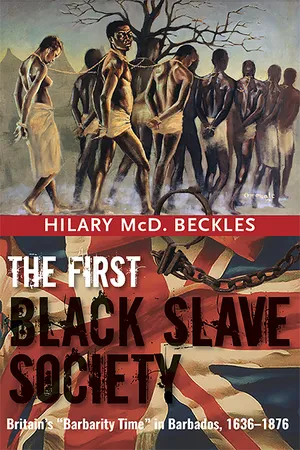
The First Black Slave Society
eBook - ePub

The First Black Slave Society

Britain's "Barbarity Time" in Barbados, 1636-1876

  1. English
  2. ePUB (mobile friendly)
  3. Available on iOS & Android
eBook - ePub

The First Black Slave Society

Britain's "Barbarity Time" in Barbados, 1636-1876

About this book

In this remarkable exploration of the brutal course of Barbados's history, Hilary McD. Beckles details the systematic barbarism of the British colonial project. Trade in enslaved Africans was not new in the Americas in the seventeenth century – the Portuguese and Spanish had commercialized chattel slavery in Brazil and Cuba in the 1500s – but in Barbados, the practice of slavery reached its apotheosis.

Barbados was the birthplace of British slave society and the most ruthlessly colonized. The geography of Barbados was ideally suited to sugar plantations and there were enormous fortunes to be made for British royalty and ruling elites from sugar produced by an enslaved, "disposable" workforce, fortunes that secured Britain's place as an imperial superpower. The inhumane legacy of plantation society has shaped modern Barbados and this history must be fully understood by the inheritors on both sides of the power dynamic before real change and reparatory justice can take place.

A prequel to Beckles's equally compelling Britain's Black Debt, The First Black Slave Society: Britain's "Barbarity Time" in Barbados, 1636–1876 is essential reading for anyone interested in Atlantic history, slavery and the plantation system, and modern race relations.

Frequently asked questions

Yes, you can cancel anytime from the Subscription tab in your account settings on the Perlego website. Your subscription will stay active until the end of your current billing period. Learn how to cancel your subscription.
At the moment all of our mobile-responsive ePub books are available to download via the app. Most of our PDFs are also available to download and we're working on making the final remaining ones downloadable now. Learn more here.
Perlego offers two plans: Essential and Complete
  • Essential is ideal for learners and professionals who enjoy exploring a wide range of subjects. Access the Essential Library with 800,000+ trusted titles and best-sellers across business, personal growth, and the humanities. Includes unlimited reading time and Standard Read Aloud voice.
  • Complete: Perfect for advanced learners and researchers needing full, unrestricted access. Unlock 1.4M+ books across hundreds of subjects, including academic and specialized titles. The Complete Plan also includes advanced features like Premium Read Aloud and Research Assistant.
Both plans are available with monthly, semester, or annual billing cycles.
We are an online textbook subscription service, where you can get access to an entire online library for less than the price of a single book per month. With over 1 million books across 1000+ topics, we’ve got you covered! Learn more here.
Look out for the read-aloud symbol on your next book to see if you can listen to it. The read-aloud tool reads text aloud for you, highlighting the text as it is being read. You can pause it, speed it up and slow it down. Learn more here.
Yes! You can use the Perlego app on both iOS or Android devices to read anytime, anywhere — even offline. Perfect for commutes or when you’re on the go.
Please note we cannot support devices running on iOS 13 and Android 7 or earlier. Learn more about using the app.
Yes, you can access The First Black Slave Society by Hilary McD. Beckles in PDF and/or ePUB format, as well as other popular books in Historia & Historia africana. We have over one million books available in our catalogue for you to explore.

Table of contents

  1. Cover Page
  2. Title Page
  3. Copyright Page
  4. Contents
  5. List of Tables
  6. Preface and Acknowledgements
  7. Introduction: Defining the Black Slave Society
  8. PART 1 CREATING THE BLACK SLAVE SOCIETY
  9. PART 2 “A WELL CONSTITUTED SOCIETY”
  10. PART 3 THE END OF DELUSION
  11. PART 4 ENDING THE “BARBARITY TIME”
  12. Conclusion
  13. Notes
  14. Bibliography
  15. Index