- English
- ePUB (mobile friendly)
- Available on iOS & Android
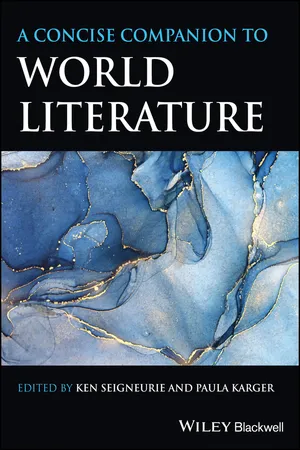
A Concise Companion to World Literature
About this book
Provides a student-friendly introduction to World Literature
Bridging the gap between introductory materials and advanced scholarly research, the Concise Companion to World Literature offers a streamlined selection of the most popular and essential essays from The Companion to World Literature, specifically tailored for undergraduate students and instructors. This single-volume resource, edited by Ken Seigneurie and Paula Karger, presents 100 carefully curated chapters, fully revised for clarity and accompanied by newly commissioned essays.
The Concise Companion, which retains the original work's three-tiered organizational structureâperiod essays, thematic bridge essays, and author-title chaptersâoffers a nuanced exploration of major literary traditions across time and geography. Each entry contextualizes major literary works within the broader framework of global literary traditions, enriching discussions on periodization, literary movements, and cross-cultural connections. With its accessible scholarship and enhanced learning tools, it is a vital resource for students beginning their journey in World Literature and for educators seeking a structured, easy-to-use reference.
Providing an engaging approach to the vast landscape of global literary traditions, the Concise Companion to World Literature:
- Features an entirely new introductory section that offers contemporary perspectives on World Literature
- Showcases a diverse array of global texts, authors, and traditions to deliver a broad and inclusive literary perspective
- Addresses key debates in World Literature, including periodization, cross-cultural exchange, and literary historiography
- Includes a new pedagogical supplement to assist instructors in course design and aid students in literary analysis
The Concise Companion to World Literature, designed for second- and third-year undergraduate students, is an essential resource for courses in World Literature, Comparative Literature, and Humanities programs. It is also a valuable tool for graduate students and faculty seeking an authoritative and easy-to-use reference for teaching and research in the field.
Frequently asked questions
- Essential is ideal for learners and professionals who enjoy exploring a wide range of subjects. Access the Essential Library with 800,000+ trusted titles and best-sellers across business, personal growth, and the humanities. Includes unlimited reading time and Standard Read Aloud voice.
- Complete: Perfect for advanced learners and researchers needing full, unrestricted access. Unlock 1.4M+ books across hundreds of subjects, including academic and specialized titles. The Complete Plan also includes advanced features like Premium Read Aloud and Research Assistant.
Please note we cannot support devices running on iOS 13 and Android 7 or earlier. Learn more about using the app.
Information
Table of contents
- Cover
- Table of Contents
- Title Page
- Copyright Page
- Notes on Contributors
- General Introduction: Changing the Way World Literature Is Taught
- Teaching and Reading World Literature
- CHAPTER 1: Introduction to World Literature Third Millennium BCE to 1500 CE
- CHAPTER 2: Bridge Essay: Origins and Transformations â Tactics of Storying and WorldâMaking
- CHAPTER 3: Should World Literature Replace the Bible?
- CHAPTER 4: The Invisible World of the Rigveda
- CHAPTER 5: Echoes of the Classics in the Voice of Confucius
- CHAPTER 6: Teachings of the Venerable Masters: Laozi and the Daode Jing
- CHAPTER 7: The QurÊŸan (Koran): Creating Community
- CHAPTER 8: The Popol Wuj: A Colonial Context
- CHAPTER 9: Bridge Essay: Looking for Love, Finding Trouble â Reading Ancient World Literature, Passionately
- CHAPTER 10: Sappho(s)
- CHAPTER 11: The Cultural Role of the Yijing (Classic of Changes) in China and Beyond
- CHAPTER 12: Love, Politics, and the Premodern Theater
- CHAPTER 13: âSoutheast Fly the Peacocksâ: An Elegy for Love from the Six Dynasties Period in China
- CHAPTER 14: Ancient Greek Tragedy in World Literature
- CHAPTER 15: Augustineâs Confessions
- CHAPTER 16: Tang Poetry: Illustrating Tensions in the Classical Tradition
- CHAPTER 17: Qasida Poetry:
- CHAPTER 18: Longing for Love
- CHAPTER 19: Bridge Essay
- CHAPTER 20: Gilgamesh
- CHAPTER 21: The First Poem
- CHAPTER 22: Homerâs Iliad and Odyssey
- CHAPTER 23: Vergilâs Aeneid
- CHAPTER 24: The Secular Wisdom of Kalila and Dimna
- CHAPTER 25: The Tale of the Heike
- CHAPTER 26: The Glory and the End of the Heroic World in the Nibelungenlied
- CHAPTER 27: The Heroic Paradigm in The Epic of the Cid
- CHAPTER 28: The KnightâErrant and the Good Fellow in Chinese Narrative
- CHAPTER 29: The Kebra Nagast
- CHAPTER 30: The Sundiata Epic and the Global Literary Imaginary
- CHAPTER 31: The Arab Oral Epic of the Bani Hilal Tribe: AlâSirah alâHilaliyyah
- CHAPTER 32: Bridge Essay: Gender and Representation
- CHAPTER 33:The Tale of Genji
- CHAPTER 34: A Woman Flouts Expectations in the Literary World
- CHAPTER 35: Engaging the Other More Favorably in Wolfram von Eschenbachâs Parzival
- CHAPTER 36: Francesco Petrarch
- CHAPTER 37: Mirabaiâs Poetry
- CHAPTER 38: Walls of Inclusivity
- CHAPTER 39: âHe Has Come, Visible and Hiddenâ
- CHAPTER 40: Introduction to World Literature 1501â1800
- CHAPTER 41: Bridge Essay
- CHAPTER 42: Rousseau and the Firmament of Modern Literature
- CHAPTER 43: Allegory and âWorldâ Formation in The Journey to the West
- CHAPTER 44: William Shakespeare
- CHAPTER 45: Staging Franceâs Classical Theater World and Discovering Its Limits
- CHAPTER 46: Bridge Essay: The Novel
- CHAPTER 47:The 1001 Nights as World Literature
- CHAPTER 48: Lust and Love in English Translation
- CHAPTER 49: Don Quixote
- CHAPTER 50: A Lash for the World
- CHAPTER 51: Voltaire
- CHAPTER 52: Introduction to World Literature 1801â1900
- CHAPTER 53: Bridge Essay
- CHAPTER 54: Bankimchandra Chattopadhyay and the Inauguration of the Modern Indian Novel
- CHAPTER 55: From Delhi to Isfahan and Beyond
- CHAPTER 56: Rudyard Kipling
- CHAPTER 57: âBut Women Feel Just as Men Doâ
- CHAPTER 58: A Persisting Unease
- CHAPTER 59: Tagore at the Conjunction of World Literatures
- CHAPTER 60: Bridge Essay
- CHAPTER 61: Goetheâs World Literature Paradigm
- CHAPTER 62: The English Lake Poets of the World
- CHAPTER 63: Jane Austen on the Global Stage
- CHAPTER 64: Six Records of a Life Adrift
- CHAPTER 65: The Other Woman
- CHAPTER 66: Introduction to World Literature 1901 to the Present
- CHAPTER 67: Bridge Essay: From Decolonization to Decoloniality
- CHAPTER 68: âA Humanitarian Is Always a Hypocriteâ
- CHAPTER 69: World Literature, World War
- CHAPTER 70:Indonesian Dissidence and Modern Narrative Form
- CHAPTER 71:Aleksandr Solzhenitsyn
- CHAPTER 72: Between Realism and Modernism
- CHAPTER 73: NgĆ©gÄ© wa Thiongâo
- CHAPTER 74: Bridge Essay: The Moral Limits of Archive
- CHAPTER 75: Lu Xunâs Fictional Worlds
- CHAPTER 76: Marcel Proust
- CHAPTER 77: Franz Kafka
- CHAPTER 78: Thomas Mann
- CHAPTER 79: Virginia Woolf and the Rhythms of the Modern
- CHAPTER 80: Social Realism and Moral Affects
- CHAPTER 81: Kawabata Yasunari
- CHAPTER 82: Ernest Hemingway
- CHAPTER 83: William Faulkner and the World Literature Debate
- CHAPTER 84: Borges in the World, the World in Borges
- CHAPTER 85: Worlding Eileen Chang (Zhang Ailing): Narratives of Frontiers and Crossings
- CHAPTER 86: Albert Camus
- CHAPTER 87: Ralph Ellisonâs Invisible Man
- CHAPTER 88: The Writerâs Passport
- CHAPTER 89: Gabriel GarcĂa MĂĄrquez and the Worlding of Latin American Literature
- CHAPTER 90: âStanding in a Doorway Lookingâ
- CHAPTER 91: Naguib Mahfouz and World Literature
- CHAPTER 92: Toni Morrisonâs Fiction
- CHAPTER 93: Mo Yanâs Red Sorghum Family: World Literature as Incursion
- CHAPTER 94: Bridge Essay: The Learned Trowel
- CHAPTER 95: Opened Subjects, Opened Worlds
- CHAPTER 96: The Poetry of C.P. Cavafy and the âWorldâ in âWorld Literatureâ
- CHAPTER 97: T. S. Eliot and Modernist Translation
- CHAPTER 98: Pablo Neruda
- CHAPTER 99: We Who Have Been Killed on Dark Paths
- CHAPTER 100: Fernando Pessoa, Singular Modernity, and World Literature
- CHAPTER 101: Bridge Essay: Modern Drama
- CHAPTER 102: How Bertolt Brecht Managed to Forge a Defamiliarized World Theater
- CHAPTER 103: Wole Soyinka
- CHAPTER 104: SaÊżdallah Wannous
- Index
- End User License Agreement