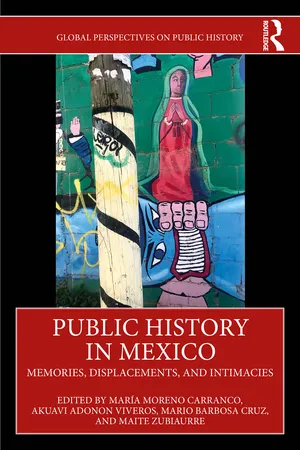
Public History in Mexico
eBook - ePub

Public History in Mexico

Memories, Displacements, and Intimacies

  1. English
  2. ePUB (mobile friendly)
  3. Available on iOS & Android
eBook - ePub

Public History in Mexico

Memories, Displacements, and Intimacies

About this book

This collection of chapters explores how history is created, shared, and contested in urban and marginalized spaces by examining memory, displacement, resilience, and community-driven historical interventions across Mexico.

Bridging academic research with lived experiences, the book shows how public history is a powerful tool that both reflects on the past and projects more egalitarian futures of justice, representation, and cultural affirmation. Centred mainly around Mexico City, but also touching on the impact of migration at the northern border, it contributes to the debates around new forms of history construction and covers topics including territorial dispossession, deportation processes, the violence entailed in erased histories, and the reconfiguration of daily life during the COVID pandemic. Through diverse approaches and methodologies such as documentary film, digital storytelling, public art, museum interpretations, grassroots activism, and other collective or community work, it provides readers with valuable insights into how historical narratives shape identities, social movements, and public policies, as well as a deeper understanding of how communities engage with their past to reclaim space, resist erasure, and foster belonging.

This book is a useful resource for all upper-level undergraduates, postgraduates, and scholars interested in urban history, public history, cultural studies, anthropology, and Latin American studies.

Frequently asked questions

Yes, you can cancel anytime from the Subscription tab in your account settings on the Perlego website. Your subscription will stay active until the end of your current billing period. Learn how to cancel your subscription.
No, books cannot be downloaded as external files, such as PDFs, for use outside of Perlego. However, you can download books within the Perlego app for offline reading on mobile or tablet. Learn more here.
Perlego offers two plans: Essential and Complete
  • Essential is ideal for learners and professionals who enjoy exploring a wide range of subjects. Access the Essential Library with 800,000+ trusted titles and best-sellers across business, personal growth, and the humanities. Includes unlimited reading time and Standard Read Aloud voice.
  • Complete: Perfect for advanced learners and researchers needing full, unrestricted access. Unlock 1.4M+ books across hundreds of subjects, including academic and specialized titles. The Complete Plan also includes advanced features like Premium Read Aloud and Research Assistant.
Both plans are available with monthly, semester, or annual billing cycles.
We are an online textbook subscription service, where you can get access to an entire online library for less than the price of a single book per month. With over 1 million books across 1000+ topics, we’ve got you covered! Learn more here.
Look out for the read-aloud symbol on your next book to see if you can listen to it. The read-aloud tool reads text aloud for you, highlighting the text as it is being read. You can pause it, speed it up and slow it down. Learn more here.
Yes! You can use the Perlego app on both iOS or Android devices to read anytime, anywhere — even offline. Perfect for commutes or when you’re on the go.
Please note we cannot support devices running on iOS 13 and Android 7 or earlier. Learn more about using the app.
Yes, you can access Public History in Mexico by María Moreno Carranco,Akuavi Adonon Viveros,Mario Barbosa Cruz,Maite Zubiaurre in PDF and/or ePUB format, as well as other popular books in Storia & Storia moderna. We have over one million books available in our catalogue for you to explore.

Information

Publisher
Routledge
Year
2025
eBook ISBN
9781040695876

Table of contents

  1. Cover Page
  2. Endorsement Page
  3. Half Title page
  4. Series page
  5. Title Page
  6. Copyright Page
  7. Contents
  8. Figures
  9. Contributors
  10. Acknowledgments
  11. Introduction
  12. Memories of the urban
  13. Periphery and erasure
  14. Exclusion beyond Mexico City
  15. Re-placing the museum
  16. Intimate spaces
  17. Index