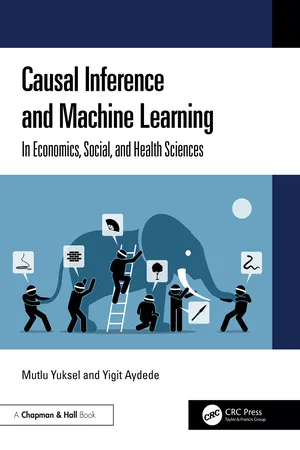
Causal Inference and Machine Learning
eBook - ePub

Causal Inference and Machine Learning

In Economics, Social, and Health Sciences

  1. English
  2. ePUB (mobile friendly)
  3. Available on iOS & Android
eBook - ePub

Causal Inference and Machine Learning

In Economics, Social, and Health Sciences

About this book

Causal Inference and Machine Learning in Economics, Social, and Health Sciences bridges the gap between modern machine learning methods and the applied needs of economists, public health researchers, and social scientists. Designed with students and practitioners in mind, the book introduces machine learning through the lens of causal inference, offering a rigorous yet accessible roadmap for using data to answer real-world policy questions.

It combines econometric and machine learning methods such as penalized regressions, random forests, boosting, double machine learning, and the most up-to-date estimation methods for addressing selection on observables (e.g., matching, AIPW) and unobservables (e.g., instrumental variables, difference-in-differences, synthetic control). Readers learn how to estimate treatment effects, uncover heterogeneity, and work with high-dimensional data, while gaining clarity on assumptions, trade-offs, and limitations. The book also covers advanced and often underrepresented topics such as time series forecasting with machine learning methods, neural networks and deep learning, and core optimization algorithms like gradient descent. Each method is introduced with intuition, formal treatment, and applied examples from economics, health, labor, and development studies. It places special emphasis on transparency, identification, and interpretability.

Beyond introducing models, it provides step-by-step guidance from raw data to estimation, showing not just what works, but how and why—both methodologically and computationally. Unlike many texts that rely on pre–built software or assume deep technical knowledge, this book builds from foundational concepts such as estimation, error decomposition, and bias-variance trade-offs, then progresses to advanced machine learning approaches. Simulation-based pedagogy helps readers visualize model behavior under known conditions, enabling researchers and students alike to see how statistical tools perform across diverse empirical settings.

A distinctive feature of the book is its focus on when and how to use predictive versus causal models. Rather than treating them as separate tasks, it shows how each can inform the other. Practical insights, diagnostics, and examples guide readers in selecting appropriate tools based on research goals and data characteristics.

With its clear style, practical code in R, and integrated approach to prediction and causality, this book is an essential resource for applied researchers, students, and anyone using data to inform policy and decision–making.

KEY FEATURES

  • Integrates causal inference with the latest econometric and machine learning methods to address real–world policy questions in economics, health, and the social sciences.
  • Offers clear, detailed explanations and intuitive guidance—even for foundational concepts often overlooked in other sources—to build theoretical understanding and link econometric principles to application.
  • Designed for applied researchers, students, and practitioners with limited technical background, with step-by-step instruction from raw data and basic code, including how both the methods and the underlying code function.
  • Provides practical guidance on when and how to use predictive vs. causal models, highlighting their trade-offs and pitfalls to avoid, supported by real-world examples and simulation-based demonstrations.

Trusted byĀ 375,005 students

Access to over 1.5 million titles for a fair monthly price.

Study more efficiently using our study tools.

Information

Year
2025
eBook ISBN
9781040453063

Table of contents

  1. Cover Page
  2. Half-Title Page
  3. Title Page
  4. Copyright Page
  5. Dedication Page
  6. Contents
  7. Preface
  8. About the Authors
  9. 1 Introduction
  10. 2 From Data to Causality
  11. 3 Learning Systems
  12. 4 Error
  13. 5 Bias–Variance Trade-off
  14. 6 Overfitting
  15. 7 Parametric Estimation: Basics
  16. 8 Nonparametric Estimations: Basics
  17. 9 Hyperparameter Tuning
  18. 10 Classification
  19. 11 Model Selection and Sparsity
  20. 12 Penalized Regression Methods
  21. 13 Classification and Regression Trees (CART)
  22. 14 Ensemble Learning and Random Forest
  23. 15 Boosting
  24. 16 Counterfactual Framework
  25. 17 Randomized Controlled Trials
  26. 18 Selection on Observables
  27. 19 Double Machine Learning
  28. 20 Matching Methods
  29. 21 Inverse Weighting and Doubly Robust Estimation
  30. 22 Selection on Unobservables and DML-IV
  31. 23 Heterogeneous Treatment Effects
  32. 24 Causal Trees and Forests
  33. 25 Meta Learners for Treatment Effects
  34. 26 Difference in Differences and DML-DiD
  35. 27 Synthetic DiD and Regression Discontinuity
  36. 28 Time Series Forecasting
  37. 29 Direct Forecasting with Random Forests
  38. 30 Neural Networks and Deep Learning
  39. 31 Matrix Decomposition and Applications
  40. 32 Optimization Algorithms: Basics
  41. References
  42. Index

Frequently asked questions

Yes, you can cancel anytime from the Subscription tab in your account settings on the Perlego website. Your subscription will stay active until the end of your current billing period. Learn how to cancel your subscription
No, books cannot be downloaded as external files, such as PDFs, for use outside of Perlego. However, you can download books within the Perlego app for offline reading on mobile or tablet. Learn how to download books offline
Perlego offers two plans: Essential and Complete
  • Essential is ideal for learners and professionals who enjoy exploring a wide range of subjects. Access the Essential Library with 800,000+ trusted titles and best-sellers across business, personal growth, and the humanities. Includes unlimited reading time and Standard Read Aloud voice.
  • Complete: Perfect for advanced learners and researchers needing full, unrestricted access. Unlock 1.5M+ books across hundreds of subjects, including academic and specialized titles. The Complete Plan also includes advanced features like Premium Read Aloud and Research Assistant.
Both plans are available with monthly, semester, or annual billing cycles.
We are an online textbook subscription service, where you can get access to an entire online library for less than the price of a single book per month. With over 1.5 million books across 990+ topics, we’ve got you covered! Learn about our mission
Look out for the read-aloud symbol on your next book to see if you can listen to it. The read-aloud tool reads text aloud for you, highlighting the text as it is being read. You can pause it, speed it up and slow it down. Learn more about Read Aloud
Yes! You can use the Perlego app on both iOS and Android devices to read anytime, anywhere — even offline. Perfect for commutes or when you’re on the go.
Please note we cannot support devices running on iOS 13 and Android 7 or earlier. Learn more about using the app
Yes, you can access Causal Inference and Machine Learning by Mutlu Yuksel,Yigit Aydede in PDF and/or ePUB format. We have over 1.5 million books available in our catalogue for you to explore.