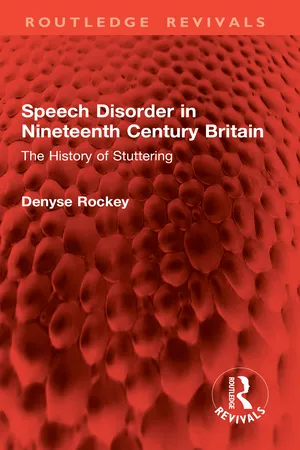
Originally published in 1980, this comprehensive study of stuttering in Britain in the nineteenth century was the first detailed examination of one speech problem as manifested in a particular time and place. It examines the problems posed by stuttering and illustrates how it became the linguistic handicap most responsible for laying the roots of professional speech therapy. The impediment was seen as a challenge to the physician in that the cure was tantalisingly elusive and the cause highly problematic. From these first attempts at treatment the profession of speech therapy developed. Many of the nineteenth century therapists were themselves stutterers who conquered their own impediment. As systematic management of speech defects emerged it matched the development of both humane mental health services and special education. It also demonstrated the community's response to disabled people which took the form of private philanthropy on the one hand and government legislation on the other.
- English
- ePUB (mobile friendly)
- Available on iOS & Android
eBook - ePub
About this book
Information
Table of contents
- Cover
- Half title
- Title Page
- Copyright Page
- Title Page
- Copyright Page
- Table of Contents
- Dedication
- List of Figures and Tables
- Abbreviations and Bibliographical Details
- Acknowledgements
- Preface
- Introduction
- 1 Emergence of the Problem
- 2 A New Profession
- 3 Notions of Causality
- 4 Irregularities of the Peripheral Speech Organs
- 5 Neurological And Psychological Influences
- 6 Therapeutic Practices
- 7 Medicine and Surgery
- 8 Didactic Techniques and Remedial Aids
- Conclusion
- Bibliography
- Index
Trusted by 375,005 students
Access to over 1.5 million titles for a fair monthly price.
Study more efficiently using our study tools.
Frequently asked questions
Yes, you can cancel anytime from the Subscription tab in your account settings on the Perlego website. Your subscription will stay active until the end of your current billing period. Learn how to cancel your subscription
No, books cannot be downloaded as external files, such as PDFs, for use outside of Perlego. However, you can download books within the Perlego app for offline reading on mobile or tablet. Learn how to download books offline
We are an online textbook subscription service, where you can get access to an entire online library for less than the price of a single book per month. With over 1.5 million books across 990+ topics, we’ve got you covered! Learn about our mission
Look out for the read-aloud symbol on your next book to see if you can listen to it. The read-aloud tool reads text aloud for you, highlighting the text as it is being read. You can pause it, speed it up and slow it down. Learn more about Read Aloud
Yes! You can use the Perlego app on both iOS and Android devices to read anytime, anywhere — even offline. Perfect for commutes or when you’re on the go.
Please note we cannot support devices running on iOS 13 and Android 7 or earlier. Learn more about using the app
Please note we cannot support devices running on iOS 13 and Android 7 or earlier. Learn more about using the app
Yes, you can access Speech Disorder in Nineteenth Century Britain by Denyse Rockey in PDF and/or ePUB format, as well as other popular books in Medicine & Social History. We have over 1.5 million books available in our catalogue for you to explore.