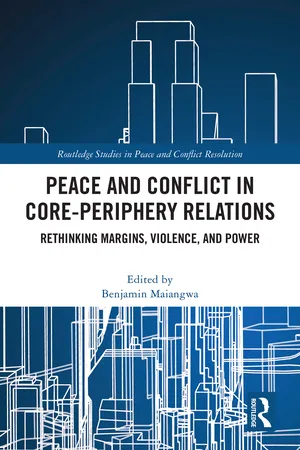
Peace and Conflict in Core-Periphery Relations
Rethinking Margins, Violence, and Power
- English
- ePUB (mobile friendly)
- Available on iOS & Android
Peace and Conflict in Core-Periphery Relations
Rethinking Margins, Violence, and Power
About this book
This book offers a grounded framework for Peace and Conflict Studies (PACS) that not only analyses conflict but also actively contributes to the well-being of marginalized communities.
In response to rising authoritarianism and shrinking democratic spaces, the volume calls for inclusive peacebuilding processes that center the voices, experiences, and agency of those historically excluded, particularly those on the periphery of the global system. The book critically engages with the limitations of traditional, Western-centric PACS frameworks and proposes a decolonial restructuring of the field. It foregrounds the lived experiences, knowledge systems, and aspirations of marginalized communities such as artists, members of the diaspora, and LGBTQIA+, thereby challenging dominant paradigms and positioning the periphery as a vital site of transformative action and knowledge production. Through practical, context-sensitive solutions, the volume seeks to make PACS more responsive, equitable, and capable of fostering sustainable peace in an increasingly complex world.
This book will be of much interest to students and practitioners of peace and conflict studies, social justice, development studies, and international relations.
Tools to learn more effectively

Saving Books

Keyword Search

Annotating Text

Listen to it instead
Information
Table of contents
- Cover
- Half-Title Page
- Series Page
- Title Page
- Copyright Page
- Table of Contents
- List of Illustrations
- Notes on Contributors
- Acknowledgments
- 1 Introduction: Marginalism, Violence, and Emancipatory Peacebuilding
- Section I Mapping Marginalism and Confronting Violence
- 2 Am I Complicit?: Seven Harms and Seven Remedies
- 3 “Ethnopatriarchy”: Muhajir Women, Intersectionality, and Emancipatory Peacebuilding
- 4 From the Margins: Informal Markets, Gender, and Everyday Peacebuilding
- 5 Reclaiming Peace from the Margins: Queer Necropolitics and Activism Resistance in Bosnia and Herzegovina
- 6 Stepping Out Violence in the Venezuelan-Colombian Border: Academics and Local Communities Overcoming Marginalization
- 7 Trust and Sustainability in Return Migration: Insights from Conflict-Affected Communities and Implications for Peacebuilding
- Section II Creative Resistance and Emancipatory Peacebuilding
- 8 The Aesthetics of Peace
- 9 Meditations on Core-Periphery Relations, Marginal Spaces, and the Roaming Selves: A Postscript
- 10 The Migrant’s Impulse: Selfhood, Justice, and Peace
- 11 Not in My Back Yard, Not My Problem: The Effect of Social Justice Discourse in Calling to Action for Community Well-Being
- 12 Social Inclusion, Peacebuilding, and Reconciliation: Lessons from Northern Ireland’s Peace Programs
- 13 Protracted Absence, Disabled People, and Peace and Conflict Studies (PACS)
- 14 Conclusion: Weaving the Margins for Decolonial Peace
- Index
Frequently asked questions
- Essential is ideal for learners and professionals who enjoy exploring a wide range of subjects. Access the Essential Library with 800,000+ trusted titles and best-sellers across business, personal growth, and the humanities. Includes unlimited reading time and Standard Read Aloud voice.
- Complete: Perfect for advanced learners and researchers needing full, unrestricted access. Unlock 1.4M+ books across hundreds of subjects, including academic and specialized titles. The Complete Plan also includes advanced features like Premium Read Aloud and Research Assistant.
Please note we cannot support devices running on iOS 13 and Android 7 or earlier. Learn more about using the app