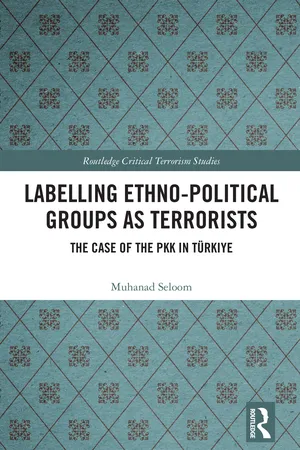
Labelling Ethno-Political Groups as Terrorists
eBook - ePub

Labelling Ethno-Political Groups as Terrorists

The Case of the PKK in TĂŒrkiye

  1. English
  2. ePUB (mobile friendly)
  3. Available on iOS & Android
eBook - ePub

Labelling Ethno-Political Groups as Terrorists

The Case of the PKK in TĂŒrkiye

About this book

This book examines the impact of applying the "terrorist" label to a group's choice to resort to violence within an ethnonationalist conflict.

Using the Partiya KarkerĂȘn KurdistanĂȘ (PKK) in TĂŒrkiye as a primary case study, the book interrogates the socio-political ramifications of the Turkish government's decision to label the PKK as a terrorist organisation. Drawing on longitudinal interviews, newly opened Turkish and Kurdish archives, media frame databases, and casualty logs, it maps five decisive moments: the 1984 guerrilla launch; Abdullah Öcalan's 1999 arrest; the 2012–2015 peace talks; Kobani's stand against ISIS in 2015 in a town in Syria; and the 2025 stand down. Furthermore, the study's empirical analysis and discussions reveal that the invocation of the label "terrorist" against the PKK places the group's actors and sympathisers in a situation that makes it harder for them to engage in peaceful means of resolving the conflict. Using four waves of interviews with Kurds in TĂŒrkiye and Syria spanning over a decade, the book offers dynamic insights into how attitudes towards the PKK and the "terrorist" label have shifted over time.

This book will be of interest to students and scholars of terrorism and political violence, ethnic conflict, critical security studies, and international relations.

Frequently asked questions

Yes, you can cancel anytime from the Subscription tab in your account settings on the Perlego website. Your subscription will stay active until the end of your current billing period. Learn how to cancel your subscription.
No, books cannot be downloaded as external files, such as PDFs, for use outside of Perlego. However, you can download books within the Perlego app for offline reading on mobile or tablet. Learn more here.
Perlego offers two plans: Essential and Complete
  • Essential is ideal for learners and professionals who enjoy exploring a wide range of subjects. Access the Essential Library with 800,000+ trusted titles and best-sellers across business, personal growth, and the humanities. Includes unlimited reading time and Standard Read Aloud voice.
  • Complete: Perfect for advanced learners and researchers needing full, unrestricted access. Unlock 1.4M+ books across hundreds of subjects, including academic and specialized titles. The Complete Plan also includes advanced features like Premium Read Aloud and Research Assistant.
Both plans are available with monthly, semester, or annual billing cycles.
We are an online textbook subscription service, where you can get access to an entire online library for less than the price of a single book per month. With over 1 million books across 1000+ topics, we’ve got you covered! Learn more here.
Look out for the read-aloud symbol on your next book to see if you can listen to it. The read-aloud tool reads text aloud for you, highlighting the text as it is being read. You can pause it, speed it up and slow it down. Learn more here.
Yes! You can use the Perlego app on both iOS or Android devices to read anytime, anywhere — even offline. Perfect for commutes or when you’re on the go.
Please note we cannot support devices running on iOS 13 and Android 7 or earlier. Learn more about using the app.
Yes, you can access Labelling Ethno-Political Groups as Terrorists by Muhanad Seloom in PDF and/or ePUB format, as well as other popular books in Politics & International Relations & Middle Eastern History. We have over one million books available in our catalogue for you to explore.

Table of contents

  1. Cover
  2. Half Title
  3. Series
  4. Title
  5. Copyright
  6. Dedication
  7. Contents
  8. Acknowledgements
  9. List of Figures
  10. List of Abbreviations
  11. Preface
  12. Introduction
  13. 1 Labels in Conflict Discourse
  14. 2 The Labelling–Securitisation Nexus
  15. 3 The PKK: Transnational Kurdish Politics in TĂŒrkiye, Iraq, Iran, and Syria
  16. 4 The PKK: From Formation to Peace Negotiations
  17. 5 Securitising Kurdish Identity: How the “Terrorist” Label Shapes the PKK in TĂŒrkiye
  18. 6 Women’s Participation in the PKK: From Guerrilla Beginnings to a Transnational Movement
  19. 7 Mediating the Terrorist Label: Turkish and International Coverage of the PKK (2011–2025)
  20. 8 Beyond the PKK: Transferability and Limits of the Terrorist Designation
  21. 9 From “Terrorist” Label to Conflict Transformation
  22. Conclusion: De-labelling, De-securitisation, and Pathways Beyond the “Terrorist” Paradigm
  23. Appendix A: Full Discourse Analysis of Empirical Data
  24. Appendix B: Multi-tier Source Validation and Bias Control
  25. Index