Architect your.NET applications by breaking them into really small pieces—microservices—using this practical, example-based guideAbout This Book• Start your microservices journey and understand a broader perspective of microservices development• Build, deploy, and test microservices using ASP.Net MVC, Web API, and Microsoft Azure Cloud• Get started with reactive microservices and understand the fundamentals behind itWho This Book Is ForThis book is for.NET Core developers who want to learn and understand microservices architecture and implement it in their.NET Core applications. It's ideal for developers who are completely new to microservices or have just a theoretical understanding of this architectural approach and want to gain a practical perspective in order to better manage application complexity.What You Will Learn• Compare microservices with monolithic applications and SOA• Identify the appropriate service boundaries by mapping them to the relevant bounded contexts• Define the service interface and implement the APIs using ASP.NET Web API• Integrate the services via synchronous and asynchronous mechanisms• Implement microservices security using Azure Active Directory, OpenID Connect, and OAuth 2.0• Understand the operations and scaling of microservices in.NET Core• Understand the testing pyramid and implement consumer-driven contract using pact net core• Understand what the key features of reactive microservices are and implement them using reactive extensionIn DetailMicroservices is an architectural style that promotes the development of complex applications as a suite of small services based on business capabilities. This book will help you identify the appropriate service boundaries within the business. We'll start by looking at what microservices are, and what the main characteristics are.Moving forward, you will be introduced to real-life application scenarios, and after assessing the current issues, we will begin the journey of transforming this application by splitting it into a suite of microservices.You will identify the service boundaries, split the application into multiple microservices, and define the service contracts. You will find out how to configure, deploy, and monitor microservices, and configure scaling to allow the application to quickly adapt to increased demand in the future.With an introduction to the reactive microservices, you strategically gain further value to keep your code base simple, focusing on what is more important rather than the messy asynchronous calls.Style and approachThis guide serves as a stepping stone that helps.NET Core developers in their microservices architecture. This book provides just enough theory to understand the concepts and apply the examples.
- 274 pages
- English
- ePUB (mobile friendly)
- Available on iOS & Android
eBook - ePub
Building Microservices with .NET Core
About this book
Information
Topic
InformatikSubtopic
Programmierung in C#What Are Microservices?
The focus of this chapter is to get you acquainted with microservices. We will start with a brief introduction. Then, we will define its predecessors: monolithic architecture and service-oriented architecture (SOA). After this, we will see how microservices fare against both SOA and the monolithic architecture. We will then compare the advantages and disadvantages of each one of these architectural styles. This will enable us to identify the right scenario for these styles. We will understand the problems that arise from having a layered monolithic architecture. We will discuss the solutions available to these problems in the monolithic world. At the end, we will be able to break down a monolithic application into a microservice architecture. We will cover the following topics in this chapter:
- Origin of microservices
- Discussing microservices
- Understanding the microservice architecture
- Advantages of microservices
- SOA versus microservices
- Understanding problems with the monolithic architectural style
- Challenges in standardizing the .NET stack
Origin of microservices
The term microservices was used for the first time in mid-2011 at a workshop of software architects. In March 2012, James Lewis presented some of his ideas about microservices. By the end of 2013, various groups from the IT industry started having discussions on microservices, and by 2014, it had become popular enough to be considered a serious contender for large enterprises.
There is no official introduction available for microservices. The understanding of the term is purely based on the use cases and discussions held in the past. We will discuss this in detail, but before that, let's check out the definition of microservices as per Wikipedia (https://en.wikipedia.org/wiki/Microservices), which sums it up as:
Microservices is a specialization of and implementation approach for SOA used to build flexible, independently deployable software systems.
In 2014, James Lewis and Martin Fowler came together and provided a few real-world examples and presented microservices (refer to http://martinfowler.com/microservices/) in their own words and further detailed it as follows:
The microservice architectural style is an approach to developing a single application as a suite of small services, each running in its own process and communicating with lightweight mechanisms, often an HTTP resource API. These services are built around business capabilities and independently deployable by fully automated deployment machinery. There is a bare minimum of centralized management of these services, which may be written in different programming languages and use different data storage technologies.
It is very important that you see all the attributes James and Martin defined here. They defined it as an architectural style that developers could utilize to develop a single application with the business logic spread across a bunch of small services, each having their own persistent storage functionality. Also, note its attributes: it can be independently deployable, can run in its own process, is a lightweight communication mechanism, and can be written in different programming languages.
We want to emphasize this specific definition since it is the crux of the whole concept. And as we move along, it will come together by the time we finish this book.
Discussing microservices
Until now, we have gone through a few definitions of microservices; now, let's discuss microservices in detail.
In short, a microservice architecture removes most of the drawbacks of SOA architectures. It is more code-oriented (we will discuss this in detail in the coming sections) than SOA services.
Slicing your application into a number of services is neither SOA nor microservices. However, combining service design and best practices from the SOA world along with a few emerging practices, such as isolated deployment, semantic versioning, providing lightweight services, and service discovery in polyglot programming, is microservices. We implement microservices to satisfy business features and implement them with reduced time to market and greater flexibility.
Before we move on to understand the architecture, let's discuss the two important architectures that have led to its existence:
- The monolithic architecture style
- SOA
Most of us would be aware of the scenario where during the life cycle of an enterprise application development, a suitable architectural style is decided. Then, at various stages, the initial pattern is further improved and adapted with changes that cater to various challenges, such as deployment complexity, large code base, and scalability issues. This is exactly how the monolithic architecture style evolved into SOA, further leading up to microservices.
Monolithic architecture
The monolithic architectural style is a traditional architecture type and has been widely used in the industry. The term monolithic is not new and is borrowed from the Unix world. In Unix, most of the commands exist as a standalone program whose functionality is not dependent on any other program. As seen in the succeeding image, we can have different components in the application such as:
- User interface: This handles all of the user interaction while responding with HTML or JSON or any other preferred data interchange format (in the case of web services).
- Business logic: All the business rules applied to the input being received in the form of user input, events, and database exist here.
- Database access: This houses the complete functionality for accessing the database for the purpose of querying and persisting objects. A widely accepted rule is that it is utilized through business modules and never directly through user-facing components.
Software built using this architecture is self-contained. We can imagine a single .NET assembly that contains various components, as described in the following image:
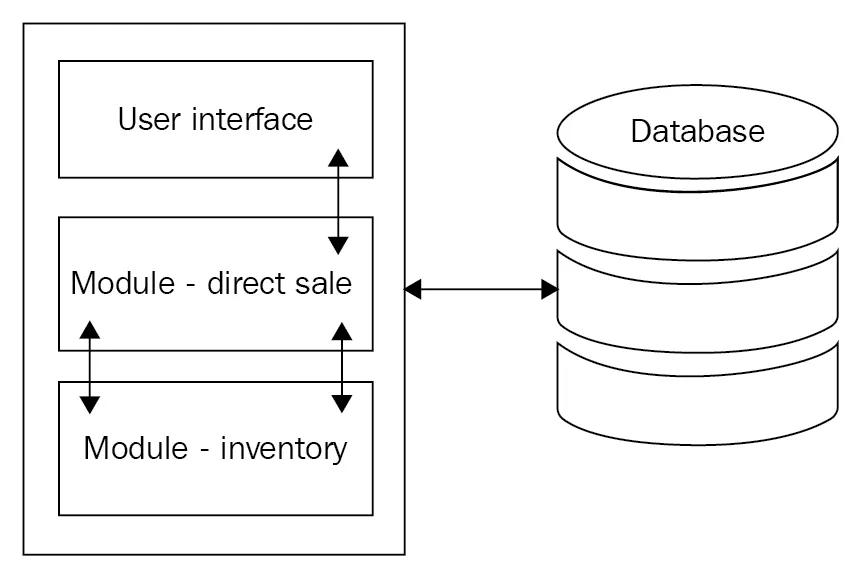
As the software is self-contained here, its components are interconnected and interdependent. Even a simple code change in one of the modules may break a major functionality in other modules. This would result in a scenario where we'd need to test the whole application. With the business depending critically on its enterprise application frameworks, this amount of time could prove to be very critical.
Having all the components tightly coupled poses another challenge: whenever we execute or compile such software, all the components should be available or the build will fail; refer to the preceding image that represents a monolithic architecture and is a self-contained or a single .NET assembly project. However, monolithic architectures might also have multiple assemblies. This means that even though a business layer (assembly, data access layer assembly, and so on) is separated, at run time, all of them will come together and run as one process.
A user interface depends on other components' direct sale and inventory in a manner similar to all other components that depend upon each other. In this scenario, we will not be able to execute this project in the absence of any one of these components. The process of upgrading any one of these components will be more complex as we may have to consider other components that require code changes too. This results in more development time than required for the actual change.
Deploying such an application will become another challenge. During deployment, we will have to make sure that each and every component is deployed properly; otherwise, we may end up facing a lot of issues in our production environments.
If we develop an application using the monolithic architecture style, as discussed previously, we might face the following challenges:
- Large code base: This is a scenario where the code lines outnumber the comments by a great margin. As components are interconnected, we will have to bear with a repetitive code base.
- Too many business modules: This is in regard to modules within the same system.
- Code base complexity: This results in a higher chance of code breaking due to the fix required in other modules or services.
- Complex code deployment: You may come across minor changes that would require whole system deployment.
- One module failure affecting the whole system: This is in regard to modules that depend on each other.
- Scalability: This is required for the entire system and not just the modules in it.
- Intermodule dependency: This is due to tight coupling.
- Spiraling development time: This is due to code complexity and interdependency.
- Inability to easily adapt to a new technology: In this case, the entire system would need to be upgraded.
As discussed earlier, if we want to reduce development time, ease of deployment, and improve maintainability of software for enterprise applications, we should avoid the traditional or monolithic architecture.
Service-oriented architecture
In the previous section, we discussed the monolithic architecture and its limitations. We also discussed why it does not fit into our enterprise application requirements. To overcome these issues, we should go with some modular approach where we can separate the components such that they should come out of the self-contained or single .NET assembly.
The main difference between SOA & monolithic is not one or multiple assembly. But as the service in SOA runs as separate process, SOA scales better compared to monolithic.
Let's discuss ...
Table of contents
- Title Page
- Copyright
- Credits
- Foreword
- About the Authors
- About the Reviewers
- www.PacktPub.com
- Customer Feedback
- Preface
- What Are Microservices?
- Building Microservices
- Integration Techniques
- Testing Strategies
- Deployment
- Security
- Monitoring
- Scaling
- Reactive Microservices
- Creating a Complete Microservice Solution
Trusted by 375,005 students
Access to over 1.5 million titles for a fair monthly price.
Study more efficiently using our study tools.
Frequently asked questions
Yes, you can cancel anytime from the Subscription tab in your account settings on the Perlego website. Your subscription will stay active until the end of your current billing period. Learn how to cancel your subscription
No, books cannot be downloaded as external files, such as PDFs, for use outside of Perlego. However, you can download books within the Perlego app for offline reading on mobile or tablet. Learn how to download books offline
Perlego offers two plans: Essential and Complete
- Essential is ideal for learners and professionals who enjoy exploring a wide range of subjects. Access the Essential Library with 800,000+ trusted titles and best-sellers across business, personal growth, and the humanities. Includes unlimited reading time and Standard Read Aloud voice.
- Complete: Perfect for advanced learners and researchers needing full, unrestricted access. Unlock 1.5M+ books across hundreds of subjects, including academic and specialized titles. The Complete Plan also includes advanced features like Premium Read Aloud and Research Assistant.
We are an online textbook subscription service, where you can get access to an entire online library for less than the price of a single book per month. With over 1.5 million books across 990+ topics, we’ve got you covered! Learn about our mission
Look out for the read-aloud symbol on your next book to see if you can listen to it. The read-aloud tool reads text aloud for you, highlighting the text as it is being read. You can pause it, speed it up and slow it down. Learn more about Read Aloud
Yes! You can use the Perlego app on both iOS and Android devices to read anytime, anywhere — even offline. Perfect for commutes or when you’re on the go.
Please note we cannot support devices running on iOS 13 and Android 7 or earlier. Learn more about using the app
Please note we cannot support devices running on iOS 13 and Android 7 or earlier. Learn more about using the app
Yes, you can access Building Microservices with .NET Core by Gaurav Kumar Aroraa, Lalit Kale, Kanwar Manish in PDF and/or ePUB format, as well as other popular books in Informatik & Programmierung in C#. We have over 1.5 million books available in our catalogue for you to explore.