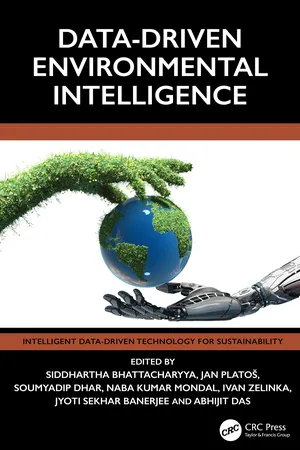
Data-Driven Environmental Intelligence
- English
- ePUB (mobile friendly)
- Available on iOS & Android
Data-Driven Environmental Intelligence
About this book
The text provides an extensive discussion on hybrid intelligent techniques and their variants for application to environmental data-centric systems, often guided by a batch process. This book reviews the fundamental concepts of gathering, processing, and analyzing data from batch processes, followed by a review of intelligent tools and techniques that can be used in this direction. The book will also cover novel intelligent algorithms for the purpose of effective environmental pollution data management at par with the existing standards.
This book:
- Introduces novel hybrid intelligent techniques needed to address environmental pollution for the well-being of the global environment
- Examines the latest hybrid intelligent technologies and algorithms related to state-of-the-art methodologies for monitoring and mitigating environmental pollution
- Introduces techniques for the removal of heavy metals, phenol, azo, and non-azo dyes from industrial effluents
- Explores green synthesis of nanofilters and their application to environmental data management
- Illustrates the statistical prediction of nanoparticle levels for controlling vector population and Internet of Things-enabled hybrid intelligent environment management
It is primarily written for senior undergraduates, graduate students, and academic researchers in the fields of electrical engineering, electrical and communications engineering, computer science and engineering, and environmental engineering.
Trusted by 375,005 students
Access to over 1 million titles for a fair monthly price.
Study more efficiently using our study tools.
Information
Table of contents
- Cover Page
- Half Title page
- Series Page
- Title Page
- Copyright Page
- Dedication
- Contents
- Preface
- About the editors
- Contributors
- Chapter 1 Data-driven environmental intelligence: Unlocking the power of data for a sustainable planet
- Chapter 2 Hybrid computational intelligence techniques for environmental hazard prediction and risk management
- Chapter 3 Microorganism image clustering based on type-2 fuzzy sets and restricted equivalent functions
- Chapter 4 Intelligent light population management
- Chapter 5 Removal of heavy metals, phenol, azo, and non-azo dyes from industrial effluents
- Chapter 6 Green synthesis of nanoparticles and their applications in various fields: Analyzing the current status in 2025
- Chapter 7 Harnessing nature’s green filter: A comprehensive review of phytoremediation for airborne pollutants
- Chapter 8 Application of regression models in pollution monitoring: Insights and implications
- Chapter 9 Preference-leveled evaluation functions in fuzzy AI systems for assessing cell abnormalities in healthcare IoT environments
- Chapter 10 IoT-enabled hybrid intelligent environmental management
- Chapter 11 AI and data-driven technologies in renewable energy systems for environmental sustainability
- Chapter 12 Decoding sustainability: A machine learning-based analysis of socioeconomic drivers in global sustainable developmental goals progress
- Chapter 13 Data-driven environmental intelligence: Concluding remarks and future directions
- Index
Frequently asked questions
- Essential is ideal for learners and professionals who enjoy exploring a wide range of subjects. Access the Essential Library with 800,000+ trusted titles and best-sellers across business, personal growth, and the humanities. Includes unlimited reading time and Standard Read Aloud voice.
- Complete: Perfect for advanced learners and researchers needing full, unrestricted access. Unlock 1.4M+ books across hundreds of subjects, including academic and specialized titles. The Complete Plan also includes advanced features like Premium Read Aloud and Research Assistant.
Please note we cannot support devices running on iOS 13 and Android 7 or earlier. Learn more about using the app