Discover how to simplify your data center architecture, reduces costs, and improve speed and agility with Cisco UCS at your sideAbout This Book• Learn how to reduce equipment and operating costs, consolidate resources, and automate data center processes• Eliminate manual, time-consuming tasks that were traditionally required to connect servers in data centers• A practical hands-on guide that will help you to deploy servers and application stacks with easeWho This Book Is ForThis book is for system, network, and storage administrators who are responsible for Cisco UCS deployments. You need to have basic knowledge of server architecture, network, and storage technologies.What You Will Learn• Set up your Lab using Cisco UCS Emulator• Configure Cisco UCS, LAN, and SAN connectivity• Create and manage Service profiles• Perform various tasks using UCS• Backup and restore Cisco UCS configuration• Test various Cisco UCS scenarios• Manage and automate multiple domainsIn DetailCisco Unified Computer System (UCS) is a powerful solution for modern data centers and is responsible for increasing efficiency and reducing costs.This hands-on guide will take you through deployment in Cisco UCS. Using real-world examples of configuring and deploying Cisco UCS components, we'll prepare you for the practical deployments of Cisco UCS data center solutions. If you want to develop and enhance your hands-on skills with Cisco UCS solutions, this book is certainly for you.We start by showing you the Cisco UCS equipment options then introduce Cisco UCS Emulator so you can learn and practice deploying Cisco UCS components. We'll also introduce you to all the areas of UCS solutions through practical configuration examples.Moving on, you'll explore the Cisco UCS Manager, which is the centralized management interface for Cisco UCS. Once you get to know UCS Manager, you'll dive deeper into configuring LAN, SAN, identity pools, resource pools, and service profiles for the servers. You'll also get hands-on with administration topics including backup, restore, user's roles, and high availability cluster configuration. Finally, you will learn about virtualized networking, third-party integration tools, and testing failure scenarios.By the end of this book, you'll know everything you need to know to rapidly grow Cisco UCS deployments in the real world.Style and approachThis hands-on book takes a tutorial-based approach to help you understand the practical methodologies and deployment of Cisco UCS components.
eBook - ePub
Implementing Cisco UCS Solutions - Second Edition
- 482 pages
- English
- ePUB (mobile friendly)
- Available on iOS & Android
eBook - ePub
Implementing Cisco UCS Solutions - Second Edition
About this book
Information
Creating and Managing Service Profiles
The Cisco UCS service profile provides the necessary platform for abstracting fundamental building blocks such as BIOS settings, firmware, storage, and networking settings for the servers. Combined with the simplified architecture and reduced infrastructure management, service profiles provide the stateless nature of Cisco UCS platforms. A service profile provides all identities and configurations to a UCS server necessary for the installation of the operating system, making the system unique on the network.
In the previous chapters, we learned about different components of UCS solutions including LAN configuration, SAN configuration, and identity and resource pools creation. These individual components provide all the resources and configurations to a blade server in the form of service profiles.
In this chapter, we'll explain the role of service profiles in the UCS platform. We'll look into creating various policies for the UCS server's configuration. We'll discuss the difference between standard and expert mode service profiles. Finally, we'll take a deep dive into creating service profiles as well as service profile templates and show the granular configuration options of each.
The list of topics that will be covered in the chapter are as follows:
- Overview of service profiles
- Different ways of creating a service profile
- Creating a service profile template
- Configuring the server BIOS policy
- Configuring the adapter policy
- Configuring the scrub policy
- Configuring the QoS policy
- Configuring the local disk policy
- Configuring IPMI
- Walking through the service profile creation-expert mode
Overview of service profiles
A service profile is the principle feature of the UCS platform that enables stateless computing. Service profiles radically improve server provisioning and troubleshooting. Servers can be provisioned in software even before the delivery of physical hardware; in case of hardware failure, it can be replaced by associating the existing software service profile of the failed server without going through any painstaking firmware upgrade procedures.
UCS Manager abstracts a service profile from the configurations available under the following categories:
- Identity and resource pools: As explained in Chapter 7, Creating Identity Resource Pools, Policies, and Templates, identity and resource pools provide silos for computing node-unique characteristics such as MAC addresses, WWNs, and UUIDs. These identities uniquely recognize systems on the network. UCS servers abstract these physical identities from software pools available from UCS Manager instead of using burned hardware identities.
- Service policies: Service policies, which will be explained later in this chapter, provide different configurations for the UCS servers including BIOS settings, firmware versions, adapter policies, scrub policies, IPMI policies, and so on.
- Templates: Templates provide the pre-configured settings that can be reused for rapid deployment of servers such as vNIC, vHBA, and service profile templates. vNIC or vHBA templates provide the customized configuration of network adapter and host bus adapter that can be recalled to create multiple interfaces for any server where a service profile template can be used to create multiple service profiles with desired identities, resource pools, and policies. A service profile combines information and features abstracted from identity and resource pools, server policies, and vNIC/vHBA templates. It is a software entity residing in UCS Manager that provides a complete server role when associated with a stateless physical hardware server. Service profile information and association is depicted in the following diagram:
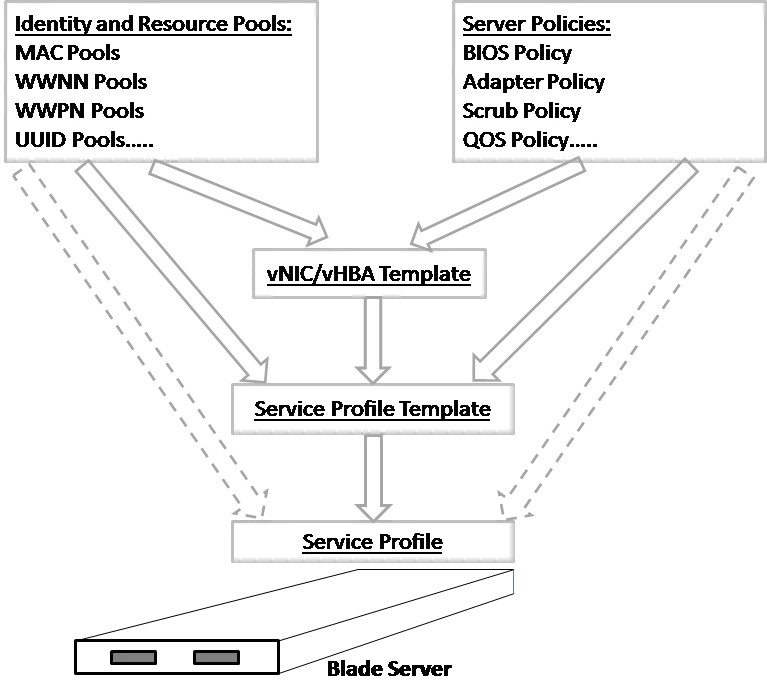
The preceding diagram shows how a service profile provides all features and identities to the physical server by extracting those identities, resources, and policies from different configurations in the form of templates, pools, and policies. It is possible t...
Table of contents
- Title Page
- Copyright
- Credits
- About the Authors
- www.PacktPub.com
- Customer Feedback
- Preface
- What's New with Cisco UCS
- Installing Cisco UCS Hardware
- Setting Up a Lab Using Cisco UCS Emulator
- Configuring Cisco UCS Using UCS Manager
- Configuring LAN Connectivity
- Configuring SAN Connectivity
- Creating Identity Resource Pools, Policies, and Templates
- Creating and Managing Service Profiles
- Managing UCS through Routine and Advanced Management
- Virtual Networking in Cisco UCS
- Configuring Backup, Restore, and High Availability
- Cisco UCS Failure Scenarios Testing
- Third-Party Application Integration
- Automation and Orchestration of Cisco UCS
Trusted by 375,005 students
Access to over 1.5 million titles for a fair monthly price.
Study more efficiently using our study tools.
Frequently asked questions
Yes, you can cancel anytime from the Subscription tab in your account settings on the Perlego website. Your subscription will stay active until the end of your current billing period. Learn how to cancel your subscription
No, books cannot be downloaded as external files, such as PDFs, for use outside of Perlego. However, you can download books within the Perlego app for offline reading on mobile or tablet. Learn how to download books offline
Perlego offers two plans: Essential and Complete
- Essential is ideal for learners and professionals who enjoy exploring a wide range of subjects. Access the Essential Library with 800,000+ trusted titles and best-sellers across business, personal growth, and the humanities. Includes unlimited reading time and Standard Read Aloud voice.
- Complete: Perfect for advanced learners and researchers needing full, unrestricted access. Unlock 1.5M+ books across hundreds of subjects, including academic and specialized titles. The Complete Plan also includes advanced features like Premium Read Aloud and Research Assistant.
We are an online textbook subscription service, where you can get access to an entire online library for less than the price of a single book per month. With over 1.5 million books across 990+ topics, we’ve got you covered! Learn about our mission
Look out for the read-aloud symbol on your next book to see if you can listen to it. The read-aloud tool reads text aloud for you, highlighting the text as it is being read. You can pause it, speed it up and slow it down. Learn more about Read Aloud
Yes! You can use the Perlego app on both iOS and Android devices to read anytime, anywhere — even offline. Perfect for commutes or when you’re on the go.
Please note we cannot support devices running on iOS 13 and Android 7 or earlier. Learn more about using the app
Please note we cannot support devices running on iOS 13 and Android 7 or earlier. Learn more about using the app
Yes, you can access Implementing Cisco UCS Solutions - Second Edition by Anuj Modi, Farhan Nadeem, Prasenjit Sarkar in PDF and/or ePUB format, as well as other popular books in Computer Science & Entreprise Applications. We have over 1.5 million books available in our catalogue for you to explore.