Unlock the complexities of machine learning algorithms in Spark to generate useful data insights through this data analysis tutorialAbout This Book• Process and analyze big data in a distributed and scalable way• Write sophisticated Spark pipelines that incorporate elaborate extraction• Build and use regression models to predict flight delays Who This Book Is ForAre you a developer with a background in machine learning and statistics who is feeling limited by the current slow and "small data" machine learning tools? Then this is the book for you! In this book, you will create scalable machine learning applications to power a modern data-driven business using Spark. We assume that you already know the machine learning concepts and algorithms and have Spark up and running (whether on a cluster or locally) and have a basic knowledge of the various libraries contained in Spark.What You Will Learn• Use Spark streams to cluster tweets online• Run the PageRank algorithm to compute user influence• Perform complex manipulation of DataFrames using Spark• Define Spark pipelines to compose individual data transformations• Utilize generated models for off-line/on-line prediction• Transfer the learning from an ensemble to a simpler Neural Network• Understand basic graph properties and important graph operations• Use GraphFrames, an extension of DataFrames to graphs, to study graphs using an elegant query language• Use K-means algorithm to cluster movie reviews datasetIn DetailThe purpose of machine learning is to build systems that learn from data. Being able to understand trends and patterns in complex data is critical to success; it is one of the key strategies to unlock growth in the challenging contemporary marketplace today. With the meteoric rise of machine learning, developers are now keen on finding out how can they make their Spark applications smarter.This book gives you access to transform data into actionable knowledge. The book commences by defining machine learning primitives by the MLlib and H2O libraries. You will learn how to use Binary classification to detect the Higgs Boson particle in the huge amount of data produced by CERN particle collider and classify daily health activities using ensemble Methods for Multi-Class Classification.Next, you will solve a typical regression problem involving flight delay predictions and write sophisticated Spark pipelines. You will analyze Twitter data with help of the doc2vec algorithm and K-means clustering. Finally, you will build different pattern mining models using MLlib, perform complex manipulation of DataFrames using Spark and Spark SQL, and deploy your app in a Spark streaming environment.Style and approachThis book takes a practical approach to help you get to grips with using Spark for analytics and to implement machine learning algorithms. We'll teach you about advanced applications of machine learning through illustrative examples. These examples will equip you to harness the potential of machine learning, through Spark, in a variety of enterprise-grade systems.
- 323 pages
- English
- ePUB (mobile friendly)
- Available on iOS & Android
eBook - ePub
Mastering Machine Learning with Spark 2.x
About this book
Information
Graph Analytics with GraphX
In our interconnected world, graphs are omnipresent. The World Wide Web (WWW) is just one example of a complex structure that we can consider a graph, in which web pages represent entities that are connected by incoming and outgoing links between them. In Facebook’s social graph, many millions of users form a network, connecting friends around the globe. Many other important structures that we see and can collect data for today come equipped with a natural graph structure; that is, they can, at a very basic level, be understood as a collection of vertices that are connected to each other in a certain way by what we call edges. Stated in this generality, this observation reflects how ubiquitous graphs are. What makes it valuable is that the graphs are well-studied structures and that there are many algorithms available that allow us to gain important insights about what these graphs represent.
Spark’s GraphX library is a natural entry point to study graphs at scale. Leveraging RDDs from the Spark core to encode vertices and edges, we can do graph analytics on vast amounts of data with GraphX. To give an overview, you will learn about the following topics in this chapter:
- Basic graph properties and important graph operations
- How GraphX represents property graphs and how to work with them
- Loading graph data in various ways and generating synthetic graph data to experiment with
- Essential graph properties by using GraphX’s core engine
- Visualizing graphs with an open source tool called Gephi
- Implementing efficient graph-parallel algorithms using two of GraphX’s key APIs.
- Using GraphFrames, an extension of DataFrames to graphs, and studying graphs using an elegant query language
- Running important graph algorithms available in GraphX on a social graph, consisting of retweets and a graph of actors appearing in movies together
Basic graph theory
Before diving into Spark GraphX and its applications, we will first define graphs on a basic level and explain what properties they may come with and what structures are worth studying in our context. Along the way of introducing these properties, we will give more concrete examples of graphs that we consider in everyday life.
Graphs
To formalize the notion of a graph briefly sketched in the introduction, on a purely mathematical level, a graph G = (V, E) can be described as a pair of vertices V and edges E, as follows:
V = {v1, ..., vn}
E = {e1, ..., em}
We call the element vi in V a vertex and ei in E an edge, where each edge connecting two vertices v1 and v2 is, in fact, just a pair of vertices, that is, ei = (v1, v2). Let's construct a simple graph consisting of five vertices and six edges, as specified by the following graph data:
V ={v1, v2, v3, v4, v5}
E = {e1 = (v1, v2), e2 = (v1, v3), e3 = (v2, v3),
e4 = (v3, v4), e5 = (v4, v1), e6 = (v4, v5)}
This is what the graph will look like:
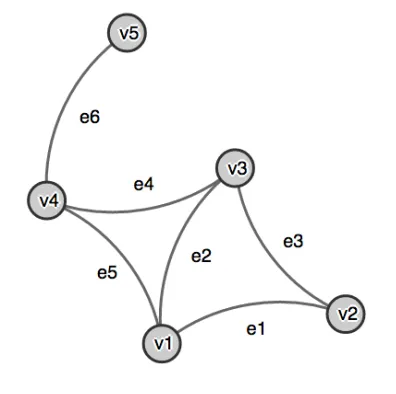
Figure 1: A simple undirected graph with five vertices and six edges
Note that in the realization of the graph in Figure 1, the relative position of nodes to each other, the length of the edges, and other visual properties are inessential to the graph. In fact, we could have displayed the graph in any other way by means of deforming it. The graph definition entirely determines its topology.
Directed and undirected graphs
In a pair of vertices that make up an edge e, by convention, we call the first vertex the source and the second one the target. The natural interpretation here is that the connection represented by edge e has a direction; it flows from the source to the target. Note that in Figure 1, the graph displayed is undirected; that is, we did not distinguish between the source and target.
Using the exact same definition, we can create a directed version of our graph, as shown in the following image. Note that the graph looks slightly different in the way it is presented, but the connections of vertices and edges remain unchanged:
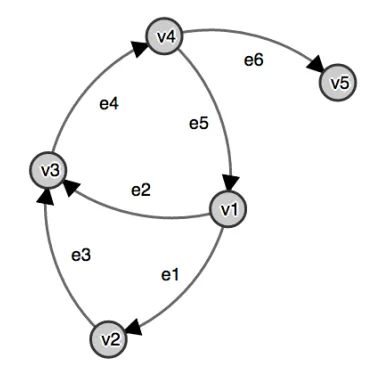
Figure 2: A directed graph with the same topology as the previous one. In fact, forgetting edge directions would yield the same graph as in Figure 1
Each directed graph naturally has an associated undirected graph, realized by simply forgetting all the edge directions. From a practical perspective, most implementations of graphs inherently build on directed edges and suppress the additional information of direction whenever needed. To give an example, think of the preceding graph as a group of five people connected by the relationship, friendship. We may argue that friendship is a symmetric property in that if you are a friend of mine, I am also a friend of yours. With this interpretation, directionality is not a very useful concept in this example, so we are, in fact, better off to treat this as an undirected graph example. In contrast, if we were to run a social network that allows users to actively send friend requests to other users, a directed graph might be better to encode this information.
Order and degree
For any graph, directed or not, we can read off some basic properties that are of interest later in the chapter. We call the number of vertices |V| the order of the graph and the number of edges |E| its degree, sometimes also referred to as its valency. The degree of a vertex is the number of edges that have this vertex as either source or target. In the case of directed graphs and a given vertex v, we can additionally distinguish between in-degree, that is, the sum of all the edges pointing towards v, and out-degree, that is, the sum of all the edges starting at v. To give an example of this, the undirected graph in Figure 1 has order 5 and degree 6, same as the directed graph shown in Figure 2. In the latter, vertex v1 has out-degree 2 and in-degree 1, while v5 has out-degree 0 and in-degree 1.
In the last two examples, we annotated the vertices and edges with their respective identifiers, as specified by the definition G = (V, E). For most graph visualizations that follow, we will assume that the identity of vertices and edges is implicitly known and will instead represent them by labeling our graphs with additional information. The reason we make this explicit distinction between identifiers and labels is that GraphX identifiers can’t be strings, as we will see in the next section. An example of a labeled graph with relationships of a group of people is shown in the following diagram:
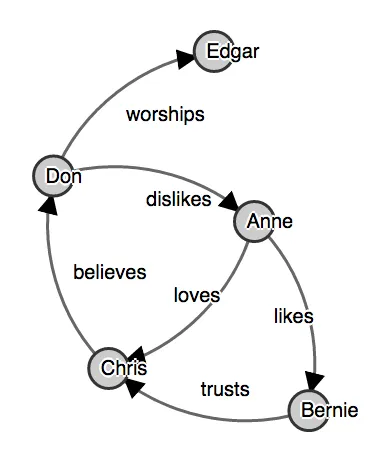
Figure 3: A directed labelled graph showing a group of people and their relationships
Directed acyclic graphs
The next notion we want to discuss is that of acyclicity. A cyclic graph is one in which there is at least one vertex for which there is a path through the graph, connecting this vertex to itself. We call such a path a cycle. In an undirected graph, any chain creating a cycle will do, while in a directed graph, we o...
Table of contents
- Title Page
- Copyright
- Credits
- About the Authors
- About the Reviewer
- www.PacktPub.com
- Customer Feedback
- Preface
- Introduction to Large-Scale Machine Learning and Spark
- Detecting Dark Matter - The Higgs-Boson Particle
- Ensemble Methods for Multi-Class Classification
- Predicting Movie Reviews Using NLP and Spark Streaming
- Word2vec for Prediction and Clustering
- Extracting Patterns from Clickstream Data
- Graph Analytics with GraphX
- Lending Club Loan Prediction
Trusted by 375,005 students
Access to over 1.5 million titles for a fair monthly price.
Study more efficiently using our study tools.
Frequently asked questions
Yes, you can cancel anytime from the Subscription tab in your account settings on the Perlego website. Your subscription will stay active until the end of your current billing period. Learn how to cancel your subscription
No, books cannot be downloaded as external files, such as PDFs, for use outside of Perlego. However, you can download books within the Perlego app for offline reading on mobile or tablet. Learn how to download books offline
Perlego offers two plans: Essential and Complete
- Essential is ideal for learners and professionals who enjoy exploring a wide range of subjects. Access the Essential Library with 800,000+ trusted titles and best-sellers across business, personal growth, and the humanities. Includes unlimited reading time and Standard Read Aloud voice.
- Complete: Perfect for advanced learners and researchers needing full, unrestricted access. Unlock 1.5M+ books across hundreds of subjects, including academic and specialized titles. The Complete Plan also includes advanced features like Premium Read Aloud and Research Assistant.
We are an online textbook subscription service, where you can get access to an entire online library for less than the price of a single book per month. With over 1.5 million books across 990+ topics, we’ve got you covered! Learn about our mission
Look out for the read-aloud symbol on your next book to see if you can listen to it. The read-aloud tool reads text aloud for you, highlighting the text as it is being read. You can pause it, speed it up and slow it down. Learn more about Read Aloud
Yes! You can use the Perlego app on both iOS and Android devices to read anytime, anywhere — even offline. Perfect for commutes or when you’re on the go.
Please note we cannot support devices running on iOS 13 and Android 7 or earlier. Learn more about using the app
Please note we cannot support devices running on iOS 13 and Android 7 or earlier. Learn more about using the app
Yes, you can access Mastering Machine Learning with Spark 2.x by Alex Tellez, Max Pumperla, Michal Malohlava in PDF and/or ePUB format, as well as other popular books in Computer Science & Data Mining. We have over 1.5 million books available in our catalogue for you to explore.