Focusing on a corpus of fantasy texts written in colonial India during the late 19th and early 20th century, this book explores the origins, motivations, nature, and role of fantasy and speculative writing during a period of tremendous social and political churning.
Taking stock of Bengali texts often marginalized as children's literature or deemed unworthy of serious critical attention, Mayurika Chakravorty examines the works of authors such as Sanjibchandra Chattopadhyay, Trailokyanath Mukhopadhyay, Parashuram (Rajshekhar Basu), Abanindranath Tagore, and Sukumar Ray to shed light on how their writing offered stringent commentaries on the colonial situation whilst grappling with larger questions around science, progress, environment, social hierarchies, ethics, and morality.
With a focus on how key authors and their works-largely omitted from the established canon-were influenced by diverse cultural streams from European, Persian, classical Sanskrit, and local folk traditions, Fantasy and the Politics of Subversion explores how these texts challenged dominant tropes and conventions while subverting authority, both literary and political.
In highlighting overlooked writing within Indian literary history, fantasy and children's literature studies, Chakravorty demonstrates that, in understanding these works in relation to one another, they provide evidence of compelling bodies of work produced in the context of, and in resistance to, the empire.
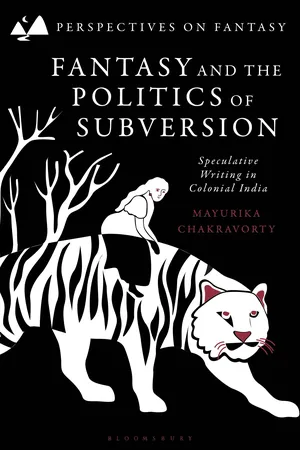
eBook - PDF
Fantasy and the Politics of Subversion
Speculative Writing in Colonial India
- 249 pages
- English
- PDF
- Available on iOS & Android
eBook - PDF
About this book
Information
Table of contents
- Cover
- Contents
- List of illustrations
- Acknowledgements
- A note on translation, transliteration, names and references
- 1 Introduction: A fairy way of writing
- 2 Resisting disenchantment: Imagination, cultural endurance and rise of the novel in nineteenth-century Bengal
- 3 An unorthodox romantic: Rebellion, whimsy and unreason in Sanjibchandra Chattopadhyay’s Kanthamala, Madhabilata and other writings
- 4 Of fever, delirium and fantastic sojourn: A study of Trailokyanath Mukhopadhyay’s Kankabati (1892) and other stories
- 5 The logic of nonsense: The enchanted realm of Sukumar Ray’s Ha-Ja-Ba-Ra-La (1922) and other writings
- 6 Chemistry of the intellect: Satire, fantasy and subversion in the fictional works of Parashuram (1880–1960)
- Epilogue
- Appendix
- Bibliography
- Index
Trusted by 375,005 students
Access to over 1.5 million titles for a fair monthly price.
Study more efficiently using our study tools.
Frequently asked questions
Yes, you can cancel anytime from the Subscription tab in your account settings on the Perlego website. Your subscription will stay active until the end of your current billing period. Learn how to cancel your subscription
No, books cannot be downloaded as external files, such as PDFs, for use outside of Perlego. However, you can download books within the Perlego app for offline reading on mobile or tablet. Learn how to download books offline
Perlego offers two plans: Essential and Complete
- Essential is ideal for learners and professionals who enjoy exploring a wide range of subjects. Access the Essential Library with 800,000+ trusted titles and best-sellers across business, personal growth, and the humanities. Includes unlimited reading time and Standard Read Aloud voice.
- Complete: Perfect for advanced learners and researchers needing full, unrestricted access. Unlock 1.5M+ books across hundreds of subjects, including academic and specialized titles. The Complete Plan also includes advanced features like Premium Read Aloud and Research Assistant.
We are an online textbook subscription service, where you can get access to an entire online library for less than the price of a single book per month. With over 1.5 million books across 990+ topics, we’ve got you covered! Learn about our mission
Look out for the read-aloud symbol on your next book to see if you can listen to it. The read-aloud tool reads text aloud for you, highlighting the text as it is being read. You can pause it, speed it up and slow it down. Learn more about Read Aloud
Yes! You can use the Perlego app on both iOS and Android devices to read anytime, anywhere — even offline. Perfect for commutes or when you’re on the go.
Please note we cannot support devices running on iOS 13 and Android 7 or earlier. Learn more about using the app
Please note we cannot support devices running on iOS 13 and Android 7 or earlier. Learn more about using the app
Yes, you can access Fantasy and the Politics of Subversion by Mayurika Chakravorty in PDF and/or ePUB format, as well as other popular books in Literature & Asian Literary Criticism. We have over 1.5 million books available in our catalogue for you to explore.