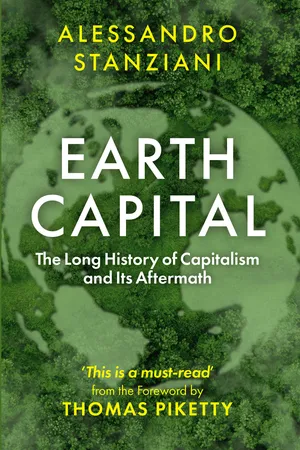
This book is a major new history of capitalism that takes account of the material and ecological underpinnings of productive activity as well as the social, political and institutional dimensions of economic life. It retraces the history of capitalism over a long time period, giving particular attention to the role of food, agriculture, energy and natural resources, and with an eye to the future, mindful of the need to find solutions to an ecological crisis that threatens to overwhelm us all.
Alessandro Stanziani shows that the development of capitalism since the twelfth century has been based on two primary forms of exploitation: of labour, often coerced, and of what he calls 'Earth capital', by which he means both the planet as a whole and its land and natural resources as factors of production. While these two forms of exploitation have gone hand-in-hand, the emphasis has shifted over time: forced labour gradually declined in importance from 1870 to the present, the exploitation of land, fossil fuels and natural resources grew at an unprecedented rate from 1870 to precedented rate, the destructive consequences of which are becoming increasingly apparent today.
Looking to the future, Stanziani argues that, in order to deal with the immense challenges we now face, we must be prepared radically to rethink our economic and political systems. He proposes a new social contract that would make democracy, social equality and the environment the three pillars of the world of tomorrow.
- English
- ePUB (mobile friendly)
- Available on iOS & Android
eBook - ePub
About this book
Trusted by 375,005 students
Access to over 1.5 million titles for a fair monthly price.
Study more efficiently using our study tools.
Table of contents
- Cover
- Table of Contents
- Dedication
- Title Page
- Copyright Page
- Graphs and Tables
- Foreword by Thomas Piketty: Earth Capital: Long Live Eco-History!
- Introduction
- Part I: Green Growth and Forced Labour, 12th–19th Century
- 1 Indispensable Labour, Forced Labour
- 2 Energy Resources in Preindustrial Economies
- 3 Crops and Material Culture
- 4 A Dangerous Mix: Environment, Institutions and Inequality
- Conclusion: Why Europe? The Power of Violence and Constraint
- Part II: The Productivist Regime and the Great Acceleration, 1870–1970
- 5 The Age of Capital
- 6 Seeds, Plants and Genetics
- 7 Transmissible Diseases and Food: Meat
- 8 Capital, Neocolonialism and Famine
- Conclusion
- Part III: From the 1970s to 2050: High Globalization, Collapse and Tomorrow’s World
- 9 Neoliberalism and the Euphoria of Speculation
- 10 Hunting for Seed Varieties vs. Genetic Selection
- 11 Towards the World of Tomorrow
- Conclusion: Just Institutions vs. Just Societies
- Index
- End User License Agreement
Frequently asked questions
Yes, you can cancel anytime from the Subscription tab in your account settings on the Perlego website. Your subscription will stay active until the end of your current billing period. Learn how to cancel your subscription
No, books cannot be downloaded as external files, such as PDFs, for use outside of Perlego. However, you can download books within the Perlego app for offline reading on mobile or tablet. Learn how to download books offline
Perlego offers two plans: Essential and Complete
- Essential is ideal for learners and professionals who enjoy exploring a wide range of subjects. Access the Essential Library with 800,000+ trusted titles and best-sellers across business, personal growth, and the humanities. Includes unlimited reading time and Standard Read Aloud voice.
- Complete: Perfect for advanced learners and researchers needing full, unrestricted access. Unlock 1.5M+ books across hundreds of subjects, including academic and specialized titles. The Complete Plan also includes advanced features like Premium Read Aloud and Research Assistant.
We are an online textbook subscription service, where you can get access to an entire online library for less than the price of a single book per month. With over 1.5 million books across 990+ topics, we’ve got you covered! Learn about our mission
Look out for the read-aloud symbol on your next book to see if you can listen to it. The read-aloud tool reads text aloud for you, highlighting the text as it is being read. You can pause it, speed it up and slow it down. Learn more about Read Aloud
Yes! You can use the Perlego app on both iOS and Android devices to read anytime, anywhere — even offline. Perfect for commutes or when you’re on the go.
Please note we cannot support devices running on iOS 13 and Android 7 or earlier. Learn more about using the app
Please note we cannot support devices running on iOS 13 and Android 7 or earlier. Learn more about using the app
Yes, you can access Earth Capital by Alessandro Stanziani in PDF and/or ePUB format, as well as other popular books in History & Modern History. We have over 1.5 million books available in our catalogue for you to explore.