Timothy D. Grundmeier's Lutheranism and American Culture examines the transformation of the nation's third-largest Protestant denomination over the course of the nineteenth century. In the antebellum era, leading voices within the church believed that the best way to become American was by modifying certain historic doctrines deemed too Catholic and cooperating with Anglo-evangelicals in revivalism and social reform. However, by the mid-1870s, most Lutherans had rejected this view. Though they remained proudly American, most embraced a religious identity characterized by a commitment to their church's confessions, isolation from other Christians, and a conservative outlook on political and social issues.
Grundmeier shows that this transformation did not happen in a vacuum. Throughout the Civil War and early years of Reconstruction, disputes over slavery and politics led to quarrels about theology and church affairs. During the war and immediately after, the Lutheran church in the United States experienced two major schisms, both driven by clashing views on the national conflict. In the postbellum years, Lutherans adopted increasingly conservative positions in theology and politics, mainly in reaction to the perceived "radicalism" of the era. By the final decades of the nineteenth century, Lutherans had established a rigorously conservative and definitively American form of the faith, distinct from their coreligionists in Europe and other Protestants in the United States.
Although Grundmeier focuses on a single religious tradition, his study has implications for several areas of Civil War scholarship. First, it demonstrates how the Lutheran experience diverged from that of other Protestant groups, thereby expanding our understanding of how American Christians responded to the era's crises, including slavery, sectionalism, and national identity. In addition, his work reinforces and extends many of the findings in other historical fields: the political culture of the Mid-Atlantic and Midwest, the views of German and Scandinavian immigrants, and the various forms of conservatism among white northerners. Grundmeier's most significant contribution, however, is examining a previously unexplored subject. In the vast corpus of works on the Civil War era and American religious history, scholars have almost entirely overlooked the views and experiences of Lutherans. Lutheranism and American Culture seeks to remedy that neglect and serve as the starting point for understanding the formative decades of this distinctive faith.
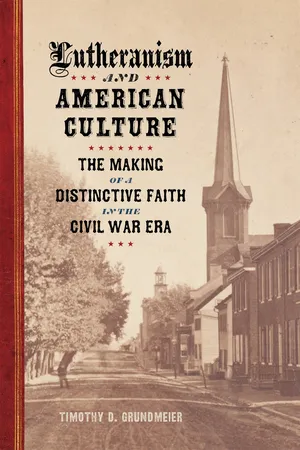
eBook - ePub
Lutheranism and American Culture
The Making of a Distinctive Faith in the Civil War Era
- English
- ePUB (mobile friendly)
- Available on iOS & Android
eBook - ePub
Lutheranism and American Culture
The Making of a Distinctive Faith in the Civil War Era
About this book
Information
Topic
Theology & ReligionSubtopic
American Civil War HistoryTable of contents
- Cover
- Title Page
- Copyright Page
- Dedication
- Contents
- ACKNOWLEDGMENTS
- Introduction
- ONE * Three American Lutheranisms, 1830–1850
- TWO * The Crises of the 1850s
- THREE * Lutherans and the Union, 1860–1863
- FOUR * The Lutheran Civil War, 1863–1866
- FIVE * Conservative Reconstruction, 1866–1872
- SIX * The Triumph of Confessional Conservatism, 1872–1900
- Epilogue
- GLOSSARY
- APPENDIX: STATISTICAL TABLES
- NOTES
- BIBLIOGRAPHY
- INDEX
Trusted by 375,005 students
Access to over 1.5 million titles for a fair monthly price.
Study more efficiently using our study tools.
Frequently asked questions
Yes, you can cancel anytime from the Subscription tab in your account settings on the Perlego website. Your subscription will stay active until the end of your current billing period. Learn how to cancel your subscription
No, books cannot be downloaded as external files, such as PDFs, for use outside of Perlego. However, you can download books within the Perlego app for offline reading on mobile or tablet. Learn how to download books offline
Perlego offers two plans: Essential and Complete
- Essential is ideal for learners and professionals who enjoy exploring a wide range of subjects. Access the Essential Library with 800,000+ trusted titles and best-sellers across business, personal growth, and the humanities. Includes unlimited reading time and Standard Read Aloud voice.
- Complete: Perfect for advanced learners and researchers needing full, unrestricted access. Unlock 1.5M+ books across hundreds of subjects, including academic and specialized titles. The Complete Plan also includes advanced features like Premium Read Aloud and Research Assistant.
We are an online textbook subscription service, where you can get access to an entire online library for less than the price of a single book per month. With over 1.5 million books across 990+ topics, we’ve got you covered! Learn about our mission
Look out for the read-aloud symbol on your next book to see if you can listen to it. The read-aloud tool reads text aloud for you, highlighting the text as it is being read. You can pause it, speed it up and slow it down. Learn more about Read Aloud
Yes! You can use the Perlego app on both iOS and Android devices to read anytime, anywhere — even offline. Perfect for commutes or when you’re on the go.
Please note we cannot support devices running on iOS 13 and Android 7 or earlier. Learn more about using the app
Please note we cannot support devices running on iOS 13 and Android 7 or earlier. Learn more about using the app
Yes, you can access Lutheranism and American Culture by Timothy D. Grundmeier, T. Michael Parrish in PDF and/or ePUB format, as well as other popular books in Theology & Religion & American Civil War History. We have over 1.5 million books available in our catalogue for you to explore.