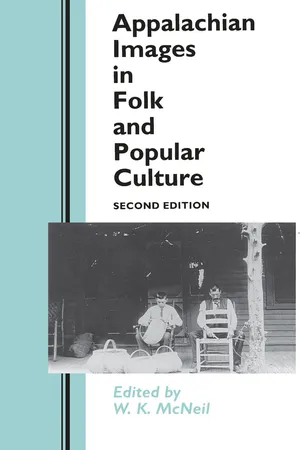
Appalachian Images in Folk and Popular Culture
eBook - ePub

Appalachian Images in Folk and Popular Culture

  1. English
  2. ePUB (mobile friendly)
  3. Available on iOS & Android
eBook - ePub

Appalachian Images in Folk and Popular Culture

About this book

In this second edition of his valuable anthology, W. K. McNeil presents an updated compilation of articles and essays from the last 130 years that illuminate the character and spirit of Appalachian culture and show how attitudes toward the region have evolved.

The essays cover a diverse and eclectic range of topics—from moonshining to Kentucky feuds, from mountain handicrafts to changing dietary habits, from shingle making to serpent handling. The articles are organized according to four major periods in the awareness of Appalachian culture. Between the years 1860 and 1899, the region was “discovered” as a “strange land” populated by a “peculiar people.” From 1900 to 1930, the published perceptions of Appalachia not only emphasized its distinctiveness but defined its culture as largely Elizabethan. From 1930 to 1950, essayists began discussing the manner in which the region’s inhabitants were forsaking their “Elizabethan ways” and adopting those of modern civilization. In the most recent period, observers not only have described aspects of folklife but have considered the ways in which they function in Appalachian society.

In addition to a new introduction and editorial commentary by McNeil, this edition includes for the first time an article by media scholar Horace Newcomb, who examines the cultural ramifications of “Appalachian” television programs, including The Beverly Hillbillies and The Waltons.

Frequently asked questions

Yes, you can cancel anytime from the Subscription tab in your account settings on the Perlego website. Your subscription will stay active until the end of your current billing period. Learn how to cancel your subscription.
No, books cannot be downloaded as external files, such as PDFs, for use outside of Perlego. However, you can download books within the Perlego app for offline reading on mobile or tablet. Learn more here.
Perlego offers two plans: Essential and Complete
  • Essential is ideal for learners and professionals who enjoy exploring a wide range of subjects. Access the Essential Library with 800,000+ trusted titles and best-sellers across business, personal growth, and the humanities. Includes unlimited reading time and Standard Read Aloud voice.
  • Complete: Perfect for advanced learners and researchers needing full, unrestricted access. Unlock 1.4M+ books across hundreds of subjects, including academic and specialized titles. The Complete Plan also includes advanced features like Premium Read Aloud and Research Assistant.
Both plans are available with monthly, semester, or annual billing cycles.
We are an online textbook subscription service, where you can get access to an entire online library for less than the price of a single book per month. With over 1 million books across 1000+ topics, we’ve got you covered! Learn more here.
Look out for the read-aloud symbol on your next book to see if you can listen to it. The read-aloud tool reads text aloud for you, highlighting the text as it is being read. You can pause it, speed it up and slow it down. Learn more here.
Yes! You can use the Perlego app on both iOS or Android devices to read anytime, anywhere — even offline. Perfect for commutes or when you’re on the go.
Please note we cannot support devices running on iOS 13 and Android 7 or earlier. Learn more about using the app.
Yes, you can access Appalachian Images in Folk and Popular Culture by W.K. Mcneil in PDF and/or ePUB format, as well as other popular books in History & North American History. We have over one million books available in our catalogue for you to explore.

Table of contents

  1. Cover
  2. Title Page
  3. Copyright Page
  4. Dedication
  5. Contents
  6. Foreword
  7. Acknowledgments
  8. Introduction to the Second Edition
  9. Introduction
  10. Part I. A Strange Land and a Peculiar People
  11. Part II. Our Contemporary Ancestors
  12. Part III. Change Comes to the Appalachian Mountaineer
  13. Part IV. Rethinking Usages: The Age of Functional Studies
  14. Index