eBook - ePub
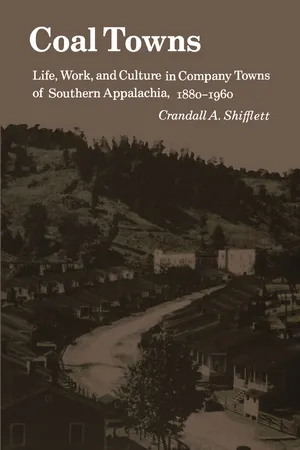
Coal Towns
Life, Work, and Culture in Company Towns of Southern Appalachia, 1880–1960
- English
- ePUB (mobile friendly)
- Available on iOS & Android
eBook - ePub
Coal Towns
Life, Work, and Culture in Company Towns of Southern Appalachia, 1880–1960
About this book
Using oral histories, company records, and census data, Crandall A. Shifflett paints a vivid portrait of miners and their families in southern Appalachian coal towns from the late nineteenth into the mid-twentieth century. He finds that, compared to their earlier lives on subsistence farms, coal-town life was not all bad. Shifflett examines how this view, quite common among the oral histories of these working families, has been obscured by the middle-class biases of government studies and the Edenic myth of preindustrial Appalachia propagated by some historians.
From their own point of view, mining families left behind a life of hard labor and drafty weatherboard homes. With little time for such celebrated arts as tale-telling and quilting, preindustrial mountain people strung more beans than dulcimers. In addition, the rural population was growing, and farmland was becoming scarce. What the families recall about the coal towns contradicts the popular image of mining life. Most miners did not owe their souls to the company store, and most mining companies were not unusually harsh taskmasters. Former miners and their families remember such company benefits as indoor plumbing, regular income, and leisure activities. They also recall the United Mine Workers of America as bringing not only pay raises and health benefits but work stoppages and violent confrontations.
Far from being mere victims of historical forces, miners and their families shaped their own destiny by forging a new working-class culture out of the adaptation of their rural values to the demands of industrial life. This new culture had many continuities with the older one. Out of the closely knit social ties they brought from farming communities, mining families created their own safety net for times of economic downturn. Shifflett recognizes the dangers and hardships of coal-town life but also shows the resilience of Appalachian people in adapting their culture to a new environment.
Crandall A. Shifflett is an associate professor of history at Virginia Polytechnic Institute and State University.
From their own point of view, mining families left behind a life of hard labor and drafty weatherboard homes. With little time for such celebrated arts as tale-telling and quilting, preindustrial mountain people strung more beans than dulcimers. In addition, the rural population was growing, and farmland was becoming scarce. What the families recall about the coal towns contradicts the popular image of mining life. Most miners did not owe their souls to the company store, and most mining companies were not unusually harsh taskmasters. Former miners and their families remember such company benefits as indoor plumbing, regular income, and leisure activities. They also recall the United Mine Workers of America as bringing not only pay raises and health benefits but work stoppages and violent confrontations.
Far from being mere victims of historical forces, miners and their families shaped their own destiny by forging a new working-class culture out of the adaptation of their rural values to the demands of industrial life. This new culture had many continuities with the older one. Out of the closely knit social ties they brought from farming communities, mining families created their own safety net for times of economic downturn. Shifflett recognizes the dangers and hardships of coal-town life but also shows the resilience of Appalachian people in adapting their culture to a new environment.
Crandall A. Shifflett is an associate professor of history at Virginia Polytechnic Institute and State University.
Frequently asked questions
Yes, you can cancel anytime from the Subscription tab in your account settings on the Perlego website. Your subscription will stay active until the end of your current billing period. Learn how to cancel your subscription.
No, books cannot be downloaded as external files, such as PDFs, for use outside of Perlego. However, you can download books within the Perlego app for offline reading on mobile or tablet. Learn more here.
Perlego offers two plans: Essential and Complete
- Essential is ideal for learners and professionals who enjoy exploring a wide range of subjects. Access the Essential Library with 800,000+ trusted titles and best-sellers across business, personal growth, and the humanities. Includes unlimited reading time and Standard Read Aloud voice.
- Complete: Perfect for advanced learners and researchers needing full, unrestricted access. Unlock 1.4M+ books across hundreds of subjects, including academic and specialized titles. The Complete Plan also includes advanced features like Premium Read Aloud and Research Assistant.
We are an online textbook subscription service, where you can get access to an entire online library for less than the price of a single book per month. With over 1 million books across 1000+ topics, we’ve got you covered! Learn more here.
Look out for the read-aloud symbol on your next book to see if you can listen to it. The read-aloud tool reads text aloud for you, highlighting the text as it is being read. You can pause it, speed it up and slow it down. Learn more here.
Yes! You can use the Perlego app on both iOS or Android devices to read anytime, anywhere — even offline. Perfect for commutes or when you’re on the go.
Please note we cannot support devices running on iOS 13 and Android 7 or earlier. Learn more about using the app.
Yes, you can access Coal Towns by Crandall A. Shifflett in PDF and/or ePUB format, as well as other popular books in History & Natural Resource Extraction Industry. We have over one million books available in our catalogue for you to explore.
Information
Table of contents
- Cover
- Title Page
- Copyright Page
- Dedication
- Contents
- Illustrations
- Preface
- Acknowledgments
- Introduction
- Part 1. Finding Work
- Part 2. Town-Building and Labor Recruitment, 1880–1930
- Part 3. Work, Culture, and Society
- Part 4. Mining Communities