- English
- ePUB (mobile friendly)
- Available on iOS & Android
About this book
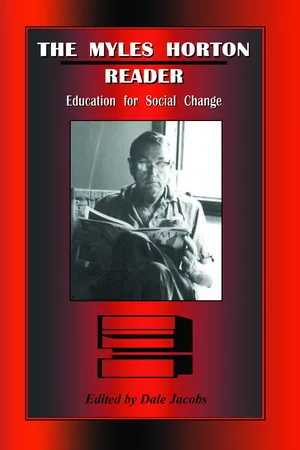
Cornel West has called Myles Horton "an indescribably courageous and visionary white brother from Tennessee." Horton (1905-1990) cofounded the Highlander Folk School (now known as the Highlander Research and Education Center), an institution controversial from its beginnings.
During the early labor movement, the Highlander School sponsored programs for both union organizers and rank-and-file members; the staff of Highlander saw education as a way to approach and work through problems. Issues of race were always important to the school, which became a beacon for the civil rights movement; its summer institutes included such influential participants as Rosa parks, Martin Luther King, Jr., and Andrew Young.
His commitment to education as an agent of social change allowed Horton to see himself as both a teacher and a student, as one who could learn from others as well as help others learn. The Myles Horton Reader presents essays, speeches, and interviews, giving the reader a grounding in the pathbreaking work of an extraordinary man.
Frequently asked questions
- Essential is ideal for learners and professionals who enjoy exploring a wide range of subjects. Access the Essential Library with 800,000+ trusted titles and best-sellers across business, personal growth, and the humanities. Includes unlimited reading time and Standard Read Aloud voice.
- Complete: Perfect for advanced learners and researchers needing full, unrestricted access. Unlock 1.4M+ books across hundreds of subjects, including academic and specialized titles. The Complete Plan also includes advanced features like Premium Read Aloud and Research Assistant.
Please note we cannot support devices running on iOS 13 and Android 7 or earlier. Learn more about using the app.
Information
Table of contents
- Cover Page
- Halftitle Page
- Title Page
- Copyright Page
- Contents
- Illustrations
- Acknowledgments
- Introduction
- I. The Idea of Highlander
- II. The Labor Movement
- Illustrations
- III. The Civil Rights Movement
- IV. Educational Philosophy
- Notes
- Work Cited
- Index of Doctor To The Front