- English
- ePUB (mobile friendly)
- Available on iOS & Android
eBook - ePub
About this book
"Filled with perceptive observations about military leaders, morale in the Confederacy, life in the Southern capital of Richmond, and a range of medical topics including the treatment of wounded, . . . Confederate surgeon Thomas Fanning Wood’s wartime letters and postwar reminiscences constitute a fine addition to the roster of published firsthand testimony about the Civil War."—Gary W. Gallagher
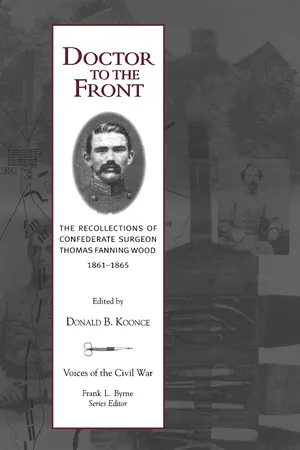
The Civil War was a tragic conflict that destroyed many lives, but for those trying to save lives the tragedy was often compounded. Military doctors labored through the smoke of battle where impossible conditions and fear of infection often forced them to resort to amputation, and most operations were performed without painkillers. Thomas Fanning Wood recorded his wartime experiences as a Confederate Army surgeon, and his recollections of those events allow us to hear a distinct voice of the Civil War.
As a young soldier recovering from fever at a Richmond hospital, Wood developed an interest in medicine that was encouraged by a doctor who steered him toward medical training. After only eight months of study he was made an assistant surgeon in the Third North Carolina Regiment. His narrative—drawn from his memoirs, letters from the front, and articles written for his hometown newspaper—presents a poignant and sometimes horrifying picture of what the Civil War physician had to face both under battlefield conditions and in urban hospitals.
Wood himself spent much of his time at the front, and his vivid narrative describes both a doctor’s daily activities and the campaigns he witnessed. He was present at many of the war’s major engagements: he was near Stonewall Jackson when the general fell at Chancellorsville, manned a field dressing station at the foot of Culp’s Hill at Gettysburg, and was one of the few survivors of the Union attack on the "mule shoe" at Spotsylvania when his entire division was wiped out. Wood’s account also lends new insight into Jubal Early’s 1864 campaigns in the Shenandoah Valley and against Washington.
With its observations of medical care and training not found in standard histories of the war—including a description of the examination required to become an assistant surgeon—Doctor to the Front offers a unique human perspective on the Civil War. With their additional descriptions of key figures and events, Wood’s recollections combine historical significance and human interest to show us another side of that terrible conflict.
The Author: Donald B. Koonce is the great-grandson of Thomas Fanning Wood and has served on the Board of Directors of the South Carolina Historical Society and the Historic Greenville Foundation. He is president of the Koonce Group, Inc., an award-winning communications company whose productions include Daybreak at the Cowpens, a documentary for the National Park Service.
The Civil War was a tragic conflict that destroyed many lives, but for those trying to save lives the tragedy was often compounded. Military doctors labored through the smoke of battle where impossible conditions and fear of infection often forced them to resort to amputation, and most operations were performed without painkillers. Thomas Fanning Wood recorded his wartime experiences as a Confederate Army surgeon, and his recollections of those events allow us to hear a distinct voice of the Civil War.
As a young soldier recovering from fever at a Richmond hospital, Wood developed an interest in medicine that was encouraged by a doctor who steered him toward medical training. After only eight months of study he was made an assistant surgeon in the Third North Carolina Regiment. His narrative—drawn from his memoirs, letters from the front, and articles written for his hometown newspaper—presents a poignant and sometimes horrifying picture of what the Civil War physician had to face both under battlefield conditions and in urban hospitals.
Wood himself spent much of his time at the front, and his vivid narrative describes both a doctor’s daily activities and the campaigns he witnessed. He was present at many of the war’s major engagements: he was near Stonewall Jackson when the general fell at Chancellorsville, manned a field dressing station at the foot of Culp’s Hill at Gettysburg, and was one of the few survivors of the Union attack on the "mule shoe" at Spotsylvania when his entire division was wiped out. Wood’s account also lends new insight into Jubal Early’s 1864 campaigns in the Shenandoah Valley and against Washington.
With its observations of medical care and training not found in standard histories of the war—including a description of the examination required to become an assistant surgeon—Doctor to the Front offers a unique human perspective on the Civil War. With their additional descriptions of key figures and events, Wood’s recollections combine historical significance and human interest to show us another side of that terrible conflict.
The Author: Donald B. Koonce is the great-grandson of Thomas Fanning Wood and has served on the Board of Directors of the South Carolina Historical Society and the Historic Greenville Foundation. He is president of the Koonce Group, Inc., an award-winning communications company whose productions include Daybreak at the Cowpens, a documentary for the National Park Service.
Frequently asked questions
Yes, you can cancel anytime from the Subscription tab in your account settings on the Perlego website. Your subscription will stay active until the end of your current billing period. Learn how to cancel your subscription.
No, books cannot be downloaded as external files, such as PDFs, for use outside of Perlego. However, you can download books within the Perlego app for offline reading on mobile or tablet. Learn more here.
Perlego offers two plans: Essential and Complete
- Essential is ideal for learners and professionals who enjoy exploring a wide range of subjects. Access the Essential Library with 800,000+ trusted titles and best-sellers across business, personal growth, and the humanities. Includes unlimited reading time and Standard Read Aloud voice.
- Complete: Perfect for advanced learners and researchers needing full, unrestricted access. Unlock 1.4M+ books across hundreds of subjects, including academic and specialized titles. The Complete Plan also includes advanced features like Premium Read Aloud and Research Assistant.
We are an online textbook subscription service, where you can get access to an entire online library for less than the price of a single book per month. With over 1 million books across 1000+ topics, we’ve got you covered! Learn more here.
Look out for the read-aloud symbol on your next book to see if you can listen to it. The read-aloud tool reads text aloud for you, highlighting the text as it is being read. You can pause it, speed it up and slow it down. Learn more here.
Yes! You can use the Perlego app on both iOS or Android devices to read anytime, anywhere — even offline. Perfect for commutes or when you’re on the go.
Please note we cannot support devices running on iOS 13 and Android 7 or earlier. Learn more about using the app.
Yes, you can access Doctor To The Front by Donald B. Koonce in PDF and/or ePUB format, as well as other popular books in History & Military Biographies. We have over one million books available in our catalogue for you to explore.
Information
Table of contents
- Cover
- Halftitle Page
- Title Page
- Copyright Page
- Dedication
- Contents
- Foreword
- Preface
- Acknowledgments
- Halftitle Page
- Chapter 1. Mr. Erambert’s Drugstore
- Chapter 2. Joining the Rifle Guards
- Chapter 3. The Regiment Moves to South Carolina
- Chapter 4. Virginia and the Seven Days Battles
- Chapter 5. Richmond
- Chapter 6. The New Assistant Surgeon
- Chapter 7. The Battle of Chancellorsville
- Chapter 8. The Gettysburg Campaign
- Chapter 9. The Winter of 1863 and the Turning Tide
- Chapter 10. The Wilderness Campaign
- Chapter 11. Early’s March on Washington City
- Notes
- Bibliography