'A beautifully written and thought provoking journey' Professor Sue Black, author of All That Remains
'There surely won't be a better history of the subject than Conisbee's' Literary Review
'Richly researched ... an intimate chronology' TLS
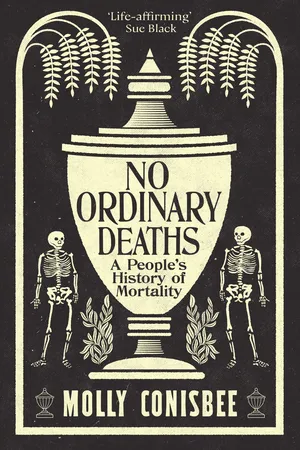
The lost art of 'dying well' was common knowledge to our ancestors - who, living closer to death than we do, had an intimate and integrated relationship with the afterlife. For centuries, cycles of death, dying and disposal have shaped society, from the death-watchers of the Middle Age to the pomp of Victorian funeral wear.
Ranging from the plague pit to the grave-robbery, from consecrated ground to the hangman's drop, No Ordinary Deaths is a groundbreaking work of social history which asks: how did our ancestors live, and die? How might the old ways help prepare us for our own ends?
- 361 pages
- English
- ePUB (mobile friendly)
- Available on iOS & Android
eBook - ePub
About this book
Information
Subtopic
Social HistoryIndex
HistoryTable of contents
- Cover
- Title Page
- Copyright Page
- Contents
- Introduction
- 1. Watch
- 2. Body and Soul
- 3. Disembodied
- 4. Criminal
- 5. Gwylnos/Wake
- 6. Funeral
- 7. Queerly Beloved
- 8. Memorial
- 9. Mourning
- 10. Grief
- 11. Afterlife
- Epilogue: Last Words
- Acknowledgements
- List of Illustrations
- Notes
- Bibliography
- Index
Trusted by 375,005 students
Access to over 1.5 million titles for a fair monthly price.
Study more efficiently using our study tools.
Frequently asked questions
Yes, you can cancel anytime from the Subscription tab in your account settings on the Perlego website. Your subscription will stay active until the end of your current billing period. Learn how to cancel your subscription
No, books cannot be downloaded as external files, such as PDFs, for use outside of Perlego. However, you can download books within the Perlego app for offline reading on mobile or tablet. Learn how to download books offline
Perlego offers two plans: Essential and Complete
- Essential is ideal for learners and professionals who enjoy exploring a wide range of subjects. Access the Essential Library with 800,000+ trusted titles and best-sellers across business, personal growth, and the humanities. Includes unlimited reading time and Standard Read Aloud voice.
- Complete: Perfect for advanced learners and researchers needing full, unrestricted access. Unlock 1.5M+ books across hundreds of subjects, including academic and specialized titles. The Complete Plan also includes advanced features like Premium Read Aloud and Research Assistant.
We are an online textbook subscription service, where you can get access to an entire online library for less than the price of a single book per month. With over 1.5 million books across 990+ topics, we’ve got you covered! Learn about our mission
Look out for the read-aloud symbol on your next book to see if you can listen to it. The read-aloud tool reads text aloud for you, highlighting the text as it is being read. You can pause it, speed it up and slow it down. Learn more about Read Aloud
Yes! You can use the Perlego app on both iOS and Android devices to read anytime, anywhere — even offline. Perfect for commutes or when you’re on the go.
Please note we cannot support devices running on iOS 13 and Android 7 or earlier. Learn more about using the app
Please note we cannot support devices running on iOS 13 and Android 7 or earlier. Learn more about using the app
Yes, you can access No Ordinary Deaths by Molly Conisbee in PDF and/or ePUB format, as well as other popular books in History & Social History. We have over 1.5 million books available in our catalogue for you to explore.