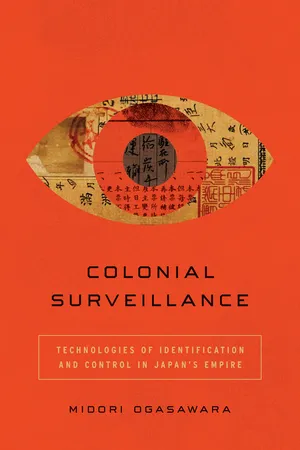
Colonial Surveillance
eBook - ePub

Colonial Surveillance

Technologies of Identification and Control in Japan’s Empire

  1. English
  2. ePUB (mobile friendly)
  3. Available on iOS & Android
eBook - ePub

Colonial Surveillance

Technologies of Identification and Control in Japan’s Empire

About this book

In order to compete with Western powers, Japan began to rapidly modernize its governing institutions, in the process creating a national population registration and identification bureaucracy, the Koseki system, in 1871. A few decades later, when Japan began to extract natural resources from and occupy Northeast China, fingerprint identification was introduced to track the movement of local populations. Taking a historical and sociological perspective informed by surveillance studies, this book shows how biometric identification became a powerful means of policing and racialization of ethnic others in Japan's empire.

  Based on archival research in Japan and China, as well as interviews with the Chinese survivors of Japanese occupation, Midori Ogasawara explores the transformation of identification techniques from Japan to its colonies and the lasting impacts of colonial surveillance on everyday people. Against the historical backdrop of Japan's colonial expansion in the pseudo-state of "Manchukuo," Ogasawara invites readers to delve into the little-known genealogy of modern-day identification systems, and the colonial roots of the troubling and often-invisible surveillance technologies that saturate our digital lives today.

Frequently asked questions

Yes, you can cancel anytime from the Subscription tab in your account settings on the Perlego website. Your subscription will stay active until the end of your current billing period. Learn how to cancel your subscription.
No, books cannot be downloaded as external files, such as PDFs, for use outside of Perlego. However, you can download books within the Perlego app for offline reading on mobile or tablet. Learn more here.
Perlego offers two plans: Essential and Complete
  • Essential is ideal for learners and professionals who enjoy exploring a wide range of subjects. Access the Essential Library with 800,000+ trusted titles and best-sellers across business, personal growth, and the humanities. Includes unlimited reading time and Standard Read Aloud voice.
  • Complete: Perfect for advanced learners and researchers needing full, unrestricted access. Unlock 1.4M+ books across hundreds of subjects, including academic and specialized titles. The Complete Plan also includes advanced features like Premium Read Aloud and Research Assistant.
Both plans are available with monthly, semester, or annual billing cycles.
We are an online textbook subscription service, where you can get access to an entire online library for less than the price of a single book per month. With over 1 million books across 1000+ topics, we’ve got you covered! Learn more here.
Look out for the read-aloud symbol on your next book to see if you can listen to it. The read-aloud tool reads text aloud for you, highlighting the text as it is being read. You can pause it, speed it up and slow it down. Learn more here.
Yes! You can use the Perlego app on both iOS or Android devices to read anytime, anywhere — even offline. Perfect for commutes or when you’re on the go.
Please note we cannot support devices running on iOS 13 and Android 7 or earlier. Learn more about using the app.
Yes, you can access Colonial Surveillance by Midori Ogasawara in PDF and/or ePUB format. We have over one million books available in our catalogue for you to explore.

Information

Table of contents

  1. Cover
  2. Title Page
  3. Copyright
  4. Dedication
  5. Contents
  6. Preface. ID Troubles: Who Defines Who You Are
  7. Acknowledgments
  8. Introduction. Colonial Surveillance and Violence
  9. Chapter One. A Genealogy of Identification: Classifying People in Empires
  10. Chapter Two. Constructing ā€œJapaneseā€ and Internal Others: The Koseki System as Surveillance
  11. Chapter Three. Japan’s Maximum Surveillant Assemblage: Separating ā€œBanditsā€ from ā€œInnocentsā€ in the Colonial Threshold of ā€œManchukuoā€
  12. Chapter Four. Bodies as Risky Resources: Fingerprinting for Labor Control
  13. Chapter Five. Fatal Classification for Imperial Science: Unit 731 and Japan’s Secret Biological Experiments
  14. Conclusion. Troubles Continued: Identification and Identity in the Post-Colonial Era
  15. Appendix. Field Notes
  16. Notes
  17. Bibliography
  18. Index