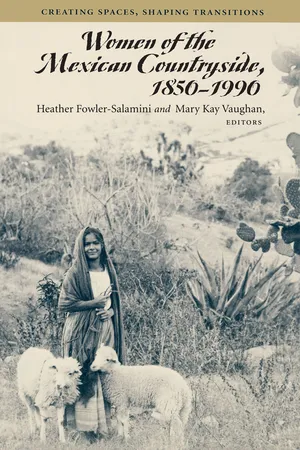
Too often in the history of Mexico, women have been portrayed as marginal figures rather than legitimate participants in social processes. As the twentieth century draws to a close, Mexican women of the countryside can be seen as true historical actors: mothers and heads of households, factory and field workers, community activists, artisans, and merchants. In this new book, thirteen contributions by historians, anthropologists, and sociologists—from Mexico as well as the United States—elucidate the roles of women and changing gender relations in Mexico as rural families negotiated the transition from an agrarian to an industrial society.
Drawing on Mexican community studies, gender studies, and rural studies, these essays overturn the stereotypes of Mexican peasant women by exploring the complexity of their lives and roles and examining how these have changed over time. The book emphasizes the active roles of women in the periods of civil war, 1854-76, and the commercialization of agriculture, 1880-1910. It highlights their vigorous responses to the violence of revolution, their increased mobility, and their interaction with state reforms in the period from 1910 to 1940. The final essays focus on changing gender relations in the countryside under the impact of rapid urbanization and industrialization since 1940. Because histories of Latin American women have heretofore neglected rural areas, this volume will serve as a touchstone for all who would better understand women's lives in a region of increasing international economic importance. Women of the Mexican Countryside demonstrates that, contrary to the peasant stereotype, these women have accepted complex roles to meet constantly changing situations.
CONTENTS
I—Women and Agriculture in Nineteenth-Century Mexico
1. Exploring the Origins of Democratic Patriarchy in Mexico: Gender and Popular Resistance in the Puebla Highlands, 1850-1876, Florencia Mallon
2. "Cheaper Than Machines": Women and Agriculture in Porfirian Oaxaca (1880-1911), Francie R. Chassen-López
3. Gender, Work, and Coffee in C¢rdoba, Veracruz, 1850-1910, Heather Fowler-Salamini
4. Gender, Bridewealth, and Marriage: Social Reproduction of Peons on Henequen Haciendas in Yucatán (1870-1901), Piedad Peniche Rivero
II—Rural Women and Revolution in Mexico
5. The Soldadera in the Mexican Revolution: War and Men's Illusions, Elizabeth Salas
6. Rural Women's Literacy and Education During the Mexican Revolution: Subverting a Patriarchal Event?, Mary Kay Vaughan
7. Doña Zeferina Barreto: Biographical Sketch of an Indian Woman from the State of Morelos, Judith Friedlander
8. Seasons, Seeds, and Souls: Mexican Women Gardening in the American Mesilla (1900-1940), Raquel Rubio Goldsmith
III—Rural Women, Urbanization, and Gender Relations
9. Three Microhistories of Women's Work in Rural Mexico, Patricia Arias
10. Intergenerational and Gender Relations in the Transition from a Peasant Economy to a Diversified Economy, Soledad González Montes
11. From Metate to Despate: Rural Women's Salaried Labor and the Redefinition of Gendered Spaces and Roles, Gail Mummert
12. Changes in Rural Society and Domestic Labor in Atlixco, Puebla (1940-1990), Maria da Glória Marroni de Velázquez
13. Antagonisms of Gender and Class in Morelos, Mexico, JoAnn Martin
Drawing on Mexican community studies, gender studies, and rural studies, these essays overturn the stereotypes of Mexican peasant women by exploring the complexity of their lives and roles and examining how these have changed over time. The book emphasizes the active roles of women in the periods of civil war, 1854-76, and the commercialization of agriculture, 1880-1910. It highlights their vigorous responses to the violence of revolution, their increased mobility, and their interaction with state reforms in the period from 1910 to 1940. The final essays focus on changing gender relations in the countryside under the impact of rapid urbanization and industrialization since 1940. Because histories of Latin American women have heretofore neglected rural areas, this volume will serve as a touchstone for all who would better understand women's lives in a region of increasing international economic importance. Women of the Mexican Countryside demonstrates that, contrary to the peasant stereotype, these women have accepted complex roles to meet constantly changing situations.
CONTENTS
I—Women and Agriculture in Nineteenth-Century Mexico
1. Exploring the Origins of Democratic Patriarchy in Mexico: Gender and Popular Resistance in the Puebla Highlands, 1850-1876, Florencia Mallon
2. "Cheaper Than Machines": Women and Agriculture in Porfirian Oaxaca (1880-1911), Francie R. Chassen-López
3. Gender, Work, and Coffee in C¢rdoba, Veracruz, 1850-1910, Heather Fowler-Salamini
4. Gender, Bridewealth, and Marriage: Social Reproduction of Peons on Henequen Haciendas in Yucatán (1870-1901), Piedad Peniche Rivero
II—Rural Women and Revolution in Mexico
5. The Soldadera in the Mexican Revolution: War and Men's Illusions, Elizabeth Salas
6. Rural Women's Literacy and Education During the Mexican Revolution: Subverting a Patriarchal Event?, Mary Kay Vaughan
7. Doña Zeferina Barreto: Biographical Sketch of an Indian Woman from the State of Morelos, Judith Friedlander
8. Seasons, Seeds, and Souls: Mexican Women Gardening in the American Mesilla (1900-1940), Raquel Rubio Goldsmith
III—Rural Women, Urbanization, and Gender Relations
9. Three Microhistories of Women's Work in Rural Mexico, Patricia Arias
10. Intergenerational and Gender Relations in the Transition from a Peasant Economy to a Diversified Economy, Soledad González Montes
11. From Metate to Despate: Rural Women's Salaried Labor and the Redefinition of Gendered Spaces and Roles, Gail Mummert
12. Changes in Rural Society and Domestic Labor in Atlixco, Puebla (1940-1990), Maria da Glória Marroni de Velázquez
13. Antagonisms of Gender and Class in Morelos, Mexico, JoAnn Martin