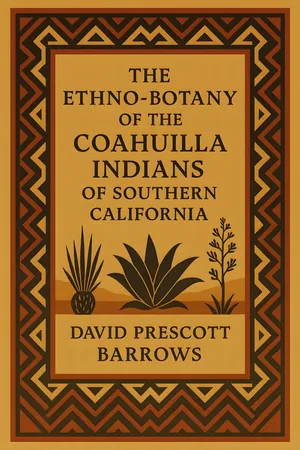
The Ethno-Botany of the Coahuilla Indians of Southern California by David Prescott Barrows is a pioneering and elegantly detailed study of the intricate relationship between an Indigenous people and their natural environment. First published in 1900, this work remains one of the earliest and most comprehensive records of the Cahuilla (Coahuilla) Nation's traditional plant knowledge — a deep ethnographic account of how the desert and mountain flora of Southern California sustained not just physical life, but an entire cultural and spiritual worldview.
Drawing on field research conducted during his travels among the Cahuilla communities, Barrows documents the plants they used for food, medicine, clothing, tools, and ritual purposes, creating a living map of ecological wisdom. Through careful observation and first-hand testimony, he reconstructs a system of knowledge in which nature was both teacher and companion, revealing how the Cahuilla maintained balance within a challenging landscape through intimate familiarity with its every resource.
More than a scientific catalogue, The Ethno-Botany of the Coahuilla Indians reflects an early recognition of the sophistication and sustainability of Indigenous ecological traditions. Barrows's writing combines ethnographic rigor with an almost poetic admiration for his subjects, portraying a people whose understanding of the natural world rivals the most advanced modern environmental sciences.
For readers of anthropology, botany, and Indigenous studies, this book remains a cornerstone of early ethnobotanical literature — a window into the harmony between people and plants that shaped millennia of life in the desert valleys of California.