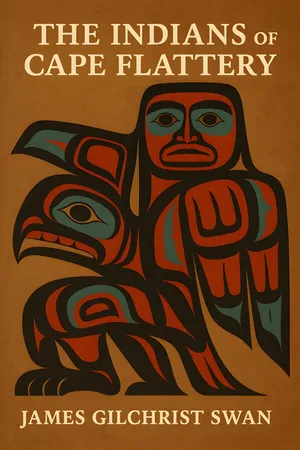
The Indians of Cape Flattery: At the Entrance to the Strait of Fuca, Washington Territory by James Gilchrist Swan is one of the earliest and most important ethnographic studies of the Indigenous peoples of the Pacific Northwest. First published in 1870 under the auspices of the Smithsonian Institution, this pioneering work records in rich detail the life, customs, language, and beliefs of the Makah Nation of Neah Bay — a maritime people whose culture was shaped by the sea and the rugged coast of the Olympic Peninsula.
Drawing upon years of residence among the Makah, Swan offers an intimate and respectful portrayal that bridges the gap between observer and participant. His chapters cover every aspect of community life: from hunting, fishing, and whaling to art, religion, and oral tradition. He documents their social organization, mythology, and ceremonial practices with rare sympathy, and his inclusion of Makah vocabulary and legends makes the book a cornerstone for later linguistic and anthropological study.
What makes The Indians of Cape Flattery enduringly valuable is Swan's sensitivity and precision. At a time when Indigenous cultures were often misrepresented, he approached his subjects as friends and equals, recording not curiosities but a living, dynamic people. His work preserves a culture on the cusp of enormous change — offering modern readers both historical context and a deep appreciation of resilience and identity.
For readers of anthropology, Native studies, and Pacific Northwest history, this book remains an essential primary source — a testament to early ethnography conducted with respect, accuracy, and enduring human insight.