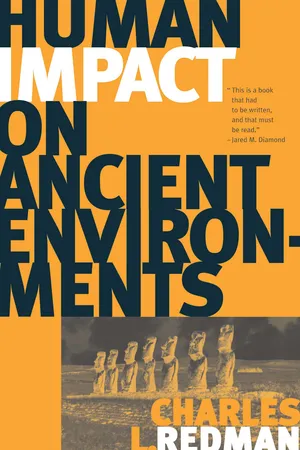
Threats to biodiversity, food shortages, urban sprawl . . . lessons for environmental problems that confront us today may well be found in the past. The archaeological record contains hundreds of situations in which societies developed long-term sustainable relationships with their environments—and thousands in which the relationships were destructive. Charles Redman demonstrates that much can be learned from an improved understanding of peoples who, through seemingly rational decisions, degraded their environments and threatened their own survival. By discussing archaeological case studies from around the world—from the deforestation of the Mayan lowlands to soil erosion in ancient Greece to the almost total depletion of resources on Easter Island—Redman reveals the long-range coevolution of culture and environment and clearly shows the impact that ancient peoples had on their world. These case studies focus on four themes: habitat transformation and animal extinctions, agricultural practices, urban growth, and the forces that accompany complex society. They show that humankind's commitment to agriculture has had cultural consequences that have conditioned our perception of the environment and reveal that societies before European contact did not necessarily live the utopian existences that have been popularly supposed. Whereas most books on this topic tend to treat human societies as mere reactors to environmental stimuli, Redman's volume shows them to be active participants in complex and evolving ecological relationships. Human Impact on Ancient Environments demonstrates how archaeological research can provide unique insights into the nature of human stewardship of the Earth and can permanently alter the way we think about humans and the environment.
- 256 pages
- English
- PDF
- Available on iOS & Android
eBook - PDF
Human Impact on Ancient Environments
About this book
Information
Publisher
University of Arizona PressYear
1999Print ISBN
9780816519637
9780816519620
eBook ISBN
9780816543205
Table of contents
- Contents
- List of Illustrations
- Preface
- Chapter 1. Lessons from a Prehistoric "Eden"
- Chapter 2. Attitudes toward the Environment
- Chapter 3. Concepts That Organize Our Thoughts
- Chapter 4. Animal Exploitation: The Prehistoric Loss of Habitat and Biodiversity
- Chapter 5. The Impact of Agrarian Systems
- Chapter 6. The Growth of World Urbanism
- Chapter 7. Forces That Grew with Society
- Chapter 8. The Past as Prologue
- Works Cited
- Index
Trusted by 375,005 students
Access to over 1.5 million titles for a fair monthly price.
Study more efficiently using our study tools.
Frequently asked questions
Yes, you can cancel anytime from the Subscription tab in your account settings on the Perlego website. Your subscription will stay active until the end of your current billing period. Learn how to cancel your subscription
No, books cannot be downloaded as external files, such as PDFs, for use outside of Perlego. However, you can download books within the Perlego app for offline reading on mobile or tablet. Learn how to download books offline
Perlego offers two plans: Essential and Complete
- Essential is ideal for learners and professionals who enjoy exploring a wide range of subjects. Access the Essential Library with 800,000+ trusted titles and best-sellers across business, personal growth, and the humanities. Includes unlimited reading time and Standard Read Aloud voice.
- Complete: Perfect for advanced learners and researchers needing full, unrestricted access. Unlock 1.5M+ books across hundreds of subjects, including academic and specialized titles. The Complete Plan also includes advanced features like Premium Read Aloud and Research Assistant.
We are an online textbook subscription service, where you can get access to an entire online library for less than the price of a single book per month. With over 1.5 million books across 990+ topics, we’ve got you covered! Learn about our mission
Look out for the read-aloud symbol on your next book to see if you can listen to it. The read-aloud tool reads text aloud for you, highlighting the text as it is being read. You can pause it, speed it up and slow it down. Learn more about Read Aloud
Yes! You can use the Perlego app on both iOS and Android devices to read anytime, anywhere — even offline. Perfect for commutes or when you’re on the go.
Please note we cannot support devices running on iOS 13 and Android 7 or earlier. Learn more about using the app
Please note we cannot support devices running on iOS 13 and Android 7 or earlier. Learn more about using the app
Yes, you can access Human Impact on Ancient Environments by Charles L. Redman in PDF and/or ePUB format, as well as other popular books in Social Sciences & Archaeology. We have over 1.5 million books available in our catalogue for you to explore.