In 212 CE, the emperor Caracalla extended citizenship to nearly all free-born residents of the Roman Empire. In doing so, he transformed not only his own, but the very ideal of empire and statehood in Europe. This volume first inquires into the contexts of Caracalla's act in his own day. Rome was an ancient empire: it had traditionally ruled over populations that were conceived and governed as distinct units, a practice that was both strategic and ideological. What were the practical and political effects of a universalizing ideology in this context? Was there a reorientation of private social and legal practice in response? And what politics of exclusion came to apply, now that citizenship no longer served to distinguish persons of higher and lower status? The volume subsequently traces the history of citizenship in universalizing ideologies and legal practice from late antiquity to the codification of law in Europe in the nineteenth century. Caracalla's act was then repeatedly cited as the ideal toward which sovereign polities should strive, be they states or empires. Citizenship and law were thereby made preeminent among the universalisms of European statecraft.
eBook - PDF
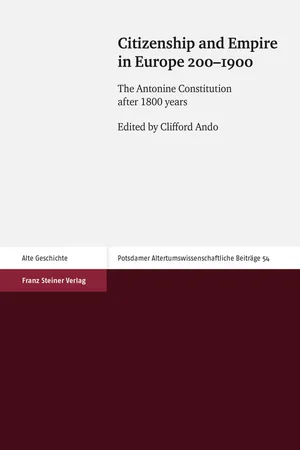
Citizenship and Empire in Europe 200–1900
The Antonine Constitution after 1800 years
- 266 pages
- English
- PDF
- Available on iOS & Android
eBook - PDF
About this book
Information
Table of contents
- CONTENTS
- INTRODUCTION: SOVEREIGNTY, TERRITORIALITY AND UNIVERSALISM IN THE AFTERMATH OF CARACALLA
- CHAPTER 1: READING THE CITIZENSHIP PAPYRUS (P.GISS. 40)
- CHAPTER 2: LOCAL LAW IN ASIA MINOR AFTER THE CONSTITUTIO ANTONINIANA
- CHAPTER 3: THE NOTION OF RES PUBLICA IN THE AGE OF CARACALLA
- CHAPTER 4: CHRISTIAN REFLECTIONS ON ROMAN CITIZENSHIP (200–430)
- CHAPTER 5: CITIZENSHIP, SUBJECTION, AND CIVIL LAW: JEAN BODIN ON ROMAN CITIZENSHIP AND THE THEORY OF CONSENSUAL SUBJECTION
- CHAPTER 6: RACIALIZATION WITHIN UNIVERSALIST SOCIETIES. IS IT POSSIBLE TO IDENTIFY VARIOUS HISTORICAL CASES OF THE SAME ANTINOMY?
- CHAPTER 7: ANCIEN RÉGIME IN THE TROPICS? A DEBATE CONCERNING THE POLITICAL MODEL OF THE PORTUGUESE COLONIAL EMPIRE
- CHAPTER 8: EXPANDING CITIZENSHIP? THE FRENCH EXPERIENCE SURROUNDING THE CODE NAPOLÉON
- CHAPTER 9: UNIVERSALISM, LEGAL PLURALISM AND CITIZENSHIP: PORTUGUESE IMPERIAL POLICIES ON CITIZENSHIP AND LAW (1820–1914)
- CHAPTER 10: TAINTED CITIZENSHIP AND IMPERIAL CONSTITUTIONS: THE CASE OF THE SPANISH CONSTITUTION OF 1812
- AFTERWORD: ROMAN CITIZENSHIP, EMPIRE, AND THE CHALLENGES OF SOVEREIGNTY
- ACKNOWLEDGMENTS
- INDEX
Trusted by 375,005 students
Access to over 1.5 million titles for a fair monthly price.
Study more efficiently using our study tools.
Frequently asked questions
Yes, you can cancel anytime from the Subscription tab in your account settings on the Perlego website. Your subscription will stay active until the end of your current billing period. Learn how to cancel your subscription
No, books cannot be downloaded as external files, such as PDFs, for use outside of Perlego. However, you can download books within the Perlego app for offline reading on mobile or tablet. Learn how to download books offline
Perlego offers two plans: Essential and Complete
- Essential is ideal for learners and professionals who enjoy exploring a wide range of subjects. Access the Essential Library with 800,000+ trusted titles and best-sellers across business, personal growth, and the humanities. Includes unlimited reading time and Standard Read Aloud voice.
- Complete: Perfect for advanced learners and researchers needing full, unrestricted access. Unlock 1.5M+ books across hundreds of subjects, including academic and specialized titles. The Complete Plan also includes advanced features like Premium Read Aloud and Research Assistant.
We are an online textbook subscription service, where you can get access to an entire online library for less than the price of a single book per month. With over 1.5 million books across 990+ topics, we’ve got you covered! Learn about our mission
Look out for the read-aloud symbol on your next book to see if you can listen to it. The read-aloud tool reads text aloud for you, highlighting the text as it is being read. You can pause it, speed it up and slow it down. Learn more about Read Aloud
Yes! You can use the Perlego app on both iOS and Android devices to read anytime, anywhere — even offline. Perfect for commutes or when you’re on the go.
Please note we cannot support devices running on iOS 13 and Android 7 or earlier. Learn more about using the app
Please note we cannot support devices running on iOS 13 and Android 7 or earlier. Learn more about using the app
Yes, you can access Citizenship and Empire in Europe 200–1900 by Clifford Ando in PDF and/or ePUB format, as well as other popular books in History & Ancient History. We have over 1.5 million books available in our catalogue for you to explore.