This e-book investigates the development of religious associations in the Aegean world in Hellenistic and Roman times on the basis of epigraphic and archaeological evidence from major sites. It offers a socio-cultural examination of religious associations linked to a variety of deities at different places. Founding or joining a religious association was a matter of individual choice. But that choice took place in an environment dominated by more traditional forms of religious worship, many of them closely integrated into the polis. Julietta Steinhauer asks what let individuals to participate in religious associations of this kind. What made these associations popular among people from different social groups and ethnic backgrounds? Who might found a religious association, how did they do it, and why? Which deities were the most popular among the worshippers initiating such associations, and what were the reasons for their choices? Two case-studies investigating the evidence from Athens and Delos form the foundation of this e-book. One chapter is dedicated to the background of people involved in religious associations. The actual assembly places are considered from an archaeological perspective. Finally, a comparative chapter deals with the socio-political place of religious associations in the post-classical poleis of the Aegean world.
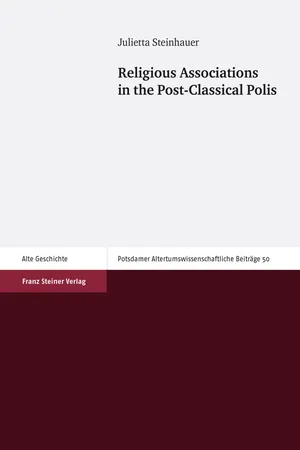
- 195 pages
- English
- PDF
- Available on iOS & Android
eBook - PDF
Religious Associations in the Post-Classical Polis
About this book
Information
Table of contents
- ACKNOWLEDGEMENTS
- CONTENTS
- ABBREVIATIONS
- 1. INTRODUCTION
- 2. ATHENS – A CASE STUDY
- 3. DELOS, A CASE STUDY
- 4. THE PEOPLE: PERSONNEL AND PARTICIPANTS
- 5. ARCHITECTURE AND ARCHAEOLOGY
- 6. RELIGIOUS ASSOCIATIONS AND CIVIC INSTITUTIONS
- 7. CONCLUSION
- 8. BIBLIOGRAPHY
- APPENDIX I
- APPENDIX II
- GENERAL INDEX
Trusted by 375,005 students
Access to over 1.5 million titles for a fair monthly price.
Study more efficiently using our study tools.
Frequently asked questions
Yes, you can cancel anytime from the Subscription tab in your account settings on the Perlego website. Your subscription will stay active until the end of your current billing period. Learn how to cancel your subscription
No, books cannot be downloaded as external files, such as PDFs, for use outside of Perlego. However, you can download books within the Perlego app for offline reading on mobile or tablet. Learn how to download books offline
Perlego offers two plans: Essential and Complete
- Essential is ideal for learners and professionals who enjoy exploring a wide range of subjects. Access the Essential Library with 800,000+ trusted titles and best-sellers across business, personal growth, and the humanities. Includes unlimited reading time and Standard Read Aloud voice.
- Complete: Perfect for advanced learners and researchers needing full, unrestricted access. Unlock 1.5M+ books across hundreds of subjects, including academic and specialized titles. The Complete Plan also includes advanced features like Premium Read Aloud and Research Assistant.
We are an online textbook subscription service, where you can get access to an entire online library for less than the price of a single book per month. With over 1.5 million books across 990+ topics, we’ve got you covered! Learn about our mission
Look out for the read-aloud symbol on your next book to see if you can listen to it. The read-aloud tool reads text aloud for you, highlighting the text as it is being read. You can pause it, speed it up and slow it down. Learn more about Read Aloud
Yes! You can use the Perlego app on both iOS and Android devices to read anytime, anywhere — even offline. Perfect for commutes or when you’re on the go.
Please note we cannot support devices running on iOS 13 and Android 7 or earlier. Learn more about using the app
Please note we cannot support devices running on iOS 13 and Android 7 or earlier. Learn more about using the app
Yes, you can access Religious Associations in the Post-Classical Polis by Julietta Steinhauer-Hogg in PDF and/or ePUB format, as well as other popular books in History & Ancient History. We have over 1.5 million books available in our catalogue for you to explore.