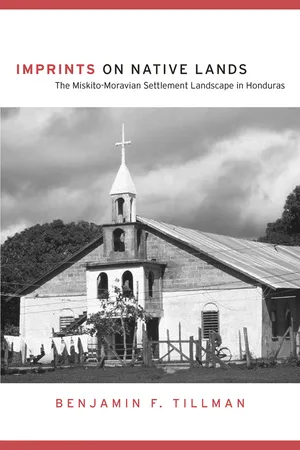
eBook - PDF
Imprints on Native Lands
The Miskito-Moravian Settlement Landscape in Honduras
- 203 pages
- English
- PDF
- Available on iOS & Android
eBook - PDF
About this book
More than one hundred fifty years ago, Moravian missionaries first landed along a so-called isolated stretch of Honduras's Mosquito Coast bordering the western Caribbean Sea. The missionaries were sent, with the strong encouragement of German political leaders and in the context of German attempts at colonization, to "spread the word" of Protestantism in Central America. Upon their arrival, the missionaries employed a three-pronged approach consisting of proselytizing, medical treatment, and education to convert the majority of the indigenous population.
Much like the Spanish and English attempts before them, German colonizing efforts in the region never completely took hold. Still, as Benjamin Tillman shows, for the region's indigenous inhabitants, the Miskito people, the arrival of the Moravian missionaries marked the beginning of an important cultural interface.
Imprints on Native Lands documents Moravian contributions to the Miskito settlement landscape in sixty four villages of eastern Honduras through field observations of material culture, interviews with village residents, and research in primary sources in the Moravian Church archives. Tillman employs the resulting data to map a hierarchy of Moravian centers, illustrating spatially varying degrees of Moravian influence on the Miskito settlement landscape.
Tillman reinforces Miskito claims to ancestral lands by identifying and mapping their created ethnic landscape, as well as supporting earlier efforts at land-use mapping in the region. This book has broad implications, providing a methodology that will be of help to those with an interest in geography, anthropology, or Latin American studies, and to anyone interested in documenting and strengthening indigenous land claims.
Much like the Spanish and English attempts before them, German colonizing efforts in the region never completely took hold. Still, as Benjamin Tillman shows, for the region's indigenous inhabitants, the Miskito people, the arrival of the Moravian missionaries marked the beginning of an important cultural interface.
Imprints on Native Lands documents Moravian contributions to the Miskito settlement landscape in sixty four villages of eastern Honduras through field observations of material culture, interviews with village residents, and research in primary sources in the Moravian Church archives. Tillman employs the resulting data to map a hierarchy of Moravian centers, illustrating spatially varying degrees of Moravian influence on the Miskito settlement landscape.
Tillman reinforces Miskito claims to ancestral lands by identifying and mapping their created ethnic landscape, as well as supporting earlier efforts at land-use mapping in the region. This book has broad implications, providing a methodology that will be of help to those with an interest in geography, anthropology, or Latin American studies, and to anyone interested in documenting and strengthening indigenous land claims.
Frequently asked questions
Yes, you can cancel anytime from the Subscription tab in your account settings on the Perlego website. Your subscription will stay active until the end of your current billing period. Learn how to cancel your subscription.
At the moment all of our mobile-responsive ePub books are available to download via the app. Most of our PDFs are also available to download and we're working on making the final remaining ones downloadable now. Learn more here.
Perlego offers two plans: Essential and Complete
- Essential is ideal for learners and professionals who enjoy exploring a wide range of subjects. Access the Essential Library with 800,000+ trusted titles and best-sellers across business, personal growth, and the humanities. Includes unlimited reading time and Standard Read Aloud voice.
- Complete: Perfect for advanced learners and researchers needing full, unrestricted access. Unlock 1.4M+ books across hundreds of subjects, including academic and specialized titles. The Complete Plan also includes advanced features like Premium Read Aloud and Research Assistant.
We are an online textbook subscription service, where you can get access to an entire online library for less than the price of a single book per month. With over 1 million books across 1000+ topics, we’ve got you covered! Learn more here.
Look out for the read-aloud symbol on your next book to see if you can listen to it. The read-aloud tool reads text aloud for you, highlighting the text as it is being read. You can pause it, speed it up and slow it down. Learn more here.
Yes! You can use the Perlego app on both iOS or Android devices to read anytime, anywhere — even offline. Perfect for commutes or when you’re on the go.
Please note we cannot support devices running on iOS 13 and Android 7 or earlier. Learn more about using the app.
Yes, you can access Imprints on Native Lands by Benjamin F. Tillman in PDF and/or ePUB format, as well as other popular books in Social Sciences & Cultural & Social Anthropology. We have over one million books available in our catalogue for you to explore.
Information
Table of contents
- Contents
- List of Illustrations
- Acknowledgments
- 1. Introduction
- 2. The Setting: Mosquito Coast Geography and the Moravian Missionary Impetus
- 3. Miskito Settlements: Change and Continuity
- 4. The Overt Moravian Landscape: Churches and Compounds
- 5. From Top to Bottom: Moravian Modification of Miskito Housing
- 6. Missionaries for Christ, or Early Prophets of Sustainability? Moravian Influence on Miskito Agriculture
- 7. Uncommon Ground: The Material Culture of Miskito Cemeteries
- Conclusion
- Appendix A: 2001 Census Population of Selected Settlements in the Department of Gracias a Dios, Honduras
- Appendix B: Scientific Names of Selected Vegetation
- Appendix C: Settlements with Catholic, Baptist, and Church of God Congregations
- Appendix D: Settlement Names
- Appendix E: Names of Selected Miskito House Parts and Construction Materials