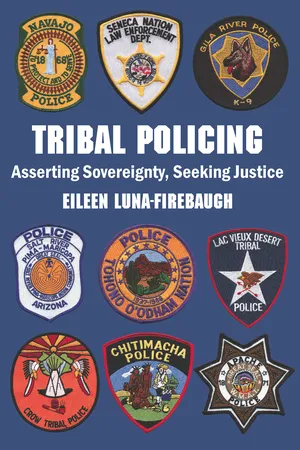
What does it mean to be a tribal police officer? What are the complexities of that role? And how do tribal communities, tribal police departments, and other law enforcement agencies collaborate to address the alarmingly high rate of violent crime in Indian country?
Author Eileen Luna-Firebaugh answers these and other questions in this well-documented text about tribal government and law enforcement in America. Based on extensive research with tribal police departments conducted over a period of eight years, Tribal Policing reveals the complicated role of police officials in Indian country and the innovative methods they are developing to address crime within their borders and to advance tribal sovereignty in the United States.
Tribal police departments face many challenges, such as heightened crime rates, a lack of resources (working patrol vehicles, 911 systems, access to police radios), and vast patrol areas. Luna-Firebaugh demonstrates that tribal officers see themselves as members of the tribal community and that tribal law enforcement is a complex balance of tribal position and authority within the community. Among other topics, Luna-Firebaugh analyzes the structure of tribal law enforcement and the ways it differs from mainstream policing; the role of women, tribal members, and others who comprise tribal law enforcement personnel; tribal jails and corrections; police training; and the legal, political, cultural, and historical issues that affect American Indian tribal policing.
This informative text addresses the scarcity of published material regarding tribal law enforcement and will be a welcome addition to courses in criminal justice, the administration of justice, law enforcement, and Native American studies.
Author Eileen Luna-Firebaugh answers these and other questions in this well-documented text about tribal government and law enforcement in America. Based on extensive research with tribal police departments conducted over a period of eight years, Tribal Policing reveals the complicated role of police officials in Indian country and the innovative methods they are developing to address crime within their borders and to advance tribal sovereignty in the United States.
Tribal police departments face many challenges, such as heightened crime rates, a lack of resources (working patrol vehicles, 911 systems, access to police radios), and vast patrol areas. Luna-Firebaugh demonstrates that tribal officers see themselves as members of the tribal community and that tribal law enforcement is a complex balance of tribal position and authority within the community. Among other topics, Luna-Firebaugh analyzes the structure of tribal law enforcement and the ways it differs from mainstream policing; the role of women, tribal members, and others who comprise tribal law enforcement personnel; tribal jails and corrections; police training; and the legal, political, cultural, and historical issues that affect American Indian tribal policing.
This informative text addresses the scarcity of published material regarding tribal law enforcement and will be a welcome addition to courses in criminal justice, the administration of justice, law enforcement, and Native American studies.