"The Earth says, God has placed me here. The Earth says that God tells me to take care of the Indians on this earth; the Earth says to the Indians that stop on the Earth, feed them right. . . . God says feed the Indians upon the earth."
—Cayuse Chief Young Chief, Walla Walla Council of 1855
America has always been Indian land. Historically and culturally, Native Americans have had a strong appreciation for the land and what it offers. After continually struggling to hold on to their land and losing millions of acres, Native Americans still have a strong and ongoing relationship to their homelands. The land holds spiritual value and offers a way of life through fishing, farming, and hunting. It remains essential—not only for subsistence but also for cultural continuity—that Native Americans regain rights to land they were promised.
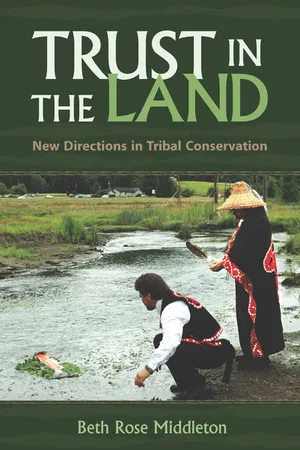
Beth Rose Middleton examines new and innovative ideas concerning Native land conservancies, providing advice on land trusts, collaborations, and conservation groups. Increasingly, tribes are working to protect their access to culturally important lands by collaborating with Native and non- Native conservation movements. By using private conservation partnerships to reacquire lost land, tribes can ensure the health and sustainability of vital natural resources. In particular, tribal governments are using conservation easements and land trusts to reclaim rights to lost acreage. Through the use of these and other private conservation tools, tribes are able to protect or in some cases buy back the land that was never sold but rather was taken from them.
Trust in the Land sets into motion a new wave of ideas concerning land conservation. This informative book will appeal to Native and non-Native individuals and organizations interested in protecting the land as well as environmentalists and government agencies.
—Cayuse Chief Young Chief, Walla Walla Council of 1855
America has always been Indian land. Historically and culturally, Native Americans have had a strong appreciation for the land and what it offers. After continually struggling to hold on to their land and losing millions of acres, Native Americans still have a strong and ongoing relationship to their homelands. The land holds spiritual value and offers a way of life through fishing, farming, and hunting. It remains essential—not only for subsistence but also for cultural continuity—that Native Americans regain rights to land they were promised.
Beth Rose Middleton examines new and innovative ideas concerning Native land conservancies, providing advice on land trusts, collaborations, and conservation groups. Increasingly, tribes are working to protect their access to culturally important lands by collaborating with Native and non- Native conservation movements. By using private conservation partnerships to reacquire lost land, tribes can ensure the health and sustainability of vital natural resources. In particular, tribal governments are using conservation easements and land trusts to reclaim rights to lost acreage. Through the use of these and other private conservation tools, tribes are able to protect or in some cases buy back the land that was never sold but rather was taken from them.
Trust in the Land sets into motion a new wave of ideas concerning land conservation. This informative book will appeal to Native and non-Native individuals and organizations interested in protecting the land as well as environmentalists and government agencies.