California has always been America's promised land—for American Indians as much as anyone. In the 1950s, Native people from all over the United States moved to the San Francisco Bay Area as part of the Bureau of Indian Affairs Relocation Program. Oakland was a major destination of this program, and once there, Indian people arriving from rural and reservation areas had to adjust to urban living. They did it by creating a cooperative, multi-tribal community—not a geographic community, but rather a network of people linked by shared experiences and understandings. The Intertribal Friendship House in Oakland became a sanctuary during times of upheaval in people's lives and the heart of a vibrant American Indian community. As one long-time resident observes, "The Wednesday Night Dinner at the Friendship House was a must if you wanted to know what was happening among Native people." One of the oldest urban Indian organizations in the country, it continues to serve as a gathering place for newcomers as well as for the descendants of families who arrived half a century ago. This album of essays, photographs, stories, and art chronicles some of the people and events that have played—and continue to play—a role in the lives of Native families in the Bay Area Indian community over the past seventy years. Based on years of work by more than ninety individuals who have participated in the Bay Area Indian community and assembled by the Community History Project at the Intertribal Friendship House, it traces the community's changes from before and during the relocation period through the building of community institutions. It then offers insight into American Indian activism of the 1960s and '70s—including the occupation of Alcatraz—and shows how the Indian community continues to be created and re-created for future generations. Together, these perspectives weave a richly textured portrait that offers an extraordinary inside view of American Indian urban life. Through oral histories, written pieces prepared especially for this book, graphic images, and even news clippings, Urban Voices collects a bundle of memories that hold deep and rich meaning for those who are a part of the Bay Area Indian community—accounts that will be familiar to Indian people living in cities throughout the United States. And through this collection, non-Indians can gain a better understanding of Indian people in America today. "If anything this book is expressive of, it is the insistence that Native people will be who they are as Indians living in urban communities, Natives thriving as cultural people strong in Indian ethnicity, and Natives helping each other socially, spiritually, economically, and politically no matter what. I lived in the Bay Area in 1975-79 and 1986-87, and I was always struck by the Native (many people do say 'American Indian' emphatically!) community and its cultural identity that has always insisted on being second to none. Yes, indeed this book is a dynamic, living document and tribute to the Oakland Indian community as well as to the Bay Area Indian community as a whole." —Simon J. Ortiz "When my family arrived in San Francisco in 1957, the people at the original San Francisco Indian Center helped us adjust to urban living. Many years later, I moved to Oakland and the Intertribal Friendship House became my sanctuary during a tumultuous time in my life. The Intertribal Friendship House was more than an organization. It was the heart of a vibrant tribal community. When we returned to our Oklahoma homelands twenty years later, we took incredible memories of the many people in the Bay Area who helped shape our values and beliefs, some of whom are included in this book." —Wilma Mankiller, former Principal Chief, Cherokee Nation
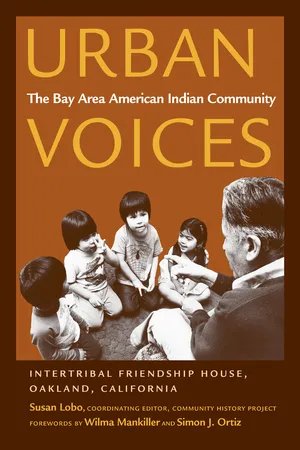
- 161 pages
- English
- PDF
- Available on iOS & Android
eBook - PDF
About this book
Information
Table of contents
- Contents
- List of Illustrations
- Foreword, by Wilma Mankiller
- Foreword, by Simon Ortiz
- Introduction, by Editorial Committee
- PART 1. THE BEGINNINGS
- PART 2. RELOCATION
- PART 3. BUILDING COMMUNITY
- PART 4. TIMES OF CHANGE
- PART 5. CREATING A COMMUNITY FOR FUTURE GENERATIONS
- BIBLIOGRAPHIES
- Source Acknowledgments
- Illustration Credits
- Contributing Editors
Trusted by 375,005 students
Access to over 1.5 million titles for a fair monthly price.
Study more efficiently using our study tools.
Frequently asked questions
Yes, you can cancel anytime from the Subscription tab in your account settings on the Perlego website. Your subscription will stay active until the end of your current billing period. Learn how to cancel your subscription
No, books cannot be downloaded as external files, such as PDFs, for use outside of Perlego. However, you can download books within the Perlego app for offline reading on mobile or tablet. Learn how to download books offline
Perlego offers two plans: Essential and Complete
- Essential is ideal for learners and professionals who enjoy exploring a wide range of subjects. Access the Essential Library with 800,000+ trusted titles and best-sellers across business, personal growth, and the humanities. Includes unlimited reading time and Standard Read Aloud voice.
- Complete: Perfect for advanced learners and researchers needing full, unrestricted access. Unlock 1.5M+ books across hundreds of subjects, including academic and specialized titles. The Complete Plan also includes advanced features like Premium Read Aloud and Research Assistant.
We are an online textbook subscription service, where you can get access to an entire online library for less than the price of a single book per month. With over 1.5 million books across 990+ topics, we’ve got you covered! Learn about our mission
Look out for the read-aloud symbol on your next book to see if you can listen to it. The read-aloud tool reads text aloud for you, highlighting the text as it is being read. You can pause it, speed it up and slow it down. Learn more about Read Aloud
Yes! You can use the Perlego app on both iOS and Android devices to read anytime, anywhere — even offline. Perfect for commutes or when you’re on the go.
Please note we cannot support devices running on iOS 13 and Android 7 or earlier. Learn more about using the app
Please note we cannot support devices running on iOS 13 and Android 7 or earlier. Learn more about using the app
Yes, you can access Urban Voices by Susan Lobo in PDF and/or ePUB format, as well as other popular books in Social Sciences & Native American Studies. We have over 1.5 million books available in our catalogue for you to explore.