Runner-Up, 2026 San Francisco Book Festival: History Category
Corrects the record on how Yiddish media portrayed African Americans
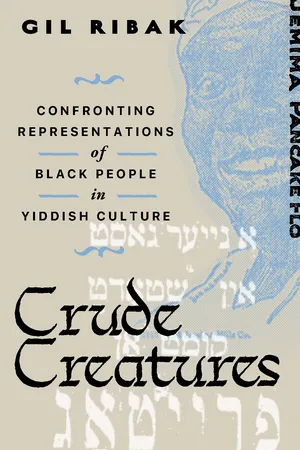
Understandings of Black-Jewish relations have been notable for the near consensus among scholars that the Yiddish press repeatedly condemned discrimination and prejudice against African Americans, and highlighted the similarities between the situation of Jews in Eastern Europe and Blacks in America. This book argues that this view covers just a sliver of the varied representations of Black women and men. East European Jewish culture during the immigration era was not uniformly supportive of Black Americans as those interpretations suggest.
Crude Creatures draws on a mixture of previously unexplored Yiddish press, theatre, and literature from Eastern Europe and the United States through 1929 to examine how Black Africans and African Americans were depicted. It charts a significant gap between the sincere condemnation of lynching, violence against Black Americans, and racial segregation on the one hand, and the ways in which Jewish authors, newspapers, playwrights, actors, and theater managers actually represented Black people on the other. While most East European Jews would not have seen a Black person before their arrival in America, they had already acquired preconceived imagery of Black people through rabbinic exegesis, pious advice, travel narratives (either original or adapted from other languages), folklore, scientific explorations, pulp literature, press reports, political rhetoric, and educational materials. Thus, Yiddish writers commonly described Black people as cannibals, oversexed, prone to violence, childlike, or just happy-go-lucky people.
Crude Creatures provides a critical revision, correcting the accepted rosy narrative of Black women and men's portrayals in Yiddish culture, and highlighting what we can learn from these representations about how immigrant groups integrated their own cultures into American racial hierarchy and vocabulary.
- English
- ePUB (mobile friendly)
- Available on iOS & Android
eBook - ePub
About this book
Information
Table of contents
- Cover
- Title Page
- Copyright Page
- Dedication
- Contents
- A Note on Transliteration and Orthography
- Introduction
- 1. “Mothers Sell Their Little Children”: Imagining Blackness in Eastern Europe
- 2. The Negro Took the Place of the Peasant: The Encounter Between East European Jewish Immigrants and African Americans
- 3. “They Deserve All the Political and Economic Rights”: Contradictory Attitudes Toward Black People in the Yiddish Press
- 4. “My Mom Drank Ink”: The Performance of Race in the Yiddish Theater and Drama
- 5. “A Heavy Bodily Scent”: Black Characters in Yiddish Prose
- Epilogue: In Search of a More Palatable Past
- Acknowledgments
- Notes
- Index
- About the Author
Trusted by 375,005 students
Access to over 1.5 million titles for a fair monthly price.
Study more efficiently using our study tools.
Frequently asked questions
Yes, you can cancel anytime from the Subscription tab in your account settings on the Perlego website. Your subscription will stay active until the end of your current billing period. Learn how to cancel your subscription
No, books cannot be downloaded as external files, such as PDFs, for use outside of Perlego. However, you can download books within the Perlego app for offline reading on mobile or tablet. Learn how to download books offline
Perlego offers two plans: Essential and Complete
- Essential is ideal for learners and professionals who enjoy exploring a wide range of subjects. Access the Essential Library with 800,000+ trusted titles and best-sellers across business, personal growth, and the humanities. Includes unlimited reading time and Standard Read Aloud voice.
- Complete: Perfect for advanced learners and researchers needing full, unrestricted access. Unlock 1.5M+ books across hundreds of subjects, including academic and specialized titles. The Complete Plan also includes advanced features like Premium Read Aloud and Research Assistant.
We are an online textbook subscription service, where you can get access to an entire online library for less than the price of a single book per month. With over 1.5 million books across 990+ topics, we’ve got you covered! Learn about our mission
Look out for the read-aloud symbol on your next book to see if you can listen to it. The read-aloud tool reads text aloud for you, highlighting the text as it is being read. You can pause it, speed it up and slow it down. Learn more about Read Aloud
Yes! You can use the Perlego app on both iOS and Android devices to read anytime, anywhere — even offline. Perfect for commutes or when you’re on the go.
Please note we cannot support devices running on iOS 13 and Android 7 or earlier. Learn more about using the app
Please note we cannot support devices running on iOS 13 and Android 7 or earlier. Learn more about using the app
Yes, you can access Crude Creatures by Gil Ribak in PDF and/or ePUB format, as well as other popular books in Social Sciences & Jewish Theology. We have over 1.5 million books available in our catalogue for you to explore.