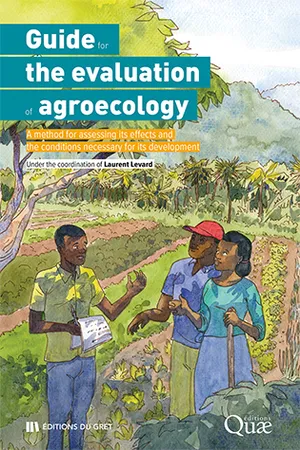
Guide for the evaluation of agroecology
A method for assessing its effects and the conditions necessary for its development
- 308 pages
- English
- PDF
- Available on iOS & Android
About this book
The Guide for the evaluation of agroecology proposes an approach and methodological tools for assessing the effects of agro ecological practices and systems on the agro-environmental and socio-economic performance of agriculture, and for assessing the conditions necessary for the development of agroecology. It aims to: help development stakeholders better design their projects, programmes and public policies in support of agroecology; facilitate the creation of references (performance and conditions necessary for development); and assist farmers so that they can better evaluate the results of their practices and thus have guidance for making decisions.
This Guide is divided into three parts. The first part presents the general approaches for one-off evaluations and for monitoring and evaluation. The second part consists of evaluation sheets covering either agro-environmental and socio-economic aspects that may be impacted by agroecology, or the conditions necessary for the development of agroecology. The third part proposes additional methodologies in the form of tool sheets.
This guide is the result of collaboration between GTAE (Agrisud International, AVSF, CARI and GRET), AgroParisTech, CIRAD, IRD and Institut Agro Montpellier.
This book is available in French: Guide pour l'évaluation de l'agroécologie
Frequently asked questions
- Essential is ideal for learners and professionals who enjoy exploring a wide range of subjects. Access the Essential Library with 800,000+ trusted titles and best-sellers across business, personal growth, and the humanities. Includes unlimited reading time and Standard Read Aloud voice.
- Complete: Perfect for advanced learners and researchers needing full, unrestricted access. Unlock 1.4M+ books across hundreds of subjects, including academic and specialized titles. The Complete Plan also includes advanced features like Premium Read Aloud and Research Assistant.
Please note we cannot support devices running on iOS 13 and Android 7 or earlier. Learn more about using the app.
Information
Table of contents
- Contents
- Introduction
- PART 1 General approaches for one-off evaluations and for monitoring and evaluation
- PART 2 Evaluation sheets
- PART 3 Tool sheets
- General bibliography
- List of authors