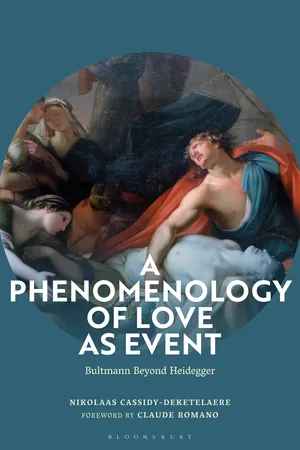
Rescuing Rudolf Bultmann from Heidegger's shadow, Nikolaas Cassidy-Deketelaere presents a philosophical reading of his theology, which reveals his unique phenomenology of love as an event.
Bultmann (1884-1976) is often regarded as a mere footnote to Heidegger's philosophy: a theologian whose thought was principally built on the Heideggerian analytic of human finitude. Yet, by reading Bultmann anew, in light of other continental philosophers' engagement with Heidegger – from Jaspers and Levinas to Ricœur and Falque – this book rejects that idea as a misunderstanding. Instead it contends that Bultmann radically develops and even improves upon Heidegger's phenomenology.
Guiding the reader through his argument in a clear and compelling style, Cassidy-Deketelaere reveals how Bultmann understands the experience of love as not being limited to an empirical occurrence but rather having a truly transcendental scope: what phenomenologists would now call 'event'. With this, Bultmann's theology not only resolves the contemporary critique of Heidegger's method as precluding a dynamic between the empirical and transcendental, but further provides a new alternative paradigm of human finitude based on love, and not death (Heidegger) or birth (Arendt).
Far more than a footnote, The Phenomenology of Love as Event uncovers Bultmann's significant contribution to philosophy. Through his theological writings, Bultmann shows us that love is the central experience of human existence, one that transforms the being of Dasein, despite Heidegger never allowing for it.
- 281 pages
- English
- PDF
- Available on iOS & Android
eBook - PDF
About this book
Information
Topic
PhilosophySubtopic
Phenomenology in PhilosophyTable of contents
- Cover
- Half Title
- Series Page
- Title Page
- Copyright Page
- Dedication
- Contents
- Foreword by Claude Romano
- Acknowledgements
- Introduction: The philosophy of Rudolf Bultmann
- Part I: Existentialism: John Macquarrie and Martin Heidegger
- Chapter 1: The project of an existentialist theology
- Chapter 2: The comparison of Heidegger and Bultmann
- Chapter 3: The poverty of the empirical
- Part II: Hermeneutics: Paul Ricœur and Karl Jaspers
- Chapter 4: A Lutheran hermeneutics of the event
- Chapter 5: The interpretation of faith
- Chapter 6: The limits of faith
- Part III: Lutheran Neo-Kantianism: The Marburg School
- Chapter 7: Bultmann and the intellectual life of Marburg
- Chapter 8: The logical idealism of Cohen and Natorp
- Chapter 9: Herrmann’s Lutheran anthropology
- Part IV: Phenomenology: Towards an eschatological ontology of love
- Chapter 10: The eschatological event
- Chapter 11: The transcendental scope of experience
- Chapter 12: The being of love
- Conclusion: The finitude of love
- Notes
- Bibliography
- Index
Trusted by 375,005 students
Access to over 1.5 million titles for a fair monthly price.
Study more efficiently using our study tools.
Frequently asked questions
Yes, you can cancel anytime from the Subscription tab in your account settings on the Perlego website. Your subscription will stay active until the end of your current billing period. Learn how to cancel your subscription
No, books cannot be downloaded as external files, such as PDFs, for use outside of Perlego. However, you can download books within the Perlego app for offline reading on mobile or tablet. Learn how to download books offline
We are an online textbook subscription service, where you can get access to an entire online library for less than the price of a single book per month. With over 1.5 million books across 990+ topics, we’ve got you covered! Learn about our mission
Look out for the read-aloud symbol on your next book to see if you can listen to it. The read-aloud tool reads text aloud for you, highlighting the text as it is being read. You can pause it, speed it up and slow it down. Learn more about Read Aloud
Yes! You can use the Perlego app on both iOS and Android devices to read anytime, anywhere — even offline. Perfect for commutes or when you’re on the go.
Please note we cannot support devices running on iOS 13 and Android 7 or earlier. Learn more about using the app
Please note we cannot support devices running on iOS 13 and Android 7 or earlier. Learn more about using the app
Yes, you can access A Phenomenology of Love as Event by Nikolaas Cassidy-Deketelaere in PDF and/or ePUB format, as well as other popular books in Philosophy & Phenomenology in Philosophy. We have over 1.5 million books available in our catalogue for you to explore.