- English
- ePUB (mobile friendly)
- Available on iOS & Android
eBook - ePub
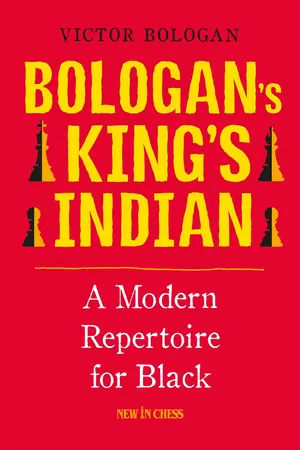
Bologan's King's Indian
About this book
The King's Indian Defence is arguably the most ambitious and exciting way to play against 1.d4. Black wants to start an early attack on his opponent's king, relying on the dynamic potential of his position. The KID has been a favourite of legendary attacking players such as Mikhail Tal, Bobby Fischer and Garry Kasparov, and remains highly popular at club level. Respected Grandmaster and acknowledged chess opening expert Victor Bologan presents a complete King's Indian repertoire for Black that is much more than just a lucidly explained and very playable set of responses. In many lines he presents two options to handle the Black position. Bologan's explanations are accessible for a wide range of players and he provides the reader with a thorough grounding in the strategic and tactical motifs. White players can benefit from this book as well, since he looks at things from both sides. During his research, Bologan has found many new ideas and resources. With this book under your belt you can go to your next tournament with confidence. You will win many exciting games with Bologan's King's Indian!
Information
Publisher
New in ChesseBook ISBN
9789056917241
Year
2017Table of contents
- Copyright Page
- Contents
- Foreword: The King’s Indian cottage
- Part I: Rare continuations: 1.d4 ♘f6 2.c4 g6 3.♘c3 ♗g7
- Part II: Averbakh System: 4.e4 d6 5.♗e2 0-0 6.♗g5
- Part III: Sämisch System: 4.e4 d6 5.f3
- Part IV: Four Pawns Variation: 4.e4 d6 5.f4
- Part V: Classical System: 4.e4 d6 5.♘f3 0-0 6.♗e2 e5
- Part VI: Fianchetto: 3.♘f3 ♗g7 4.g3 0-0 5.♗g2 d6 6.0-0 ♘c6
- Part VII: Other fianchetto lines
- Part VIII: London and Torre Systems
- Part IX: Positions for solving
- Index of variations
- Bibliography
- Explanation of symbols
Trusted by 375,005 students
Access to over 1.5 million titles for a fair monthly price.
Study more efficiently using our study tools.