- English
- ePUB (mobile friendly)
- Available on iOS & Android
eBook - ePub
About this book
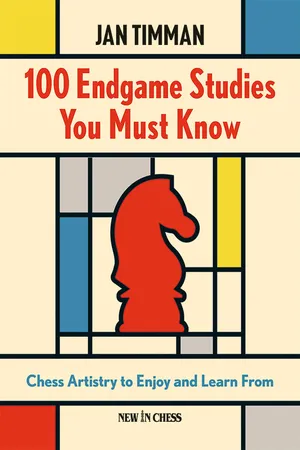
Perhaps the greatest beauty in chess can be found in endgame studies. Delightful twists and turns on the board are combined into true works of art. In studies, chess is distilled into its purest form, with all pieces making only the most essential moves. Endgame studies are also useful exercises for practical chess players, as they show patterns, improve calculation, and inspire out-of-the-box thinking. Grandmaster Jan Timman has been fascinated by endgame studies since his youth. The artistry and perfection have always appealed to him. In recent years his focus has shifted from practical chess to composing endgame studies, and many of his compositions have won awards. Timman wrote about composing in The Art of the Endgame. (New In Chess, Revised Edition 2023). In this new book Timman presents the one hundred greatest endgame studies. In five chapters he guides you through masterpieces of increasing difficulty, beginning with elementary endings such as the Réti and Lasker manoeuvres. The studies include themes such as minor) promotion, Zugzwang and domination, all beautifully illustrated and clearly explained. By the time you reach the final chapter with the most complicated examples, you will be amazed at the myriad possibilities of chess and inspired to add more finesse to your own endgame play.
Information
Publisher
New in ChesseBook ISBN
9789083406435
Year
2024Table of contents
- Copyright Page
- Contents
- Explanation of Symbols
- Preface
- Chapter 1 Elementary endings
- Chapter 2 Classical studies
- Chapter 3 More complicated studies
- Chapter 4 Special themes
- Chapter 5 Complex studies
- Glossary of terms
- Bibliography
Trusted by 375,005 students
Access to over 1.5 million titles for a fair monthly price.
Study more efficiently using our study tools.