Sergei Tiviakov was unbeaten in a streak of more than a hundred chess games as a professional player. Who better to share the secrets of Rock Solid Chess and the activity and value of pieces than Tiviakov?
The highly acclaimed first volume of his chess strategy trilogy dealt with pawn structures. In this second volume, Sergei moves on to discuss piece play and unique chessboard situations. Topics covered include the bishop pair, opposite-coloured bishops, centralization and the almost-ignored question of when and whether to castle.
Tiviakov also demonstrates how the value of pieces can vary drastically depending on their exact position. He shows how the entire assessment of a position, and the correct strategy for playing it, can be changed by moving a single pawn from one square to another.
In the final chapters, Tiviakov discusses how to play cramped and passive positions, how to play for a win with Black and how to choose your strategy, based on the opponent’s style and other psychological factors.
Illustrated with examples from classic games and from his own games, and supported by instructive exercises, Volume Two of Rock Solid Chess offers invaluable and unique instruction on topics not covered in traditional textbooks. These strategy lessons will significantly improve your chess and are suitable for all readers, from club players to grandmasters.
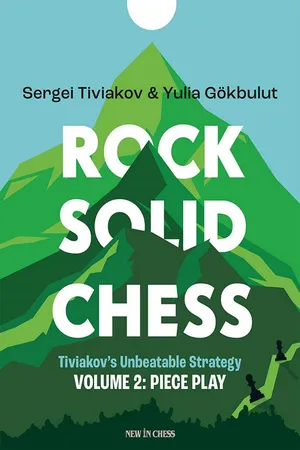
eBook - ePub
Rock Solid Chess
Tiviakov's Unbeatable Strategies: Piece Play V2
- English
- ePUB (mobile friendly)
- Available on iOS & Android
eBook - ePub
About this book
Information
Publisher
New in ChesseBook ISBN
9789083387710
Year
2024Table of contents
- Copyright Page
- Contents
- Explanation of symbols
- Introduction
- Chapter 1 The effect of moving one pawn on the assessment of the position
- Chapter 2 The relative value of tempi in different positions
- Chapter 3 The relative value of pieces depending on their position on the board
- Chapter 4 The advantage of the two bishops
- Chapter 5 Opposite-coloured bishops
- Chapter 6 Maximum centralization: the key to success
- Chapter 7 Domination
- Chapter 8 Playing cramped and passive positions
- Chapter 9 Flexibility with castling
- Chapter 10 Choosing a plan depending on your opponent’s style, your own physical and psychological condition, and position in the tournament
- Conclusion
- Index of names
- Bibliography
Trusted by 375,005 students
Access to over 1.5 million titles for a fair monthly price.
Study more efficiently using our study tools.