eBook - ePub
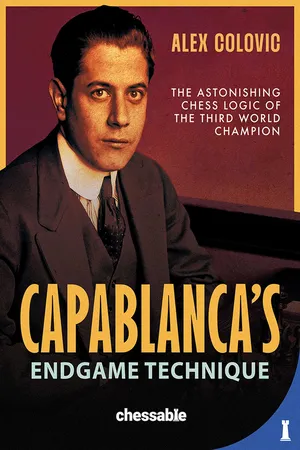
Capablanca's Endgame Technique
The Astonishing Chess Logic of the 3rd World Champion
- English
- ePUB (mobile friendly)
- Available on iOS & Android
eBook - ePub
About this book
Although Jose Raul Capablanca was the World Chess Champion a century ago, his games remain among the most interesting to study. The clear logic and simplicity of his moves inspired other great players such as Mikhail Botvinnik and Bobby Fischer. And the clarity of his play will boost the confidence of any chess student. It all seems so easy when you read the explanations, says a student in a comment on Chessable, so much so that you really believe you can play like Capablanca. Capablanca's most instructive endgames will help you to understand: - The principle of two weaknesses - the art of creating a second weakness, leaving opponents helpless because they cannot deal with both at the same time. - How to convert an advantage in the endgame, not by brute calculation, but by knowing where best to position your pieces. - Sharpen your intuition in double rook endgames and avoid wasting energy calculating everything and making mistakes. - The key concept of prophylaxis when it comes to trading pieces, a remarkable aspect of all Capablanca's games. You will learn when to trade off unnecessary pieces. Capablanca's Endgame Technique will help you play with precision at all levels of the game, not just in the endgame. It was Capablanca himself who said, 'To improve your game, you must study the endgame before anything else.'
Table of contents
- Copyright Page
- Contents
- Preface
- Introduction
- Chapter 1: The complete Capablanca
- Chapter 2: Conversion of an advantage
- Chapter 3: The principle of two weaknesses
- Chapter 4: Double-rook endgames
- Chapter 5: Piece activity in the endgame
- Chapter 6: Drawn endgames
- Index of names
Trusted by 375,005 students
Access to over 1.5 million titles for a fair monthly price.
Study more efficiently using our study tools.