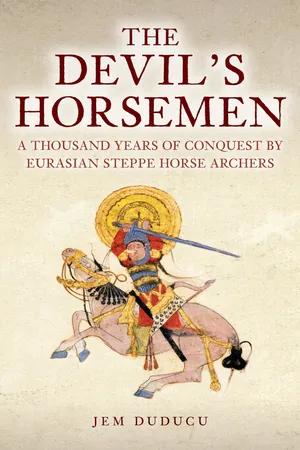
The Devil's Horsemen
A Thousand Years of Conquest by Eurasian Steppe Horse Archers
- English
- ePUB (mobile friendly)
- Available on iOS & Android
About this book
In the fifth century, Attila the Hun terrorised both the Eastern and Western Roman Empires; his were the first of the Devil's horsemen. After his death his empire quickly disintegrated – but then came the Magyars, fighting the early Holy Roman Empire, and the heavy cavalry used to counter them is where the concept of the knight in armour comes from. Thirdly, there are the Turks, the only group that didn't expand into Europe, but instead conquered the Middle East. Like the other groups, they were shamanistic pagans and yet within a generation they had converted to Islam.
Fourthly, and most famously, we have the Mongol Empire, the largest land-based empire in history, spreading from Korea to Poland. It was hugely important for a century and its impact lasted for half a millennium. Finally, there is Tamerlane. Alexander the Great gets a lot of credit for fighting for eight years without a loss. Tamerlane fought for 25 without loss and he was paralysed down one side of his body. He would even vanquish two of the earlier groups, in wars against the Mongols and the Turkish Ottoman sultans.
What links them all is the horse as a weapon of war. In his own attractive style – 'as accessible as it is informative' (Deus Vult) – Jem Duducu rides across a thousand years of conquest on horseback.
Frequently asked questions
- Essential is ideal for learners and professionals who enjoy exploring a wide range of subjects. Access the Essential Library with 800,000+ trusted titles and best-sellers across business, personal growth, and the humanities. Includes unlimited reading time and Standard Read Aloud voice.
- Complete: Perfect for advanced learners and researchers needing full, unrestricted access. Unlock 1.4M+ books across hundreds of subjects, including academic and specialized titles. The Complete Plan also includes advanced features like Premium Read Aloud and Research Assistant.
Please note we cannot support devices running on iOS 13 and Android 7 or earlier. Learn more about using the app.
Information
Table of contents
- Cover
- Introduction
- 1 Life on the Steppe
- 2 The Origins of the Hunnic Empire
- 3 Attila the Hun
- 4 The Avars and the Magyars
- 5 The Turks
- 6 The Ottomans
- 7 Temujin
- 8 The Mongols after Genghis Khan
- 9 Emir Timur
- 10 Babur and the Mughal Empire
- Conclusion
- Bibliography