- English
- ePUB (mobile friendly)
- Available on iOS & Android
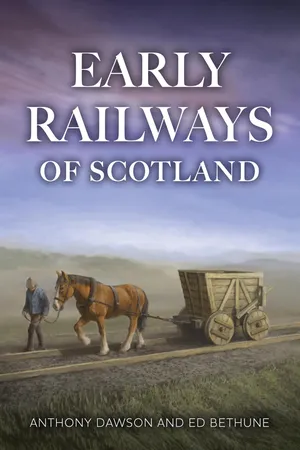
Early Railways of Scotland
About this book
Scottish railway history began in 1722 when William Dickson commenced work on the Tranent–Cockenzie Waggonway. Built entirely in wood and designed to carry coal from pits at Tranent to salt pans at Cockenzie, it was the first railway to be built in Scotland. Developing first in the most industrialised parts of the country, in the Lothians and later around Glasgow, wooden and iron railways flourished in no small part thanks to the work of Robert Stevenson. Ed Bethune and Anthony Dawson of the 1722 Waggonway Project present a century-long tour of the earliest of Scottish railways, beginning in 1722 and ending with the Garnkirk & Glasgow Railway of 1831, the first 'modern' railway in Scotland. The 1722 Waggonway Heritage Group was established in 2017 to preserve, promote and enhance the history of the Tranent–Cockenzie Waggonway through research, archaeology and community heritage initiatives. Thanks to the work of the group, much is now known about how early wooden railways were constructed and how early nineteenth-century fish-bellied rails laid on stone blocks worked, as well as the 1833 Robert Stevenson-designed harbour at Cockenzie.
Brand-new information from the archival and archaeological work into Scotland's earliest railways is showcased alongside fascinating and rare images, all serving to set the scene for the beginnings of the Scottish railway network as conceived by trailblazers William Dickson, William Adam and Robert Stevenson.
Frequently asked questions
- Essential is ideal for learners and professionals who enjoy exploring a wide range of subjects. Access the Essential Library with 800,000+ trusted titles and best-sellers across business, personal growth, and the humanities. Includes unlimited reading time and Standard Read Aloud voice.
- Complete: Perfect for advanced learners and researchers needing full, unrestricted access. Unlock 1.4M+ books across hundreds of subjects, including academic and specialized titles. The Complete Plan also includes advanced features like Premium Read Aloud and Research Assistant.
Please note we cannot support devices running on iOS 13 and Android 7 or earlier. Learn more about using the app.
Information
Table of contents
- Cover
- Foreword by Andrew McLean, National Railway Museum
- 1 Origins
- 2 The First Waggonways
- 3 The Introduction of Iron
- 4 The Coming of Steam
- 5 What to See and Places to Go
- Final Thoughts
- Bibliography and Further Reading
- Acknowledgements