- English
- ePUB (mobile friendly)
- Available on iOS & Android
eBook - ePub
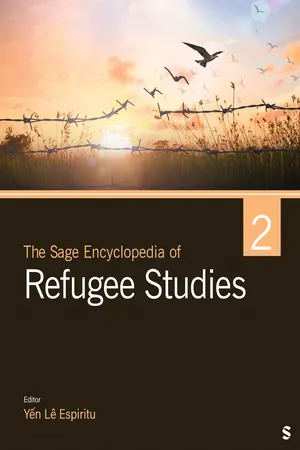
The Sage Encyclopedia of Refugee Studies
About this book
Refugees and displacement are defining issues of the 21st century, with over 70 million asylum seekers, refugees, and stateless individuals forced from their homes as of 2020. Every two seconds, one person is forcibly displaced due to climate change, global epidemics, and ongoing conflicts. The SAGE Encyclopedia of Refugee Studies, edited by members of The Critical Refugee Studies Collective, serves as a vital and comprehensive resource for understanding the historical, political, and cultural dimensions of displacement.
Featuring over 250 authoritative articles, this landmark reference work is organized into three key themes: law, politics, and policy; humanitarianism and humanitarian organizations; and media, culture, and storytelling. Drawing from disciplines such as migration studies, Indigenous studies, critical race studies, environmental studies, sociology, political science, law, anthropology, and the arts, this encyclopedia critically examines refugee issues in relation to imperialism, racism, patriarchy, and militarism.
Beyond academic analysis, The SAGE Encyclopedia of Refugee Studies centers refugee voices through narratives, first-person accounts, and visual storytelling, highlighting the lived experiences, communities, and creative expressions of displaced individuals. This essential resource is invaluable for scholars, educators, policymakers, community-based organizations, and refugees themselves.
Information
Table of contents
- Cover
- Half Title
- Editorial Board
- Title Page
- Copyright Page
- List of Entries
- About the Editor
- About the Associate Editors
- List of Contributors
- Introduction
- Access to Health Care
- Aesthetics
- Africa
- Alternate Economies
- Amerasians, U.S.
- American Dream or American Nightmare
- Amnesty
- Ancestor as Refugee
- Anti-Blackness
- Anti-Muslim Racism
- Archive, Community
- Asia and the Pacific
- Asylum System, U.S.
- Asylum, Agency, and Victim Narratives
- Beauty
- Boat People
- Boat People, Australia
- Border Control Industry and Refugees
- Border Patrols
- Border Security
- Burden Sharing
- Care and Care Work
- Caribbean Basin, Refugees in
- Cartagena Declaration, 1984
- Central American Migrant Caravans
- Central American Revolutions
- Changing Gender Relations
- Child Labor
- Children’s Picture Books
- Citizenship
- Climate Change and Displacement
- Cold War Refugees, Asia
- Cold War Refugees, Central America and the Hispanic Caribbean
- Cold War Refugees, South America
- Collaborative Media-Making
- Collective Refugee Poetry
- Colonialism
- Communism, Europe
- Community Gardens
- Compulsory Dispersal
- COVID‐19 and Southeast Asian Americans
- Criminalization of Refugees
- Crossing
- Dalit Refugeehood
- Dance
- Decolonization in Refugee and Forced Migration Studies
- Deportation
- Detention Centers
- Diasporic Refusal
- Digital Archives
- Digital Bordering
- Digital Poetics
- Digital Resistance
- Displaced Children
- Documentary
- Ecofeminism
- Employment and Workforce Integration
- Engaged Scholarship
- Environmental Activism
- Ethnic Restaurants
- Europe
- European Union’s Dublin Regulation
- Évian Conference
- Exile
- Feminized Labor, Asia–Pacific Region
- Fiction
- Frontex
- Futurity
- Gaza Strip
- Gender and Asylum
- Genocide and Displacement
- Graphic Novels
- Hauntings
- Home
- Hostile Terrain
- Human Rights and Refugees
- Humanitarian Parole
- Hunger Strikes
- Hybrid Governmentality
- Hyper-Reproductivity
- Illegal Immigration Reform and Immigrant Responsibility Act of 1996
- Indigenous Refugees
- Intercountry and Transracial Adoption
- Interdiction at Sea
- Internally Displaced Persons
- Joy
- Kidnapping, Ransoming, and Extortion
- Land Refugees
- Language Education for Refugees
- Latin American Dependency Theory
- Life Writing
- Lip-Sewing Protests
- Literature
- Little Amal
- Livability
- Living Knowledges
- Loss
- Mapping Displacement
- Mariel Boatlift
- Medical Screening and Misdiagnoses
- Mediterranean Basin, The
- Memoirs
- Memory and Trauma
- Mental Health
- Migrant Justice Movements
- Militarized Humanitarianism
- Military Waste and Displacement
- Mobile Media and Refugees
- Monuments
- Nakba
- Neoliberalism
- Networked Refugees
- 1980 Refugee Act, U.S.
- 1951 UN Refugee Convention and 1967 Protocol
- 1969 OAU Convention
- North American Free Trade Agreement
- Oceania
- Operation New Life
- Orphan
- Outsourcing Asylum
- Palestinian Youth in Diaspora
- Partition Migrations
- Performance
- Philippine Refugee Centers
- Photography and Refugees
- Pinkwashing
- Placemaking Activities
- Poetry
- Postmemory
- Post-Socialist Transitions
- Prevention Through Deterrence
- Private Sponsorship
- Protection Gaps
- Public Witnessing
- Quarantine Camp, HIVAIDS
- Queer and Trans Migrations
- Queer Dis/Inheritance
- Queer Families
- Radio
- Rage
- Refuge
- Refugee (In)Gratitude
- Refugee Administrative Pipelines
- Refugee Agency
- Refugee Archives
- Refugee Art
- Refugee Artivism
- Refugee Cinema
- Refugee Cities
- Refugee Collective Action
- Refugee Comics
- Refugee Detention Protest
- Refugee Dignity
- Refugee Entrepreneurship
- Refugee Exclusion
- Refugee Feelings
- Refugee Film Festivals
- Refugee Housing
- Refugee Humor
- Refugee Integration in the Global South
- Refugee Lifeworlds
- Refugee Music
- Refugee Nationalism
- Refugee Pedagogy
- Refugee Repertoire
- Refugee Resettlement
- Refugee Settlers
- Refugee Status Determination
- Refugee Teaching
- Refugee Temporality
- Refugee, Definition
- Refugeehood and Freedom
- Refugees and Gang Violence
- Refugees in Antiquity
- Refugees in Higher Education
- Religion and Forced Migration
- Rematriation
- Remittances
- Remote Border Control
- Repatriation
- Rescue
- Resilience
- Returnees
- Right of Return
- Right to Move
- Safe Third Country Agreement
- Sanctuary Movements
- Scholars at Risk
- Scholasticide and Sophicide
- School-to-Prison-to-Deportation Pipeline
- Second-Generation Refugees
- Securitization of Social Services
- Security
- Selfies
- Settler Carcerality
- Settler Colonialism
- Sexual and Reproductive Health
- Shamans
- Silences
- South America
- Spatial Politics
- Storytelling
- Students With Interrupted Formal Education
- Super-Refugees
- Surveillance Systems
- Survivance
- Tear Gas and Borders
- Temporary Protected Status, U Visas, and T Visas
- Testimony
- Theater
- TikTok and Refugees
- Title 42, U.S.
- Transborder Music
- Transgenerational Trauma
- Transnational Families
- Undocumented Immigration
- Uneven Humanitarianism
- United Nations High Commissioner for Refugees
- Universal Declaration of Human Rights
- Waiting
- War and Militarized Violence
- War on Terror
- Water
- Well-Being and Healing
- World War II and Forced Migration
- Zionism
- Index
Trusted by 375,005 students
Access to over 1.5 million titles for a fair monthly price.
Study more efficiently using our study tools.
Frequently asked questions
Yes, you can cancel anytime from the Subscription tab in your account settings on the Perlego website. Your subscription will stay active until the end of your current billing period. Learn how to cancel your subscription
No, books cannot be downloaded as external files, such as PDFs, for use outside of Perlego. However, you can download books within the Perlego app for offline reading on mobile or tablet. Learn how to download books offline
Perlego offers two plans: Essential and Complete
- Essential is ideal for learners and professionals who enjoy exploring a wide range of subjects. Access the Essential Library with 800,000+ trusted titles and best-sellers across business, personal growth, and the humanities. Includes unlimited reading time and Standard Read Aloud voice.
- Complete: Perfect for advanced learners and researchers needing full, unrestricted access. Unlock 1.5M+ books across hundreds of subjects, including academic and specialized titles. The Complete Plan also includes advanced features like Premium Read Aloud and Research Assistant.
We are an online textbook subscription service, where you can get access to an entire online library for less than the price of a single book per month. With over 1.5 million books across 990+ topics, we’ve got you covered! Learn about our mission
Look out for the read-aloud symbol on your next book to see if you can listen to it. The read-aloud tool reads text aloud for you, highlighting the text as it is being read. You can pause it, speed it up and slow it down. Learn more about Read Aloud
Yes! You can use the Perlego app on both iOS and Android devices to read anytime, anywhere — even offline. Perfect for commutes or when you’re on the go.
Please note we cannot support devices running on iOS 13 and Android 7 or earlier. Learn more about using the app
Please note we cannot support devices running on iOS 13 and Android 7 or earlier. Learn more about using the app
Yes, you can access The Sage Encyclopedia of Refugee Studies by Yen Le Espiritu in PDF and/or ePUB format, as well as other popular books in Social Sciences & Emigration & Immigration. We have over 1.5 million books available in our catalogue for you to explore.