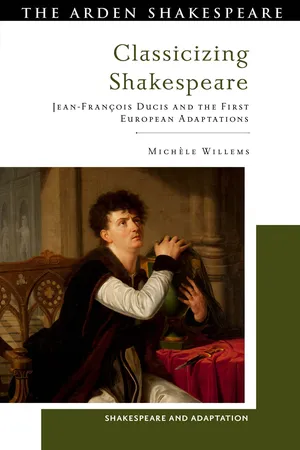
This book explores the nature and wide-ranging impact of the work of Jean-François Ducis (1733-1816), the first adaptor of Hamlet and of five other Shakespeare tragedies for the French theatre.
Jean-François Ducis is anything but prominent in the histories of Shakespeare adaptation, yet he was pivotal in introducing French and European audiences to Shakespeare's plays on the stage. His Hamlet, tragédie imitée de l'anglais, performed at the Comédie française in 1769, was the first representation of a Shakespeare play on a French stage and was still performed in 1851. Despite his total ignorance of English, Ducis also adapted Romeo and Juliet, Macbeth, King Lear, King John and Othello, playswhich were then translated, like his Hamlet, into a number of European languages.
Classicizing Shakespeare studies Ducis's Shakespearean corpusin the context of the neoclassical climate which, a century earlier, had set off a wave of adaptations in England. Within the wider picture of the European representation of Shakespeare on the stage from 1660 to 1850, the study of Ducis's emblematic case sheds further light on the rationale of these English adaptations as well as on the reception of Shakespeare's plays in most Continental countries well into the 19th century. Willems' rich contextual study demonstrates why the translations of Ducis's own 'imitations' were instrumental in exporting Shakespeare all over the Continent. Through attention to the professional relationship with the renowned actor, François-Joseph Talma, Classicizing Shakespeare reveals too how collaborative practices in the theatre impact on the evolution of a text.
eBook - PDF
Classicizing Shakespeare
Jean-François Ducis and the First European Adaptations
- 249 pages
- English
- PDF
- Available on iOS & Android
eBook - PDF
Classicizing Shakespeare
Jean-François Ducis and the First European Adaptations
About this book
Information
Table of contents
- Cover
- Contents
- List of illustrations
- Note on text/translation
- List of abbreviations
- Preface
- Acknowledgements
- Introduction: Classicizing Shakespeare
- 1 From criticism to adaptation
- 2 Jean-François Ducis
- 3 Hamlet
- 4 Roméo et Juliette
- 5 Le Roi Léar
- 6 Macbeth
- 7 Jean Sans-Terre ou La mort d’Arthur
- 8 Othello
- 9 Appropriation or re-vision?
- 10 The construction of a European Shakespeare
- Notes
- References
- Index
Trusted by 375,005 students
Access to over 1.5 million titles for a fair monthly price.
Study more efficiently using our study tools.
Frequently asked questions
Yes, you can cancel anytime from the Subscription tab in your account settings on the Perlego website. Your subscription will stay active until the end of your current billing period. Learn how to cancel your subscription
No, books cannot be downloaded as external files, such as PDFs, for use outside of Perlego. However, you can download books within the Perlego app for offline reading on mobile or tablet. Learn how to download books offline
Perlego offers two plans: Essential and Complete
- Essential is ideal for learners and professionals who enjoy exploring a wide range of subjects. Access the Essential Library with 800,000+ trusted titles and best-sellers across business, personal growth, and the humanities. Includes unlimited reading time and Standard Read Aloud voice.
- Complete: Perfect for advanced learners and researchers needing full, unrestricted access. Unlock 1.5M+ books across hundreds of subjects, including academic and specialized titles. The Complete Plan also includes advanced features like Premium Read Aloud and Research Assistant.
We are an online textbook subscription service, where you can get access to an entire online library for less than the price of a single book per month. With over 1.5 million books across 990+ topics, we’ve got you covered! Learn about our mission
Look out for the read-aloud symbol on your next book to see if you can listen to it. The read-aloud tool reads text aloud for you, highlighting the text as it is being read. You can pause it, speed it up and slow it down. Learn more about Read Aloud
Yes! You can use the Perlego app on both iOS and Android devices to read anytime, anywhere — even offline. Perfect for commutes or when you’re on the go.
Please note we cannot support devices running on iOS 13 and Android 7 or earlier. Learn more about using the app
Please note we cannot support devices running on iOS 13 and Android 7 or earlier. Learn more about using the app
Yes, you can access Classicizing Shakespeare by Michèle Willems, Mark Thornton Burnett in PDF and/or ePUB format, as well as other popular books in Literature & Literary Criticism of Shakespeare. We have over 1.5 million books available in our catalogue for you to explore.