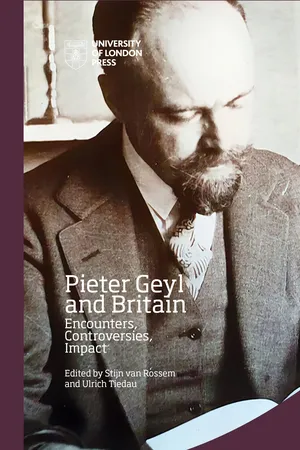
Pieter Geyl (1887—1966) was undoubtedly one of the most internationally renowned Dutch historians of the twentieth century, but also one of the most controversial. Having come to the UK as a journalist, he started his academic career at the University of London in the aftermath of World War I (1919) and played an important role in the early days of the Institute of Historical Research. Known in this time for his re-interpretation of the sixteenth-century Dutch Revolt against the Habsburgs, that challenged existing historiographies of both Belgium and the Netherlands but was also linked to his political activism in favour of the Flemish movement in Belgium, Geyl left his stamp on the British perception of Low Countries history before moving back to his country of origin in 1935. Having spent World War II in German hostage camps, he famously coined the adage of history being 'a discussion without end' and re-engaged in public debates with British historians after the war, partly conducted on the airwaves of the BBC. A prolific writer and an early example of a 'public intellectual', Geyl remains one of the most influential thinkers on history of his time. The present volume re-examines Geyl's relationship with Britain (and the Anglophone world at large) and sheds new light on his multifaceted work as a historian, journalist, homme de lettres and political activist.
- English
- ePUB (mobile friendly)
- Available on iOS & Android
eBook - ePub
About this book
Information
Table of contents
- Cover
- Title Page
- Copyright
- Dedication
- Contents
- Notes on contributors
- List of figures
- 1. Geyl and Britain: an introduction Ulrich Tiedau and Stijn van Rossem
- 2. The Greater Netherlands idea of Pieter Geyl (1887–1966) Pieter van Hees
- 3. Pieter Geyl and Émile Cammaerts: the Dutch and Belgian chairs at the University of London between academia and propaganda, 1914–1935 Ulrich Tiedau
- 4. Pieter Geyl and the Institute of Historical Research Stijn van Rossem
- 5. ‘It’s a part of me’: the literary ambitions of Pieter Geyl Wim Berkelaar
- 6. Pieter Geyl and the idea of federalism Leen Dorsman
- 7. Debating Toynbee after the Holocaust: Pieter Geyl as a post-war public historian Remco Ensel
- 8. Pieter Geyl and the eighteenth century Reinier Salverda
- 9. The historiographical legacy of Pieter Geyl for revolutionary and Napoleonic studies Mark Edward Hay
- 10. Pieter Geyl and his entanglement with German Westforschung Alisa van Kleef
- 11. Between Leuven and Utrecht: the afterlife of Pieter Geyl and the ‘Greater Netherlands idea’ Fons Meijer
- Bibliography
- Index
Trusted by 375,005 students
Access to over 1.5 million titles for a fair monthly price.
Study more efficiently using our study tools.
Frequently asked questions
Yes, you can cancel anytime from the Subscription tab in your account settings on the Perlego website. Your subscription will stay active until the end of your current billing period. Learn how to cancel your subscription
No, books cannot be downloaded as external files, such as PDFs, for use outside of Perlego. However, you can download books within the Perlego app for offline reading on mobile or tablet. Learn how to download books offline
Perlego offers two plans: Essential and Complete
- Essential is ideal for learners and professionals who enjoy exploring a wide range of subjects. Access the Essential Library with 800,000+ trusted titles and best-sellers across business, personal growth, and the humanities. Includes unlimited reading time and Standard Read Aloud voice.
- Complete: Perfect for advanced learners and researchers needing full, unrestricted access. Unlock 1.5M+ books across hundreds of subjects, including academic and specialized titles. The Complete Plan also includes advanced features like Premium Read Aloud and Research Assistant.
We are an online textbook subscription service, where you can get access to an entire online library for less than the price of a single book per month. With over 1.5 million books across 990+ topics, we’ve got you covered! Learn about our mission
Look out for the read-aloud symbol on your next book to see if you can listen to it. The read-aloud tool reads text aloud for you, highlighting the text as it is being read. You can pause it, speed it up and slow it down. Learn more about Read Aloud
Yes! You can use the Perlego app on both iOS and Android devices to read anytime, anywhere — even offline. Perfect for commutes or when you’re on the go.
Please note we cannot support devices running on iOS 13 and Android 7 or earlier. Learn more about using the app
Please note we cannot support devices running on iOS 13 and Android 7 or earlier. Learn more about using the app
Yes, you can access Pieter Geyl and Britain by Stijn van Rossem,Ulrich Tiedau in PDF and/or ePUB format, as well as other popular books in History & Social Science Biographies. We have over 1.5 million books available in our catalogue for you to explore.